 Skip to content

You're probably here because a notice showed up from the Dallas County Probate Department, or because the date on your guardianship paperwork is getting close and you don't want to miss something the court expects every year. That worry is valid. In Dallas County, the guardianship annual report deadline is not a single county-wide day on the calendar, it turns on the guardian's qualification date, and the report is due within 60 days after each anniversary of that date under Texas guardianship practice and Dallas County probate guidance (Dallas County's guardianship guide, Texas courts annual reporting guidance).
That one detail is what catches a lot of families off guard. People assume the court will send a reminder, or that there's one statewide filing window that fits every case. The truth is more exacting than that, and if you're handling a parent's, spouse's, or child's guardianship in Dallas, the safest approach is to track the anniversary of the qualification date first, then make sure the report gets to the right place on time.
Table of Contents
- Why the Dallas County Guardianship Annual Report Deadline Trips People Up
- Texas Law and Dallas County Rules Behind the Deadline
- What the Annual Report Must Contain and How to Prepare It
- Anniversary Date Versus the Statewide Reporting Window
- Filing Fees, Methods, and Where to Submit in Dallas County
- What Happens When the Deadline Is Missed
- Local Help, Common Mistakes, and Practical Next Steps
Why the Dallas County Guardianship Annual Report Deadline Trips People Up
A lot of people search for a single Dallas County deadline because that's how most court filing deadlines work in everyday life. This one doesn't work that way. If a guardian qualified in March 2023, the annual report timing is tied to that qualification anniversary, not to a county-wide March deadline or a fixed date like January 31.
The deadline follows the guardian, not the calendar
Texas guardianship reporting runs on a rolling 12-month reporting period that starts on the guardian's qualification date, and the report is due no later than the 60th day after that period ends (Texas Estates Code annual reporting rules). Dallas County's probate guide mirrors that same structure and says the annual report is due within 60 days of the anniversary of qualification (Dallas County probate guide).
That means two guardians in the same household could have different filing dates if they qualified on different days. It also means the court's calendar doesn't set your deadline for you. You do.
Practical rule: the most important date is the date the court qualified you as guardian, not the date you received a reminder or the date you last filed something.
Filing destination and reporting framework are not the same thing
Another reason families get tripped up is that the paperwork doesn't live in one neat lane. Dallas County probate filings go to the Dallas County Clerk, Probate Department at the George Allen Courts Building, while Texas also has statewide guardianship reporting systems and forms that can create a second calendar to watch.
That gap matters because a guardian may be current on one filing path and still miss the other. A family member trying to “just submit the annual report” often doesn't realize the court file, the county filing destination, and the statewide guardian reporting structure can each have their own practical steps. If you only look for a county month-end deadline, you can miss the actual trigger entirely.
For families sorting out which Dallas probate court handle applies to their matter, this Dallas County probate court guide can help narrow the filing path before you send anything in.
Texas Law and Dallas County Rules Behind the Deadline
The deadline comes from more than one layer of law and procedure, and that's why it feels confusing at first. Texas Estates Code reporting rules create the core obligation, statewide certification materials add another compliance track, and Dallas County local practice tells you where the filing goes.
Three layers shape the filing obligation
Under the Texas Estates Code, the annual report for a guardian of the person or estate follows the anniversary-based reporting schedule described above (Texas Estates Code annual reporting rules). Dallas County probate materials mirror that same deadline structure rather than shortening it (Dallas County probate guide).
A separate statewide layer exists through the Judicial Branch Certification Commission, or JBCC, which uses its own guardianship certification reporting process. That statewide process is not the same thing as filing the annual report with the probate court. In practice, a guardian has to keep both lanes straight if they apply.
| Legal Layer | What It Requires | Timing |
|---|---|---|
| Texas Estates Code | Annual report for the guardian of the person or estate | Due within 60 days after the relevant anniversary of qualification (Texas Estates Code annual reporting rules) |
| Dallas County probate practice | File the annual report with the county probate clerk | Follows the same anniversary-based deadline (Dallas County probate guide) |
| JBCC statewide reporting | Guardianship certification reporting through the state's process | Separate from the county probate filing (JBCC annual reporting page) |
Dallas County does not create a shorter deadline
The county's role is procedural, not to invent a new timer. Dallas County's guidance tracks the statewide Estates Code deadline, and the practical takeaway is simple. If your report is late, arguing that you were waiting for a county form or a different county mailing cycle usually doesn't solve the problem.
The safest mindset is to treat the qualification anniversary like a recurring court-controlled appointment. Miss it once, and the file can already be behind.
For readers trying to identify the right filing location in the county system, the Dallas County probate filing location guide is a useful companion to the deadline rule.
What the Annual Report Must Contain and How to Prepare It
The annual report is not just a cover sheet. It's a sworn update to the court that shows what the guardian has done during the reporting period and whether the guardianship still needs to continue. If you're filing in Dallas County, the court wants a form that matches the Texas Estates Code and the county's probate procedure.
Person reports and estate reports cover different information
A guardian of the person reports on the ward's living situation and care. That usually includes the ward's current residence, mental and physical condition, services provided, medical decisions, educational decisions if relevant, and whether the guardianship should continue.
A guardian of the estate reports on money and property. That accounting should show receipts, disbursements, assets on hand, and supporting documentation such as bank records or receipts tied to estate spending. The point is traceability. The court wants to see where the ward's property went and why.
Verify it before you file it
The report should be verified by oath, which means it needs to be sworn before a notary or filed in the legally required verified form. That's not a formality. Unverified paperwork is one of the easiest ways to create delay in probate filing.
A workable preparation routine usually looks like this:
- Gather care records early: Pull together notes about the ward's residence, medical updates, and any major life changes before you touch the form.
- Reconcile the estate records: Match bank statements, receipts, and disbursements before you summarize the year.
- Make copies before filing: Keep one complete copy for your records and one for the ward if appropriate.
- Attach support where needed: Estate filings often need backup paperwork to show the numbers are accurate.
If you want the form source used in Dallas County practice, this annual report form is the one the county directs guardians to use and return to the clerk's office, and it shows the local filing destination clearly: the Dallas County Clerk, Probate Department at the George Allen Courts Building, 600 Commerce Street, Dallas, Texas 75202 (Dallas County annual report form).
A guardian trying to keep a file in good standing should think of the annual report as part recordkeeping, part sworn declaration. If the numbers or care details are thin, the court may push back.
Anniversary Date Versus the Statewide Reporting Window
Dallas County's annual report deadline is anniversary-based, but the statewide JBCC process can create a separate timing problem, especially for late-year qualifications. That's where families get blindsided. They assume the “annual report” is one thing, then discover the local probate filing and the statewide certification reporting don't move on the same schedule.
Two different clocks can run at the same time
The Dallas County probate deadline is tied to the guardian's qualification anniversary. The JBCC reporting framework, by contrast, follows its own annual cycle for statewide guardianship reporting. If your qualification date sits near the end of the year, the two schedules can feel uncomfortably close together.
That's more than a paperwork nuisance. Missing the statewide window can create consequences separate from the county probate filing, including certification-related problems, even if the local annual report was filed on time. A guardian who only watches the county clerk deadline may still end up with a statewide compliance issue.
| Reporting Obligation | Triggering Date | Filing Destination | Consequence of Missing |
|---|---|---|---|
| Dallas County annual report | Anniversary of qualification date | Dallas County Clerk, Probate Department | Probate court can treat the filing as late and enforce the reporting duty |
| JBCC statewide reporting | Statewide reporting cycle | JBCC reporting process | Separate certification consequences may follow |
Late-fall qualifications need a paper calendar, not a memory
If a guardian qualified in December, both the anniversary-based probate filing and the statewide reporting schedule can crowd the same stretch of time. That's the kind of timing issue people don't see until they're already under pressure.
The practical fix is simple, but it has to be deliberate. Mark both deadlines when you're appointed. If you're a family member helping with the process, keep a hard-copy calendar and a digital reminder. When the court file and the statewide reporting window both matter, memory is a weak system.
A clean file usually starts with one habit, writing the qualification date in two places and checking it every year before the month begins.
Filing Fees, Methods, and Where to Submit in Dallas County
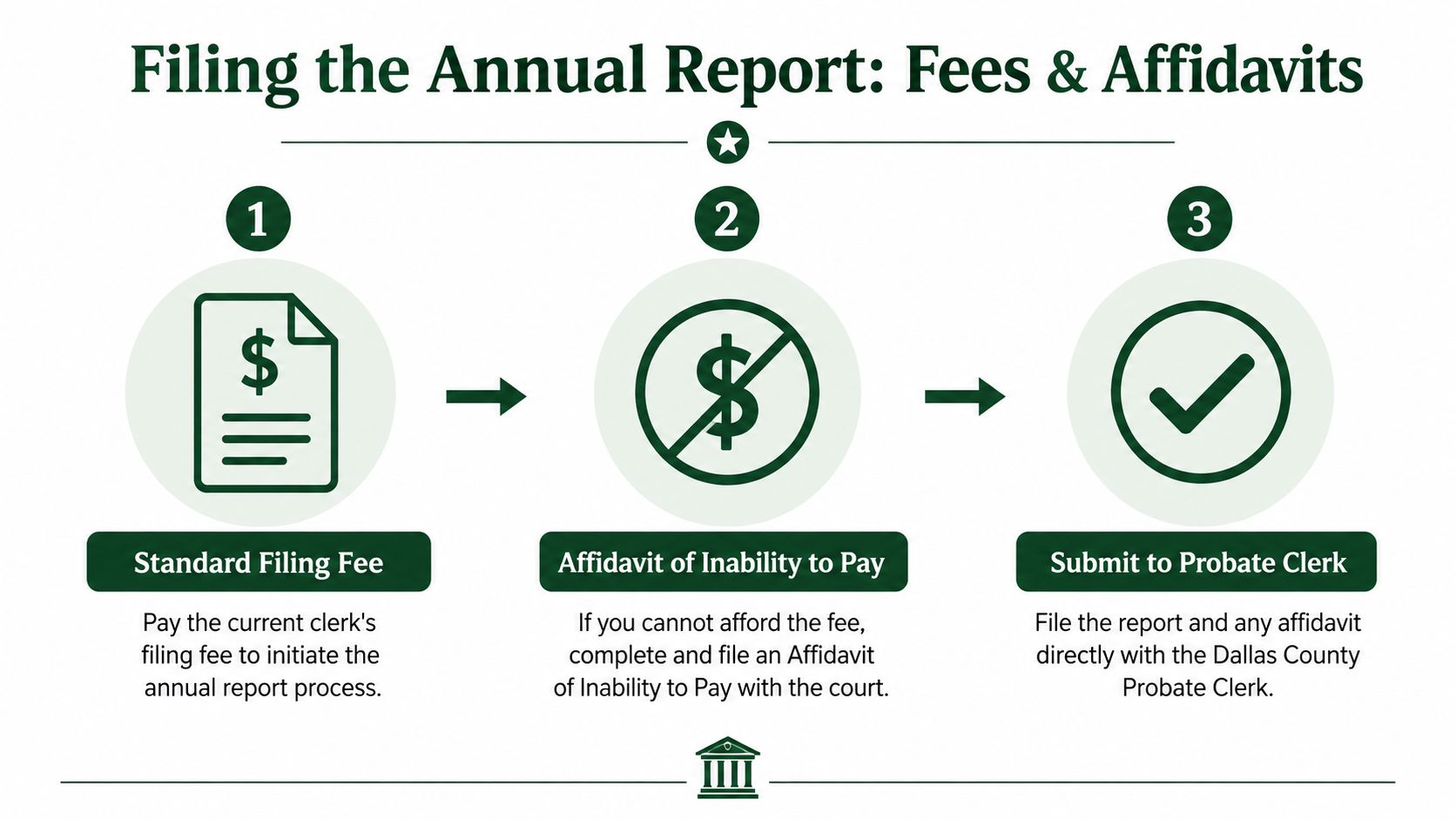
Dallas County's filing fee for the guardianship annual report is $12.00, unless the guardian filed an affidavit of inability to pay costs (Dallas County guardianship guide). That fee detail matters because the cost is small, but the filing still has to be handled correctly.
How the report can be submitted
Dallas County probate practice accepts paper and electronic filing. The usual options are in-person filing, mailing the report to the clerk, or electronic filing through an approved eFileTexas service provider. The key is not just sending it, but sending it to the correct probate filing channel and keeping proof of what was submitted.
For local procedural context, this Dallas County probate filing resource is a useful reference point when you're deciding whether to file in person or through another accepted method.
A practical filing checklist looks like this:
- Confirm the current fee. Make sure the clerk's fee and any copy charges are known before you leave home.
- Decide whether you need an inability-to-pay affidavit. If the fee is a problem, the affidavit route may be available.
- Keep a complete filing copy. Save the signed report, any affidavit, and proof of submission.
- Request a stamped copy if filing in person. That's the easiest way to prove the clerk received it.
What to keep after you file
Keep the filed report, the notary page, any supporting estate documents, and a record of how and when the filing was delivered. If you mailed it, keep the mailing proof. If you filed electronically, keep the confirmation.
Certified copies can be obtained for an additional fee, and that can matter if another institution later asks for evidence that the report was filed. If the guardianship file is complex, especially where property or financial records are involved, a guardian can also use outside legal help to keep the process organized. One option families in Dallas sometimes use is The Law Office of Bryan Fagan, PLLC, which handles guardianship-related matters along with broader family law and probate issues.
What Happens When the Deadline Is Missed
Missing the annual report deadline is not just a clerical problem. Texas law treats it as a compliance failure that can affect the guardian's authority to keep serving. Under the Texas Estates Code, a guardian who fails to file on time can face removal, successor appointment, and personal responsibility for damages tied to the lapse (Texas Estates Code reporting consequences).
The court can react to more than just lateness
A missed filing may lead the probate court to issue orders requiring the guardian to explain the delay. If the report still isn't filed, the court can hold further proceedings, assess costs, and take the guardianship out of the current guardian's hands. The statute also makes clear that removal is a real risk, not an extreme edge case.
That's why a late report should be treated as urgent the moment it's discovered. The longer the gap, the harder it is to show that the guardianship is being handled responsibly. Repeat misses are worse than one isolated mistake because they suggest a pattern the court may not ignore.
What a missed deadline can look like in practice
For a Dallas family, the consequences can show up in very ordinary ways. The court may demand a corrected filing before approving other requests, such as changes in residence or financial authority. A successor guardian may be brought in if the judge believes the current guardian can't or won't comply.
If the report is late, the right move is to file immediately and be ready to explain the delay clearly. Silence helps no one.
The safest assumption is simple, the annual report is not optional, and it isn't something to defer until the next reminder. Once the deadline passes, the court file changes character from routine administration to a compliance issue.
Local Help, Common Mistakes, and Practical Next Steps
Dallas guardians don't have to guess their way through the filing process. The county probate clerk, the Dallas County probate court system, and the statewide JBCC forms page all exist to help guardians keep the file moving. For a broader guardianship overview, this Dallas guardianship practice page is a useful starting point for families who need more than the annual report itself.
Where families usually get help
The Dallas County Probate Department handles the local filing side, and the county's probate materials and forms are the first place to confirm what gets filed and where. The JBCC forms webpage is the statewide source for guardianship certification reporting materials, which matters when the local probate duty is only one piece of the compliance picture.
If a family needs in-person guidance, local probate clerks and guardianship-focused legal resources can help point them toward the right form. For people who want to handle the filing themselves, the safest path is to work from the official form, keep copies of everything, and confirm the deadline based on the qualification anniversary rather than guessing the calendar month.
Mistakes that keep showing up
- Treating the deadline like a county-wide date: The filing date depends on the qualification anniversary, not a generic calendar reminder.
- Waiting until the end of the month to start: Annual reports usually need records gathered well before the due date.
- Skipping the financial backup: Estate filings without clear support are harder to defend if the court questions them.
- Mailing without proof: If you can't show the court got it, you may still have a problem.
- Forgetting address updates: If the ward's residence changes, the court file should reflect it promptly.
A good habit is to start preparing the report several weeks before the anniversary date. Pull the records, confirm the filing destination, and check whether the fee or an inability-to-pay affidavit applies. If a guardian keeps the ward's file organized all year, the annual report stops being a crisis and becomes a routine filing.
For families who want help handling guardianship questions more broadly, including probate filings and related court procedure, The Law Office of Bryan Fagan, PLLC offers Dallas-based guidance that can help you avoid missed deadlines and filing mistakes while keeping the case on track.
If you're trying to sort out a Dallas County guardianship filing, don't wait until the anniversary date is already behind you. The Law Office of Bryan Fagan, PLLC can help you understand the annual reporting deadline, prepare the paperwork, and decide what to do if your file is already late. Reach out through the Dallas office resources on the site so you can get a clear plan before the court asks for one.
