 Skip to content
If you’re staring at a new divorce, custody, or enforcement case and the notice says 254th District Court, the first question is usually simple. What happens next, and how do you avoid missing something important before you ever step into the George L. Allen, Sr. Courts Building?
The short answer is that this courtroom runs on tight local procedures, not loose courtroom habits. The Dallas County 254th District Court family docket procedures are built around advance filing, remote coordination, and submission deadlines, so a parent who waits until the hearing date to figure things out can lose time fast.
Table of Contents
- What Dallas Families Should Know About the 254th District Court
- How Dallas County Assigns Family Cases to the 254th
- Filing and Service Requirements in the 254th District Court
- Setting Hearings and the 254th Docket Call Process
- Motions, Temporary Orders, and Continuances at the 254th
- Working With an Attorney or Going Pro Se in the 254th
- Practical Checklist and Next Steps for Dallas County Families
What Dallas Families Should Know About the 254th District Court
A lot of Dallas parents first meet the 254th on a Monday morning, standing near the elevator bank at the George L. Allen, Sr. Courts Building with a folder in one hand and a phone in the other. One lawyer is checking a clerk window on the second floor, another is trying to confirm whether the matter is on the Zoom calendar, and a worried parent is asking a very basic question, “Do I need to be here?”

The answer depends on which part of the docket you’re on. Dallas County says the 254th is one of its family district courts, and the court’s own posted procedure distinguishes between pretrial hearings held via Zoom and 8:02 dismissal dockets that are submission deadlines only, meaning parties are told not to appear in person for those settings. Dallas County also lists the family district courts in the George L. Allen, Sr. Courts Building at 600 Commerce Street, which is part of why everything feels centralized and highly organized rather than spread across multiple courthouses.
Why the court feels so structured
Family cases in Dallas County are document-heavy from the start. Texas Law Help notes that a civil case information sheet must be completed and filed with original petitions or applications that start a new civil, family law, probate, or mental health case, and also with post-judgment modification or enforcement filings in family cases. That same guidance identifies motion types that need judge approval before they can even be set for hearing, which is a big reason Dallas family dockets can feel more controlled than people expect.
Practical rule: in the 254th, showing up prepared matters more than showing up early.
If you’re handling divorce, custody, child support, possession and access, protective orders, paternity, or enforcement, that structure affects everything from where you file to whether your matter is called in court. For a plain-English overview of how the courthouse fits into Dallas family practice, see how the George L. Allen, Sr. Courts Building handles Dallas family cases. The gallery also runs like a courtroom, not a lobby, so dress neatly, keep food out of the gallery, and assume the judge expects you to be orderly, punctual, and ready to proceed.
How Dallas County Assigns Family Cases to the 254th
A petition doesn’t land in the 254th because a parent asks for it or because a lawyer prefers that courtroom. Dallas County’s local family-court rules say divorce, custody, support, enforcement, paternity, adoption, protective orders, and other Family Code matters are docketed numerically in order of filing and then randomly assigned among the county’s family district courts, including the 254th District Court. That assignment system is why the case number, filing sequence, and subject matter matter from day one.
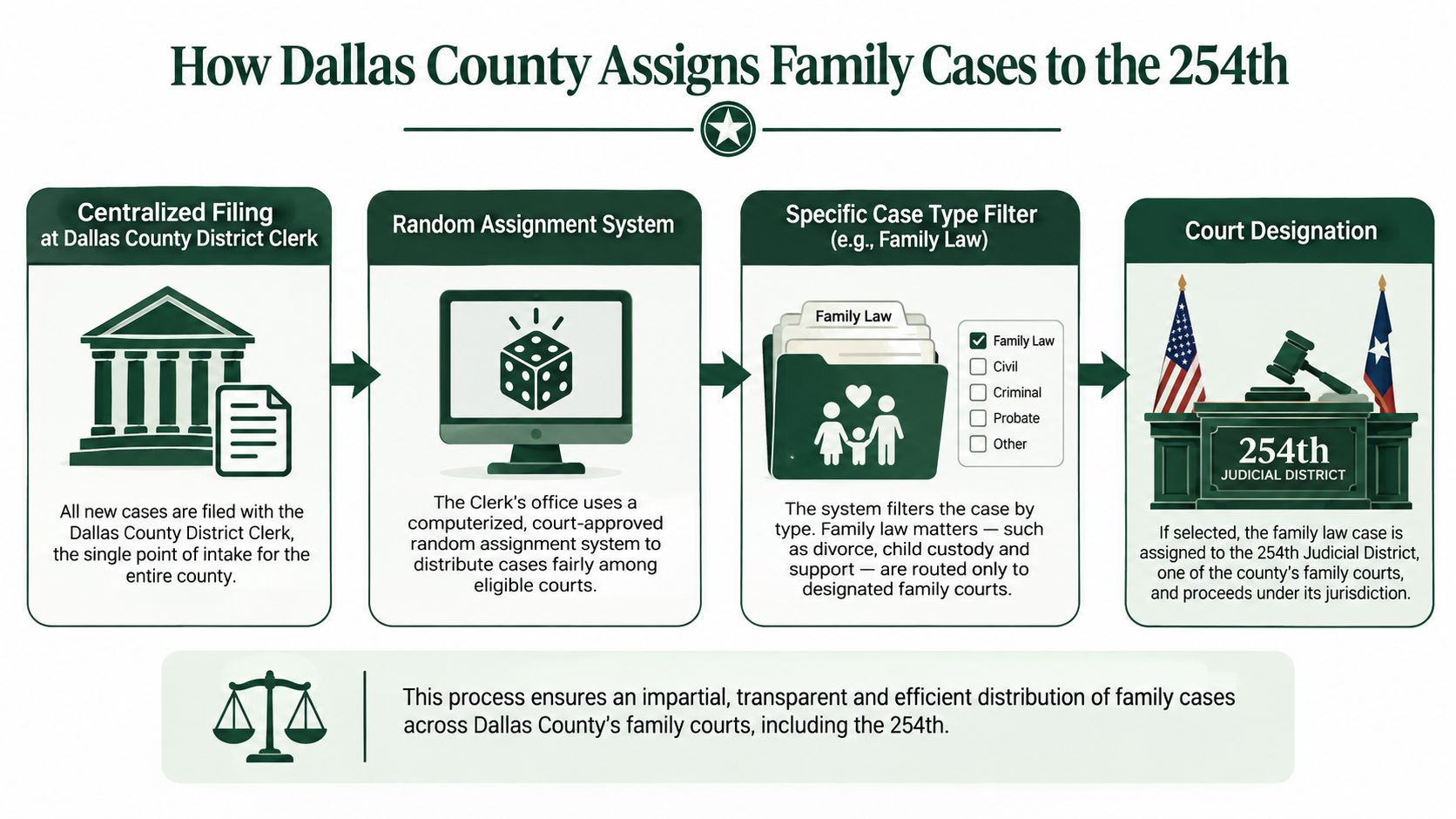
The filing path that controls the assignment
The District Clerk’s family filing infrastructure is centralized at the George L. Allen, Sr. Courts Building, Suite 103, 600 Commerce Street, Dallas, TX 75202, and Dallas County lists the District Clerk phone number as (214) 653-7307 and the Civil/Family File Desk at (214) 653-7787. Dallas County also distinguishes family cases by a “DF” prefix while civil cases use “DC”, which helps litigants and lawyers track the right file.
Texas Law Help adds another important filter point. In Dallas County family cases, certain motions require judge approval before they can be set for hearing, including contempt show-cause orders, motions to modify filed within one year, motions to modify requesting temporary orders, applications for protective orders, and motions for continuance. That means the court’s routing isn’t just about where the petition goes, it’s also about which motion can move forward without a judicial gatekeeper.
Some Dallas family cases move slowly not because the court is ignoring them, but because the filing and scheduling rules are designed to screen matters before they reach a hearing slot.
If a case is dismissed and refiled, the filing sequence starts over, but that doesn’t erase the underlying family-law history. In practical terms, prior orders, enforcement issues, and continuing jurisdiction can still shape where the dispute lands and how it gets managed. That’s why Dallas family cases often turn on more than just the caption on the petition.
The central takeaway is simple. The 254th isn’t an isolated courtroom running its own private system, it operates inside a countywide structure where filing order, subject matter, and assignment rules determine where your case goes next. If you’re trying to predict the courtroom before you file, start with the clerk’s office, not with assumptions.
Filing and Service Requirements in the 254th District Court
The 254th’s docket only becomes manageable if the paperwork is filed and served the right way. In Dallas County family practice, that starts with e-filing through the required system and making sure the documents are in a format the court can use without delay.
Getting the papers into the system
Dallas County’s family-court guidance says filings must be e-filed, and the same procedural environment expects proposed orders to be filed separately so the court can review them cleanly. For contested motions, a certificate of conference is also required, which means the filing party has to show that they conferred with the other side before asking the court to step in. If the hearing is approaching and that groundwork wasn’t done, the filing can get stuck before it ever reaches the judge.
Service works differently depending on what you filed. Original petitions generally require formal service through a private process server or the sheriff, while citation by publication is reserved for situations where personal service can’t be completed and the court allows publication. Texas rules also allow a waiver of service under Rule 119, which can simplify things when the other side signs a valid waiver instead of forcing formal service.
Why timing matters so much here
Dallas County family practice also uses a 10-day response window for motions other than those governed by TRCP 21a, so waiting until the last minute is a bad habit in this courthouse. The court’s 8:02 submission docket makes that even more unforgiving, because a missed deadline can mean your matter doesn’t get live hearing time at all. In a submission-only setting, a late filing is often not just late, it can be treated as unusable for that docket.
Bottom line: if your motion needs a hearing, don’t assume the judge will “hear it anyway” just because you filed something close to the deadline.
One of the easiest places for families to get confused is the difference between filing a motion and securing a hearing. In the 254th, those are separate steps, and the court expects the moving party to do both correctly. For divorce, custody, child support, enforcement, and post-judgment disputes, the safest approach is to file early, exchange the required materials, and confirm that the motion is on the right docket before you rely on a hearing date.
Setting Hearings and the 254th Docket Call Process
A Dallas family hearing in the 254th usually turns on coordination long before anyone walks into the courtroom. Pretrial hearings are held via Zoom using Judge Brown’s afternoon Zoom meeting ID 974 2677 7489, while the court’s 8:02/dismissal dockets are submission deadlines only. Those two settings are not interchangeable, and mixing them up is one of the fastest ways to waste a hearing slot.
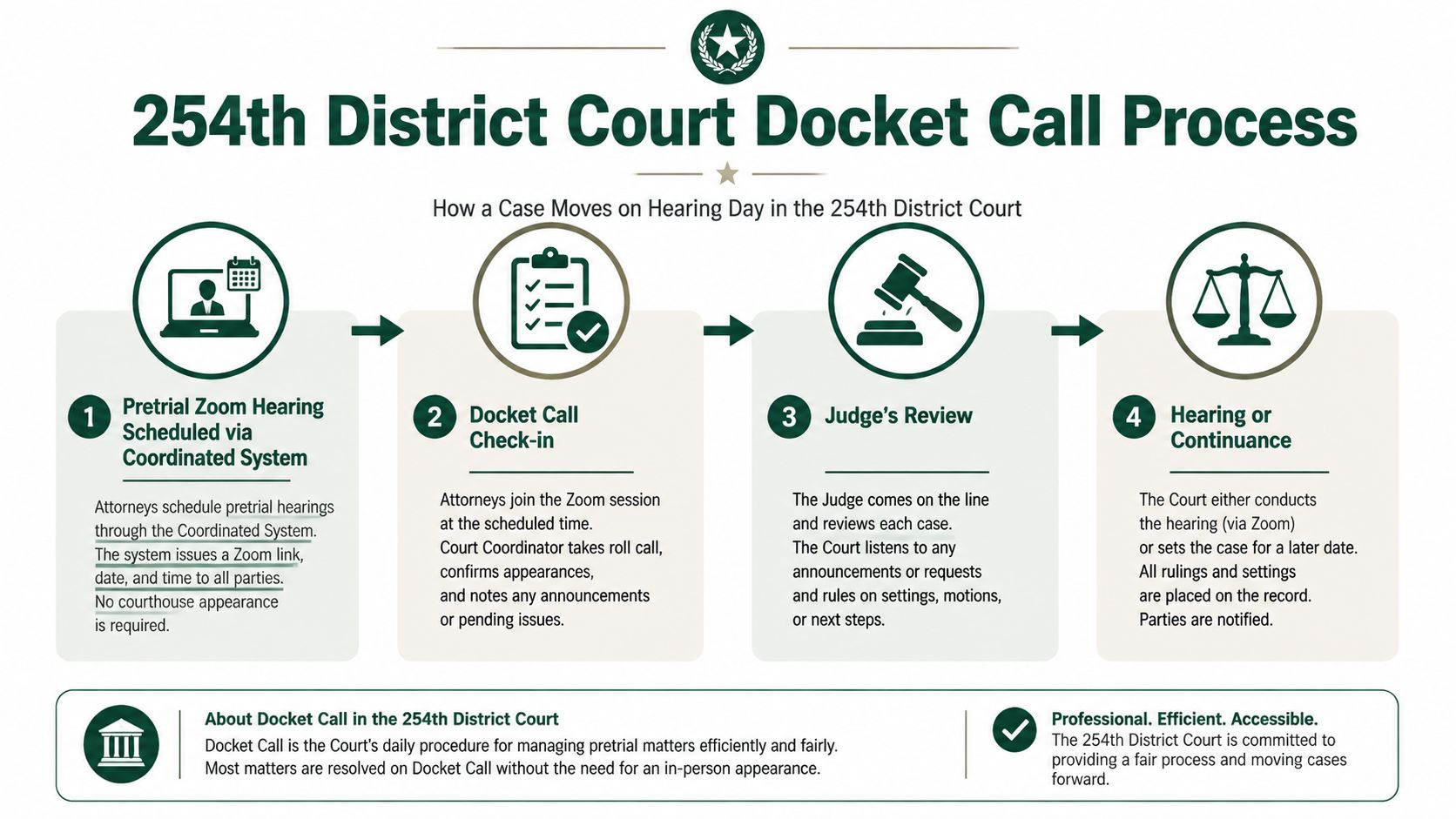
What has to happen before the hearing
The court’s posted procedure requires opposing counsel and parties to exchange exhibits and witness lists and copy the court by 5:00 p.m. the business day before any scheduled hearing, except CPS hearings. That deadline is not decorative. If the other side shows up ready to argue and you didn’t circulate your materials, the judge may decide the matter isn’t ready to proceed.
The 254th also expects agreed matters and non-evidentiary matters to be handled by submission when possible. In plain English, if nobody needs live testimony and the parties can put a proposed order in front of the court, the matter may be resolved without taking up a live slot. That is why temporary orders, uncontested final hearings, and some agreed motions are often coordinated through the court coordinator instead of being dropped onto a busy in-person docket at the last moment.
What happens when the case is called
Docket day usually begins with a sign-in process, either in person or through the remote process the court has set. The court call sheet and the coordinator’s instructions determine whether the case is reached, passed, or reset. If a case is reached, the judge can hear it that day, but if the parties are not ready, the court may pass it to later in the docket or reset it entirely.
A family-law case can be “on the docket” and still not be ready for hearing if the exhibits, witness list, or proposed order weren’t exchanged on time.
For parents, that means the hearing outcome often depends less on courtroom drama and more on disciplined preparation. The 254th runs on advance coordination, not last-minute scrambling.
Motions, Temporary Orders, and Continuances at the 254th
The motion practice in this courtroom rewards precision. A parent asking for temporary orders, a continuance, or post-judgment relief needs to know which requests can be submitted, which ones need judge approval before setting, and which ones need live testimony.
Temporary orders and urgent requests
Temporary orders are the court’s way of putting short-term rules in place while the case is pending. That can involve conservatorship, possession, child support, exclusive use of a home, or safety-related restrictions in protective-order cases. In genuine emergencies, the request has to be framed carefully and supported with the kind of evidence the court can rely on at a short hearing.
The 254th’s docket structure makes this especially important because not every temporary matter gets the same path to a hearing. Some requests can move faster if the court approves the setting, while others wait for the coordinator’s available slot and the parties’ compliance with pre-hearing exchange requirements.
Continuances and contested motions
Continuances are not casual. A written motion is required, the other side’s position needs to be disclosed through the certificate of conference, and the judge expects the request to explain the reason in detail and propose new dates when possible. If a party waits until the hearing day to ask for a continuance without a solid explanation, the request can go nowhere.
Contested motions also need the right setup. If the matter involves live testimony, the court is not likely to treat it like a simple paperwork submission. Agreed motions are different, because they can often ride the submission docket with a proposed order, but contested issues usually need a hearing where the judge can hear from the parties.
The most common mistake is treating all motion practice like it works the same way. It doesn’t. A motion to modify, a temporary orders request, and a continuance all have different procedural paths, and the 254th expects those paths to be followed before the court gives the matter attention.
Working With an Attorney or Going Pro Se in the 254th
A represented litigant and a self-represented litigant face the same docket rules in the 254th, but they don’t experience them the same way. Counsel who works regularly in Dallas County family court already knows how the coordinator wants things set, what the court expects in proposed orders, and how local timing issues tend to play out.
Where representation helps
An attorney can usually spot the procedural trap before it becomes a hearing problem. That includes knowing when a motion needs pre-approval, how to handle the exhibit exchange deadline, and what kind of setting is likely to be accepted for a temporary issue versus a final hearing. In a courthouse where submission and coordination matter this much, that familiarity saves a client from avoidable resets.
Self-represented litigants often assume the clerk or court staff will explain what to do next. They won’t give legal advice, and they can’t tell you which strategy is better for custody, property division, enforcement, or protective orders. The same procedural rules still apply, and opposing counsel is not required to relax them because one party is pro se.
When going pro se makes sense
Self-representation can be workable for simple, uncontested matters where both sides already agree on the major terms and the filing path is straightforward. It gets much harder when the case involves custody fights, child support disputes, business ownership, retirement assets, separate property claims, or temporary orders where testimony and evidence matter.
Limited-scope representation can be a middle path in Texas, where an attorney may appear for a discrete hearing without handling the whole case. That can be useful when a parent needs help getting through one hearing but can otherwise manage the paperwork.
If you want a broader overview of Texas family-law issues beyond this courthouse, the firm’s family law practice page is a good place to start. The practical question, though, is whether your case is simple enough to risk going alone. In the 254th, once the docket turns contested, the procedure itself can become the biggest obstacle.
Practical Checklist and Next Steps for Dallas County Families
When a case lands in the 254th, the safest move is to work in order instead of reacting to the calendar at the last minute. Dallas family cases reward people who treat deadlines, service, and hearing settings as part of the case, not as afterthoughts.
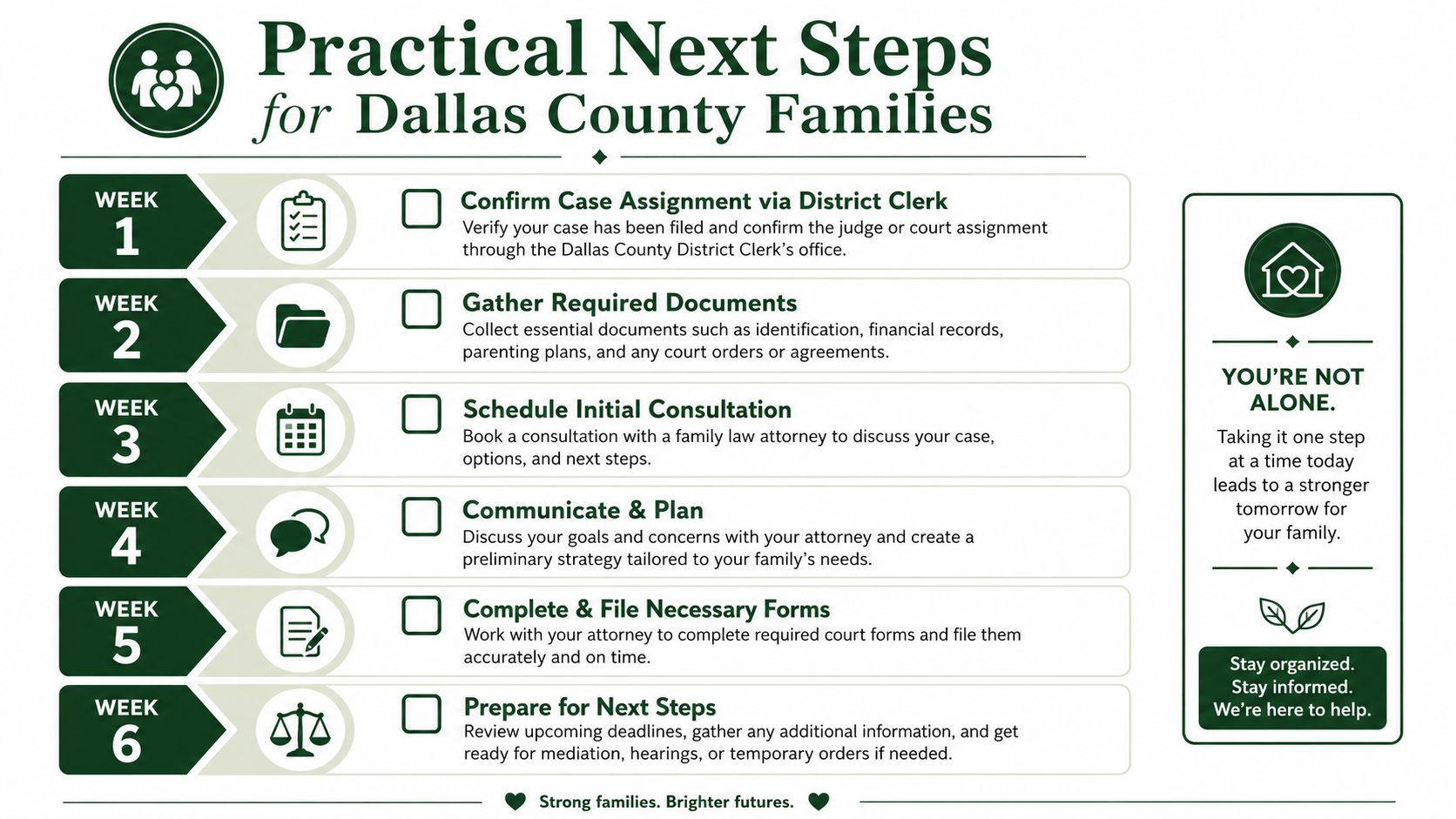
A practical week-by-week approach
- Week 1, confirm the assignment: check with the Dallas County District Clerk so you know whether the case is in the 254th and track the file under the correct DF designation.
- Week 2, gather documents: pull bank records, pay stubs, parenting schedules, school records, insurance information, and anything tied to property, support, or safety concerns.
- Week 3, verify service: make sure the petition or motion was served correctly, or confirm that a waiver of service was signed and filed if that route is available.
- Week 4, prepare for filing: set up e-filing, draft proposed orders separately, and make sure any contested motion includes the certificate of conference.
- Week 5, test the hearing setup: confirm the Zoom link, the coordinator’s instructions, and the exchange of exhibits and witness lists before the business-day deadline.
- Week 6, build your hearing folder: keep courtesy copies of exhibits, a clean chronology, and a note of any temporary orders, discovery responses, or child support issues that still need attention.
Dallas County families also need to watch for timing rules outside the courthouse. In divorce cases involving minor children, the statutory waiting period matters, and parents should calendar that from the beginning rather than discovering it late. If child support is part of the case, it also helps to review the Texas Attorney General’s child support guidance so you understand the framework before a hearing.
For plain answers to common Dallas family-law process questions, the firm’s family law FAQ page can help you sort out the basics before your first call. Non-legal procedural questions can often be directed to the 254th’s staff attorney or coordinator, but if the issue involves custody, property, enforcement, or a disputed temporary order, it’s smarter to have counsel step in early.
The people who do best in this docket are usually the ones who stay organized, respond quickly, and respect the court’s deadlines. That’s not luck, it’s preparation.
If you’re dealing with a divorce, custody dispute, support issue, or enforcement matter in the 254th District Court, The Law Office of Bryan Fagan, PLLC can help you understand the local process and prepare for what comes next. Visit The Law Office of Bryan Fagan, PLLC to get started with a Dallas family law team that works with these procedures every day.
