 Skip to content

A Dallas family member has died, a will names you as executor, and suddenly you're holding a stack of unfamiliar probate papers. You may understand who should inherit, but that doesn't answer the practical question: what must Dallas County's probate court receive before a judge will approve independent administration?
The short answer is that the application needs to be complete, specific, and supported by information about the estate, its debts, and every person entitled to notice. Dallas County's published guidelines make the filing more evidence-driven than a bare request for appointment. The application must be filed before a prove-up setting can be obtained, and service or waivers for distributees can become a significant source of delay.
Table of Contents
- What Independent Administration Means in a Dallas County Probate
- Who Can Apply and What the Application Must State
- Documents and Information to Gather Before Filing
- Where and How to File in Dallas County
- What Happens After You File
- Common Mistakes That Stall Dallas County Applications
- When to Handle It Yourself and When to Call an Attorney
What Independent Administration Means in a Dallas County Probate
Suppose a Dallas resident's mother leaves a will naming her adult child as executor. The family expects the process to be straightforward, but the executor still needs court authority before handling estate property. The application asks the Dallas County Probate Courts to recognize the will, appoint the appropriate personal representative, and authorize the requested type of administration.
Independent administration generally allows the personal representative to manage the estate with less ongoing court supervision. That can make routine administration more efficient than dependent administration, where the court has a more active role in estate transactions and approvals. The choice matters because it affects what the administrator may do after appointment, not just what appears on the initial filing.
A will may expressly authorize independent administration. If the will doesn't address it, the ability to proceed independently may depend on the applicable legal requirements and the agreement of the people entitled to inherit. The exact answer can change based on the will, the family structure, the estate's assets, and whether anyone objects.
Practical rule: Independent administration reduces court involvement after appointment, but it doesn't eliminate the need for a careful application at the beginning.
The application is the gateway document. A judge must have enough information to determine whether the applicant is qualified, identify the people entitled to notice or distribution, understand the estate being administered, and decide whether the requested administration is legally appropriate. An incomplete filing can lead to corrections, continuances, or additional service work before the court can reach the prove-up.
The Dallas County independent administration application process therefore has a clear sequence: prepare the estate information, file through the county's procedures, address citation and service, obtain a prove-up setting, attend the hearing, and receive authority to begin administration. The difficult part is often not understanding the label “independent.” It's assembling the evidence that supports the request.
Who Can Apply and What the Application Must State
The first question is whether the applicant is an interested person. Dallas County's guidelines require the applicant to state that they qualify as an interested person, which generally means the applicant has a legally recognized interest in the estate. An heir, beneficiary, creditor, or another person with a recognized estate-related interest may fall into that category, but the facts and requested relief matter.
Priority can also depend on whether the decedent left a will. When a will names an executor, the nominated person is often the natural applicant, subject to qualification and the court's review. If there's no will, the court must address intestate heirs and the applicable appointment framework. A family shouldn't assume that the person who handled the decedent's finances automatically has authority to administer the estate.
Dallas County requires more than a name and appointment request
Dallas County's published independent administration guidelines require the application to address several specific subjects. The court expects an organized disclosure, not a vague estimate or incomplete family summary.
The application must state:
- Applicant status: The applicant must identify why they're an interested person and why they're entitled to seek the requested appointment.
- Estate value: The estate's value must be stated asset by asset, rather than as an unexplained total. A useful schedule may identify bank accounts, real property, vehicles, investments, business interests, and other property separately.
- Debts: The decedent's debts must be identified creditor by creditor. Listing only “normal bills” doesn't give the court the same information as identifying lenders, mortgage holders, credit-card companies, medical creditors, or other known claimants.
- Necessity for administration: The application must explain whether a necessity for administration exists. This helps the court understand why appointment and administration are needed instead of assuming that every estate requires the same procedure.
- Will status: The application must state whether a will exists and provide the relevant information about it.
- Heirs and distributees: The filing must provide the names, addresses, and incapacity status of distributees or heirs. “Distributees” are people entitled to receive estate property under the will or applicable inheritance law.
This level of detail helps the court identify who must receive notice and what issues may affect administration. It also gives the applicant an early opportunity to identify complications, such as an heir whose address is unknown, a beneficiary who may lack capacity, or an asset whose ownership is uncertain.
A complete application won't guarantee an uncontested hearing. It does, however, give the court a usable factual record and can reduce avoidable defects. Dallas County's independent administration guidelines should be reviewed against the current facts before filing.
Documents and Information to Gather Before Filing
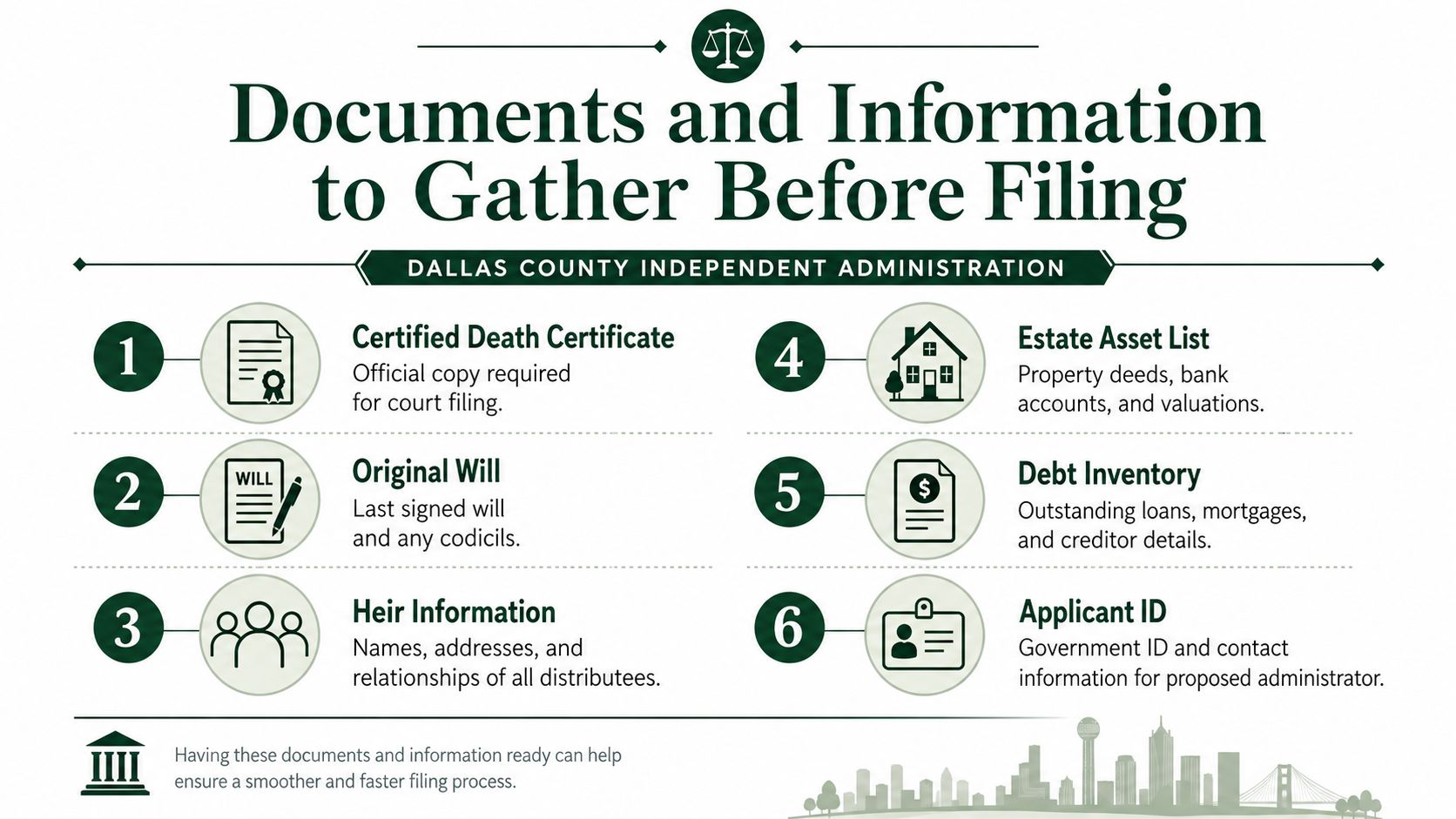
Preparation should begin with three working documents: an asset schedule, a debt schedule, and an heir or distributee list. The will and death certificate support the filing, but those schedules help demonstrate that the application describes the estate and the people affected by it.
Start with the core records
Gather the following before submitting the application:
- Original will: Locate the last signed original will and any codicils. A codicil is an amendment or addition to a will.
- Certified death certificate: Obtain the official certified copy needed to support the court filing.
- Applicant information: Assemble the proposed administrator's legal name, address, contact information, and identification.
- Heir and distributee information: List every person who may inherit or is entitled to notice, along with current addresses, relationships, and any relevant incapacity information.
- Estate asset list: Identify each known asset and its approximate value or supporting records. Include deeds, bank statements, vehicle records, retirement account information, investment statements, and business ownership documents when applicable.
- Debt inventory: Identify each known creditor and obligation, including loans, mortgages, medical balances, credit accounts, taxes, and other debts.
A family dealing with Dallas County records may also benefit from reviewing the Dallas County records building and what is filed there before deciding which original documents need to be delivered and which records should be retained for the estate file.
Why incomplete preparation causes trouble
An incomplete heir list can affect citation and service. An incomplete asset schedule can leave the court without a clear picture of the estate. An unexplained debt list can make the necessity and administration questions harder to evaluate.
Consider two hypothetical Dallas families. The first files quickly but omits a distributee's current address. The court or clerk identifies a service problem, and the family must locate the person and correct the citation before moving forward. The second family prepares the heir list, asset schedule, and debt inventory before filing, so the application and proposed order can be reviewed together.
The difference isn't that one family had an easier loss. The difference is that the second family treated the application as an evidence package rather than a simple appointment form. Dallas County's detailed requirements are designed around that kind of preparation.
Where and How to File in Dallas County
Dallas County probate matters are handled through the Dallas County Probate Courts. The relevant venue is the county, not the city named in someone's mailing address. A resident of Dallas, Garland, Mesquite, Cedar Hill, or another community within Dallas County generally looks to the same county probate system, while a person living in a city that crosses county lines must confirm which county has proper venue.
The filing package should be prepared for the county's procedures and submitted through the available filing process. Attorneys generally use electronic filing, while self-represented applicants should verify the current submission options and technical requirements before attempting to file. County procedures, clerk requirements, and document-delivery instructions can change, so use the current Dallas County materials rather than relying on an old checklist.
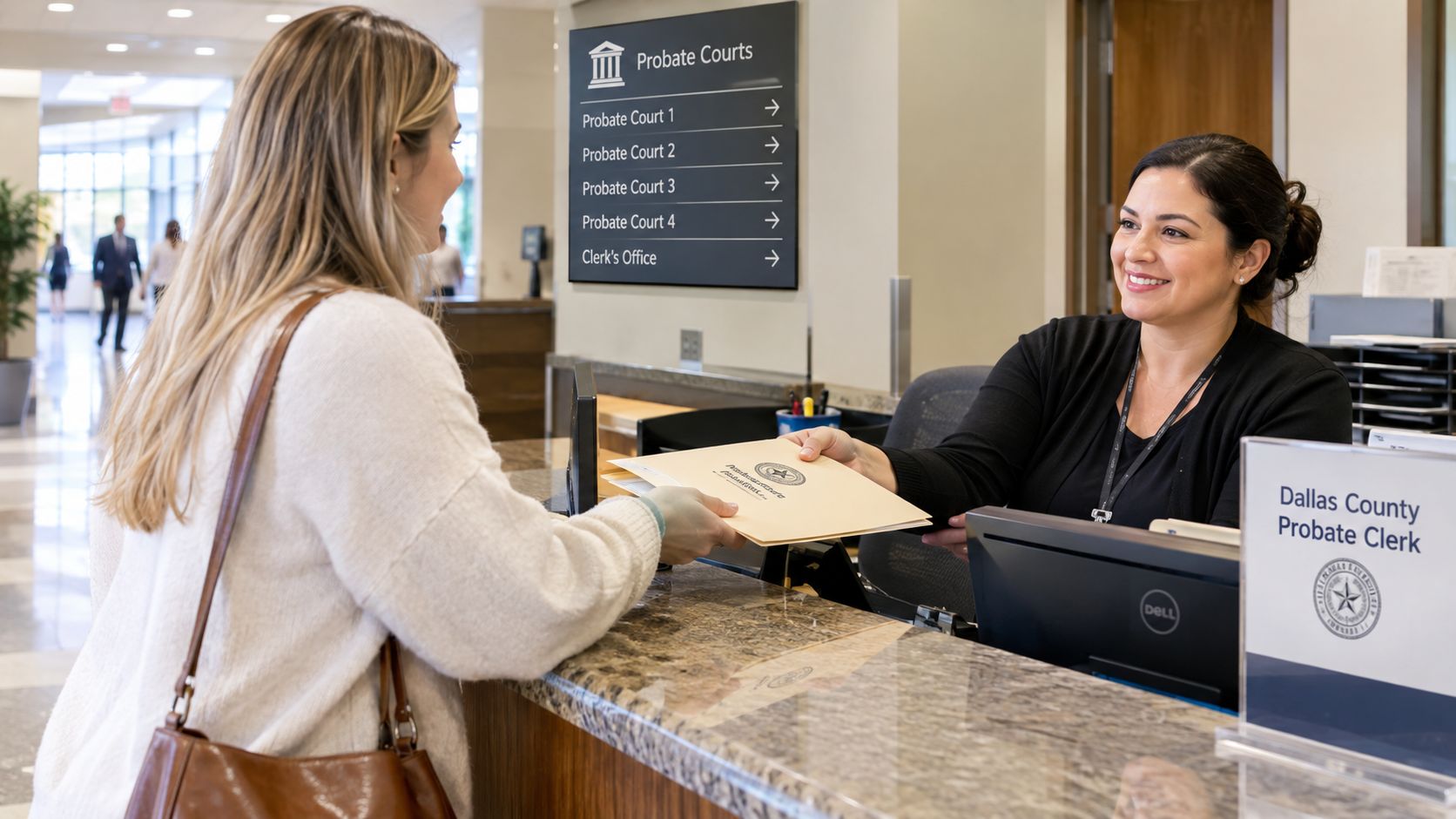
The 2026 Dallas County probate fee schedule lists a $360 filing fee for applications for administration, including independent administration, dependent administration, community administration, or no administration. Confirm the current fee and payment instructions through the Dallas County probate court filing resource before submitting, because additional services or certified copies may involve separate charges.
Filing comes before the prove-up setting
A common procedural misunderstanding is trying to schedule the prove-up before the application has been filed. Dallas County materials make the sequence clear: the application must be filed before a prove-up setting can be obtained.
That order matters because the court cannot evaluate a hearing request without a filed case and an application identifying the estate, applicant, heirs or distributees, and requested administration. Filing creates the procedural foundation for citation, service, review, and the eventual hearing.
After submission, keep copies of everything filed, including the application, will-related documents, proposed order, and proof of filing. You'll need a reliable record when checking whether the clerk accepted the package, whether corrections were requested, and whether service has been completed.
The following video may help orient families to the general court-filing environment, but it doesn't replace current Dallas County instructions or legal advice for a specific estate.
What Happens After You File
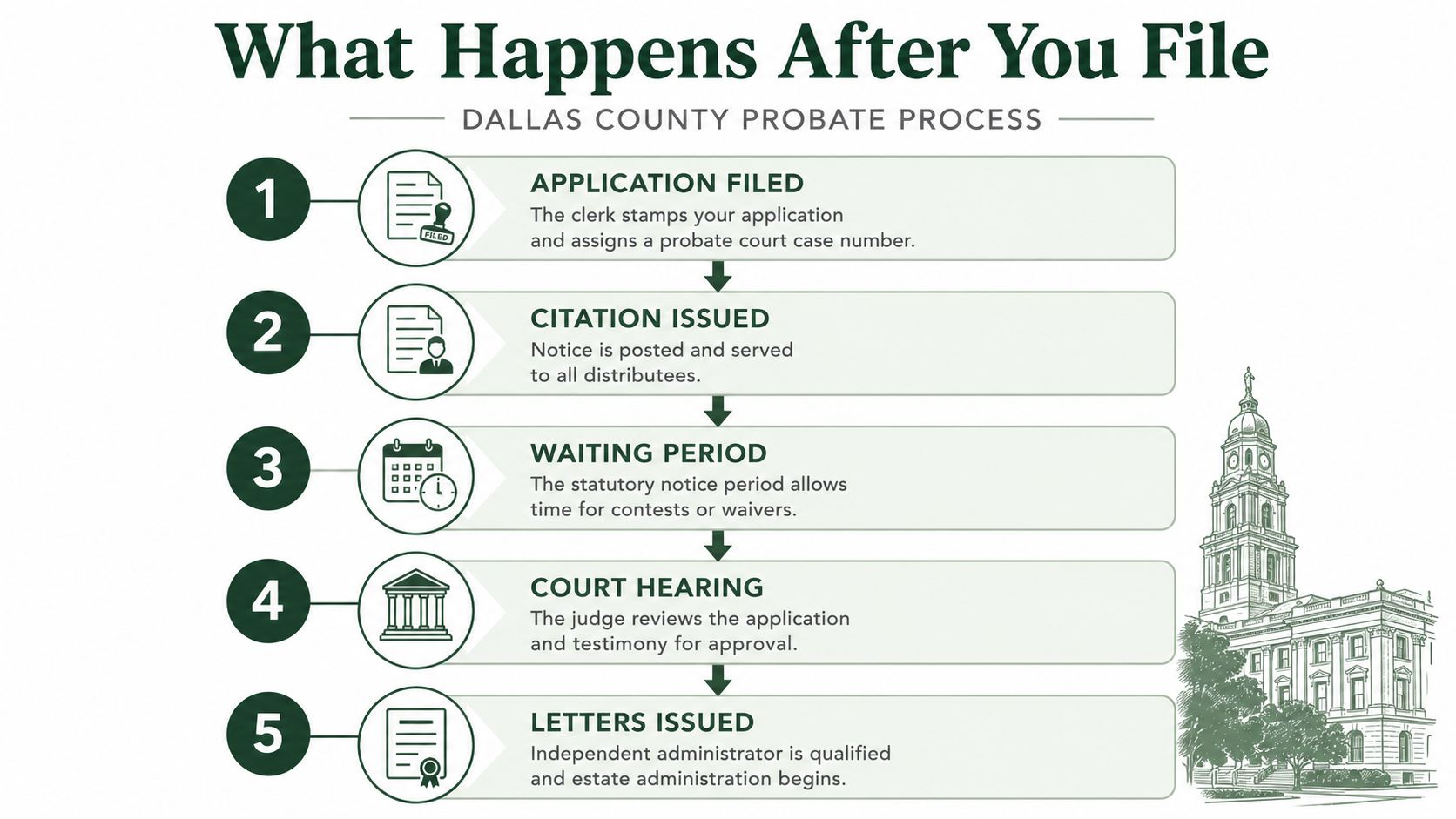
Filing the application doesn't mean the judge can immediately sign the order. The post-filing process usually requires the court and clerk to address notice, citation, service, waivers, and the hearing record before the prove-up can proceed.
The sequence begins with the filed application. The court or clerk then handles the required notice process for the people identified as heirs or distributees. The precise service method can depend on the person's identity, address, location, capacity, and the type of proceeding.
Service often controls the practical schedule
A hearing generally can't proceed until all distributees have been served or have properly waived service, subject to the court's rules and the facts of the case. That's why a missing address can matter as much as a missing signature. The court may need additional work before it can treat notice as complete.
Service problems commonly arise when:
- An address is stale: The applicant lists an old residence even though the distributee moved.
- A family member is omitted: The applicant names will beneficiaries but fails to identify an heir who may still be entitled to notice.
- Capacity is unclear: The filing doesn't explain whether a distributee is incapacitated or whether someone else must act for that person.
- A waiver is assumed: A family conversation is treated as consent even though the court needs a valid written waiver or completed service.
The prove-up is the hearing at which the applicant presents the facts and documents needed for the judge to approve the requested relief. The judge may examine the will, the applicant's qualifications, the estate information, notice status, and whether independent administration is legally available under the circumstances.
Bond is another issue that requires attention. A will may address bond in connection with independent administration, but the result can differ when the will is silent or when the requested appointment is not supported by the necessary agreement or legal basis. The court's order controls, so an applicant shouldn't assume that independent administration automatically means no bond.
Recently amended Texas probate forms can also affect how applicants present inventory and separate-property disclosures in 2026. Using an outdated form may create inconsistencies or omissions, particularly when the estate includes property that may be separate rather than community property. A current form should be checked against the court's requirements before filing.
Dallas County's probate court information can help families understand the local court structure. For case-specific questions about notice, waivers, bond, or updated forms, a probate lawyer should review the actual application and family circumstances.
Common Mistakes That Stall Dallas County Applications
Most application problems are fixable, but they can still create unnecessary delay, extra correspondence, and another trip through the filing process. The recurring issue is usually a mismatch between what the family knows informally and what the court needs documented formally.
Audit the package before submission
- Incomplete asset or debt schedule: The clerk or court may request clarification because the filing doesn't identify property or creditors specifically. Fix: Update the schedules asset by asset and creditor by creditor.
- Missing distributee addresses: Citation can't be completed smoothly when the applicant supplies outdated or incomplete contact information. Fix: Confirm current addresses and preserve the method used to locate them.
- No necessity statement: The application doesn't explain why administration is needed. Fix: Address the necessity directly instead of leaving the court to infer it.
- Unresolved service or waiver issue: A family member may say they agree, but the court still needs proper service or a valid waiver. Fix: Track each distributee separately and verify the required documentation.
- Outdated probate forms: An old form may not match current disclosure expectations. Fix: Compare every form with current Dallas County materials before filing.
- Missing incapacity information: The filing doesn't identify whether a distributee is incapacitated. Fix: Include the status requested by the county guidelines and determine whether additional representation or service is necessary.
A wrong-court filing can also create problems. Dallas County residents should make sure the case belongs in the Dallas County Probate Courts rather than treating the city name as the only venue question. The same concern applies to an unsigned application, missing notarization when required, or failure to provide the certified death certificate.
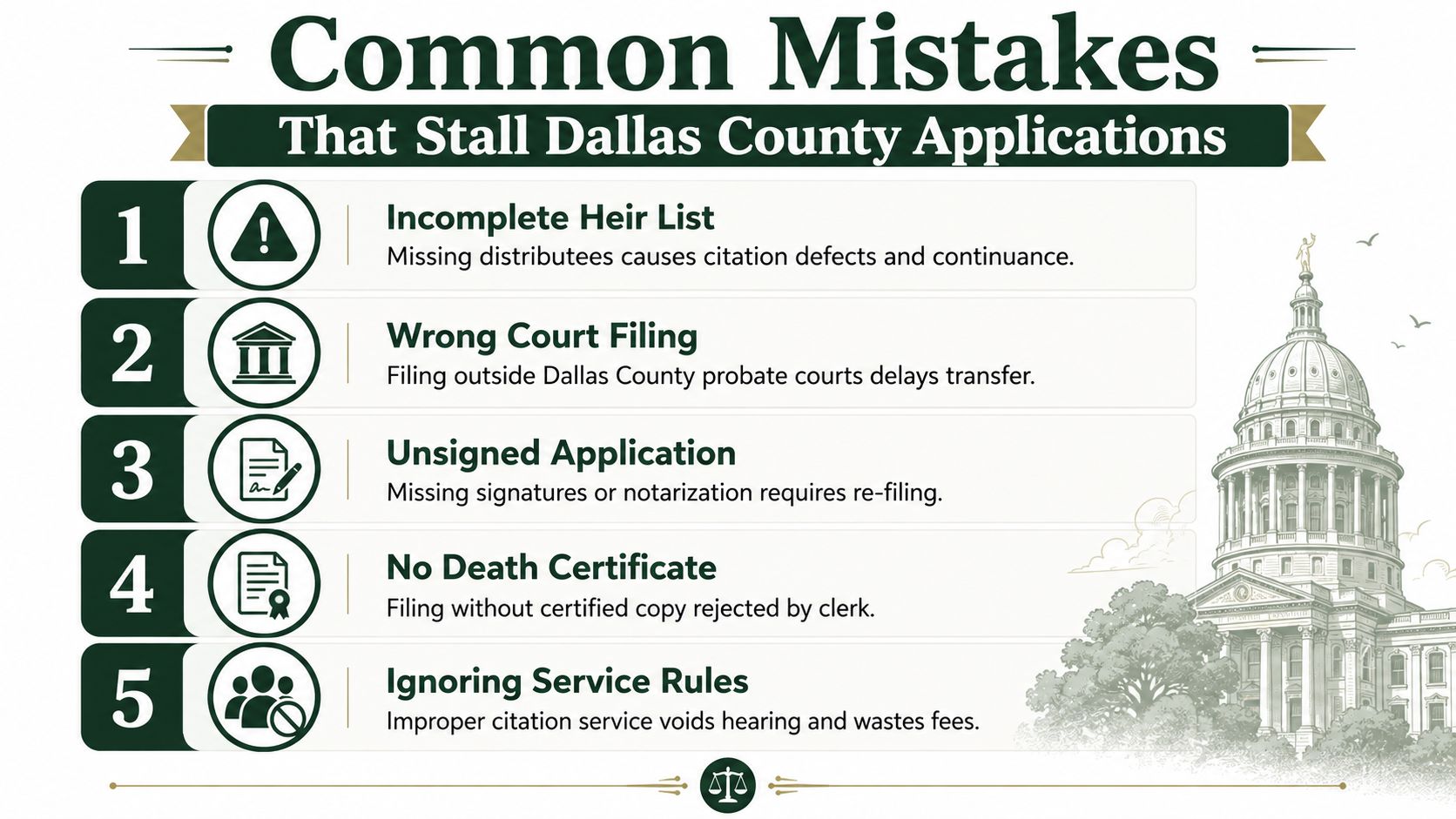
A short pause before filing can reveal a missing heir, an unclear address, or a form that no longer matches the court's expectations.
Use a simple final audit. Match every heir or distributee to an address and capacity entry, match every asset to an identified category and value, match every debt to a creditor, confirm the will information, and confirm that the proposed administration is clearly stated. These steps don't remove every possible dispute, but they catch many correctable defects before they interfere with the hearing.
When to Handle It Yourself and When to Call an Attorney
Self-representation may be realistic when the estate is small and uncontested, the will is clear, the heirs cooperate, and the records are complete. Even then, the applicant must still satisfy Dallas County's requirements for estate information, debts, heirs, addresses, incapacity status, filing, and service.
Legal help becomes more valuable when the facts are less predictable. Consider consulting a probate attorney if the estate includes:
- Disputed heirs or beneficiaries: A disagreement can affect notice, appointment, and the requested administration.
- Business interests: Ownership records, valuation questions, and transfer restrictions may require careful review.
- Real property title problems: Deeds, liens, joint ownership, or unclear title can complicate administration.
- A blended family: Stepchildren, prior relationships, and competing claims can make the heir analysis difficult.
- Incapacitated distributees: The court may require additional attention to representation and service.
- Separate-property questions: Tracing may be needed when property classifications affect inheritance or administration.
A probate attorney can help organize the application, identify missing people or documents, assess service and waiver issues, review the proposed order, and prepare for the prove-up. That support is most useful before filing, when a defect can often be corrected without disrupting the rest of the case.
Before seeking a consultation, create a short self-audit: list every heir and distributee, attach a current address to each person, prepare the asset and debt schedules, locate the original will, and write down any dispute or uncertainty. Then bring those materials to a qualified Dallas probate lawyer for case-specific guidance.
The Law Office of Bryan Fagan, PLLC can help Dallas County families evaluate and prepare probate and estate administration filings, including questions about independent administration, heir information, service, and court procedure. Visit The Law Office of Bryan Fagan, PLLC to learn about local legal resources and request help with the facts of your estate.
