

If you're standing downtown with a stack of papers and you're not sure whether you're supposed to walk into the Records Building or the family court building, you're not alone. A lot of Dallas parents and spouses use “courthouse” as a catch-all, but the filing system is split in a way that matters.
The short answer is this. The Dallas County Records Building is where you go for the County Clerk's recording work, not for a divorce petition or most family-court pleadings. Family cases, custody matters, and most court filings belong with the District Clerk at the George L. Allen, Sr. Courts Building. Dallas County also treats civil, family, criminal, and recording functions as separate channels, which is why the wrong line can cost you a morning and sometimes a filing deadline.
Table of Contents
- What the Dallas County Records Building Is
- Records Filed at the County Clerk's Recording Division
- Where Dallas Family Court Records Are Filed Instead
- How Divorce and Family Filings Reach the Courthouse
- Family-Law Documents Kept at the District Clerk's Office
- Getting Copies, Certifications, and Records Searches
- Practical Next Steps for Dallas County Residents
What the Dallas County Records Building Is
A Dallas parent can walk downtown with a divorce packet and still land in the wrong line if the building names blur together. The Dallas County Records Building, also called the Hall of Records, serves the County Clerk's Recording Division. Dallas County lists the office at 500 Elm Street, Suite 2100, with records services from 8:00 a.m. to 4:30 p.m., Monday through Friday (Dallas County County Clerk recording office).
The part that clears up most confusion is the split between the County Clerk and the District Clerk. The County Clerk's recording side handles public records and some vital-records services. The District Clerk handles family-court records at the George L. Allen, Sr. Courts Building. Dallas County's historical materials describe the building as the old Hall of Records, built in 1927–28 and expanded in the 1950s, while the larger Records Complex is presented as part of the county's civic and legal history (Dallas County historical and recording information).
What that means in practice
If you are recording a document that belongs in the county's public record, Elm Street may be the right stop. If you are filing a family lawsuit, it usually is not.
Most visitors do not walk into a courtroom. They use a public counter, a fee window, or a records service desk, then leave with a receipt or a request for a certified copy. In that way, the building works more like an administrative records office than a courthouse.
For Dallas families, that distinction matters because several government functions sit in the same downtown area. A divorce, custody case, or protective-order matter may connect to the courthouse complex, but that does not mean every paper belongs at the Records Building. A deed, a lien, or another record meant for the county's public files goes one place. A family-case filing goes another.
That is the part many people miss. Once you separate the recording office from the family-records desk, the filing system starts to make sense.
Records Filed at the County Clerk's Recording Division
The County Clerk's recording side is where Dallas County turns private paperwork into part of the official public record. At the Records Building, the filing function is about recording instruments, not opening court cases. That includes documents that affect ownership, notice, or public record status.
Real property and public notice records
The most familiar examples are deeds, deeds of trust, mortgages, mechanic's liens, releases, easements, plats, and condominium declarations. When these documents are recorded, they become part of the Official Public Records of Dallas County, which is the county's searchable public recording system. In Texas property practice, recording is what gives later readers notice that a document exists and affects the property, which is why the wrong filing location can create real problems for buyers, lenders, and spouses dividing real estate in divorce.
The County Clerk's recording division also handles certain UCC financing statements and fixture filings under the Texas Business and Commerce Code. Those filings matter when a creditor wants to secure an interest in collateral, including equipment attached to real property.
Vital records and marriage services
The Records Building function also extends to some vital-records services through the County Clerk. That can include birth certificates for births in Dallas County, death certificates, and marriage licenses. Dallas County also distinguishes between a formal marriage license and an informal marriage declaration, which is the county's way of documenting a common-law marriage claim.
Practical rule: if the document's job is to create a public record, preserve property notice, or obtain a civil record copy, recording may be the right lane. If the document starts a family case, it usually belongs elsewhere.
What does not belong here is just as important. A divorce petition, custody filing, SAPCR, or protective-order request is not a recording transaction at the County Clerk counter. Those are court filings. If you treat them like property records, you'll end up at the wrong window and lose time.
| What Gets Filed at the Dallas County Records Building vs. What Does Not | |
|---|---|
| Filed at the Records Building, County Clerk | Filed at Other Courthouses, District Clerk |
| Deeds and deeds of trust | Original divorce petitions |
| Mortgages and releases | SAPCR filings |
| Liens and easements | Custody modifications |
| Plats and condominium declarations | Temporary orders requests |
| UCC financing statements | Protective-order case filings |
| Birth and death certificate services | Most family-court pleadings |
Where Dallas Family Court Records Are Filed Instead
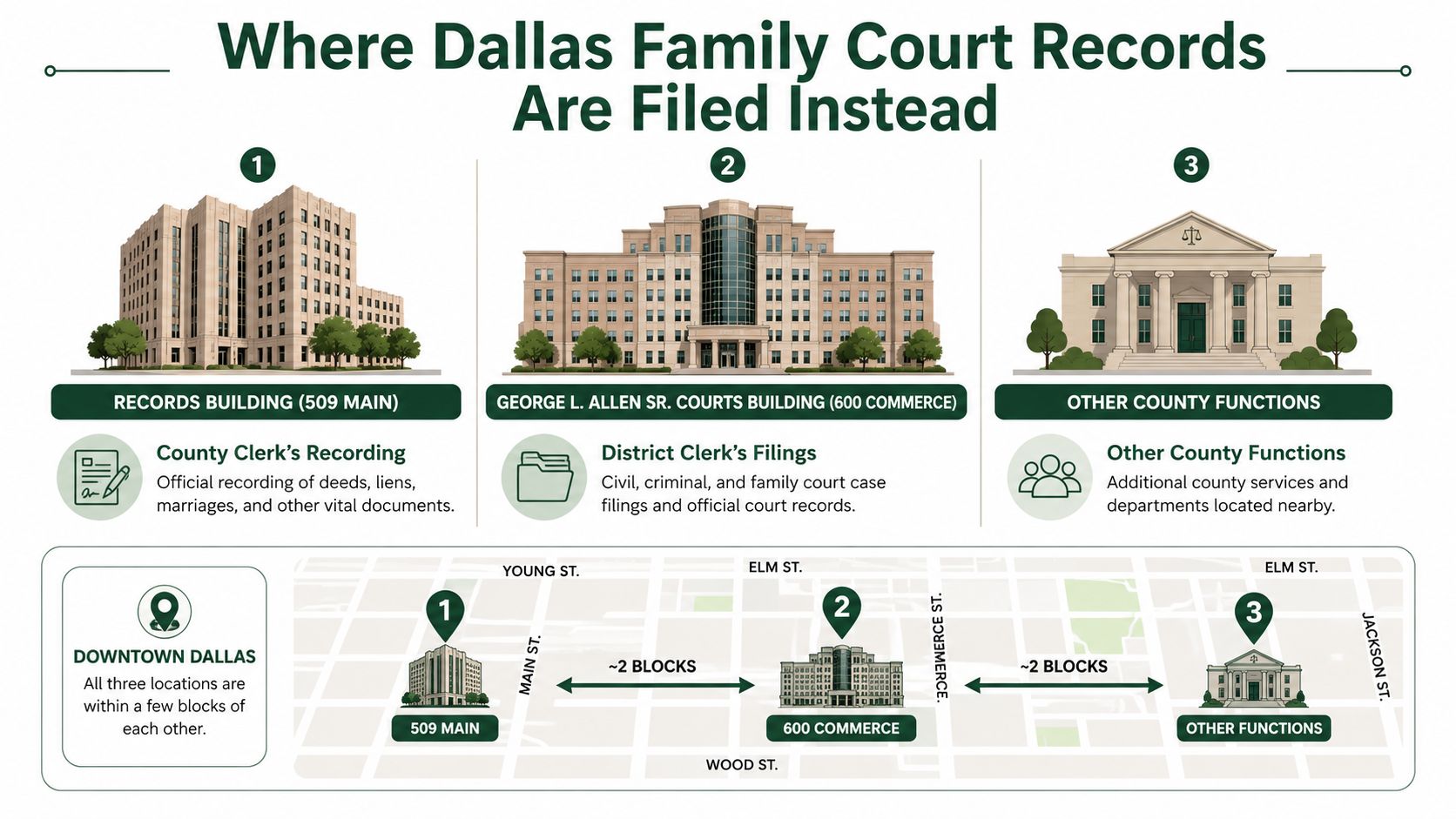
Dallas families often get mixed up because three downtown buildings sit close together, yet they serve different jobs. The Records Building handles the County Clerk's recording work, the George L. Allen, Sr. Courts Building at 600 Commerce Street handles most family district court activity, and the Frank Crowley Courts Building handles criminal matters. Dallas County keeps its family-records desk at the Allen building on the Basement “B” Floor West, and the office lists 214-653-6076 with hours of 8:00 a.m. to 4:30 p.m., Monday through Friday (Dallas County family records desk).
The District Clerk keeps the family case file. The County Clerk's recording division does not. Divorce cases, child custody cases, and many post-judgment matters enter the district-court system through the Allen building, where the clerk stamps the papers, assigns the case number, and sends the file to the correct family court. Dallas County also says attorneys file electronically in the district courts, while self-represented litigants may file paper pleadings at the Pearl C. Smith Civil File Desk on the first floor west of the Allen building (Dallas County civil and family filing FAQ).
Why the split matters
If you are filing a divorce petition, an original SAPCR, or a modification, the filing belongs in the family docket at the Allen building, not at the Records Building. The clerk there gives the case a cause number and places it on the court's calendar. That process is separate from recording a deed or requesting a certificate. Dallas County's law-library FAQ also says Dallas County residents may file in person at the District Clerk's office on the first floor of the Allen building, and that original petitions and answers are usually filed there (Dallas County law library FAQ).
People often use the word “court” as if every filing goes to the same window. In Dallas County, the document decides the path. A protective order tied to family violence may follow one route, while a civil protective-order request may follow another, so filing at the wrong desk can send you back to start.
The clean rule is simple. If the paper opens or manages a family lawsuit, start with the District Clerk at the Allen building. If the paper belongs in the county's public records, use the County Clerk's recording division at the Records Building. For a courthouse-level overview of where family cases are heard, see this Dallas County family-court guide.
How Divorce and Family Filings Reach the Courthouse
Dallas County uses two different filing paths, and that is where a lot of confusion starts. A divorce petition belongs in the family-court system, so it enters through the District Clerk at the Allen Courts Building. The County Clerk's recording division at the Records Building handles public recording work, like deeds and other recordable documents, not the start of a divorce case.
For attorneys, the first step is usually electronic filing through Texas eFileTexas, which sends the Original Petition for Divorce into the district-court system. The clerk then receives it, stamps it, assigns the case number, and sends it into the proper family court. For a self-represented filer, the petition may still be brought in on paper, but it has to go to the district-court intake desk that handles family filings.
The filing method can change the route, but it does not change the destination. The document still has to reach the family case intake side of the courthouse, because that is where the lawsuit is opened.
Attorney filing and self-filing look different
Attorneys are generally required to file electronically in Dallas County district courts. That means the petition is uploaded, reviewed through the court system, and then processed by the District Clerk. A self-represented person may file paper pleadings instead, but paper filing still means choosing the correct intake window for family cases.
Dallas County's civil and family filing FAQ explains that paper pleadings from self-represented litigants are filed at the Pearl C. Smith Civil File Desk, not at the County Clerk's recording window. That distinction matters because a filing clerk can only open a family case if the packet reaches the right desk.
If a filer cannot afford the fee, a request to proceed without paying costs may be available. That changes the payment issue, not the filing path. The petition still has to enter the correct family-court intake channel before the case can begin.
A packet with every page in order can still miss the mark if it goes to the wrong building. Family-law filings belong at the Allen Courts Building. The Records Building is for recording and other public-record services, not for starting a divorce, custody, or support case.
For a closer look at how the family docket works once the case is inside the court system, this Dallas County family docket resource is helpful.
Family-Law Documents Kept at the District Clerk's Office
Once a family case is opened, the paperwork lives with the District Clerk, not with the County Clerk's recording division. That matters because family-law cases generate a different kind of record, one tied to the court's docket, hearings, and orders. If you're looking for a divorce file, a custody file, or a modification history, you're looking for a District Clerk case file at the Allen Courts Building.
Common documents that stay in the family case file
Here are the kinds of documents that usually remain in the district-court record after the case is opened:
- Original petition. This starts the lawsuit and tells the court what kind of relief the filer wants.
- Waiver of service. This can show that a party agreed to give up formal service.
- Citation with return. This shows how service was completed when a waiver isn't used.
- Temporary orders and temporary injunctions. These control the parties while the case is pending.
- Final decree of divorce. This ends the case and sets the final terms.
- Parenting class certificate. Some cases require proof that a class was completed.
- Qualified domestic relations order. This is often used to divide retirement benefits.
- Post-judgment motions such as modification or enforcement requests.
These are court pleadings and orders. They are filed into the case, docketed by the clerk, and maintained as part of the lawsuit record. They are not the same thing as a recorded deed, lien, or certificate that belongs in the County Clerk's public recording system.
Why the distinction helps families
A lot of confusion comes from the word “record.” In everyday speech, people say “court records” and “recording records” as if they mean the same thing. They don't. Family-law filings tell the court what happened in the case, while recording documents tell the county's public records system what happened with property or a civil record.
Practical rule: if the document answers a judge's question, it belongs in the case file. If the document gives the public notice about property or a civil record, it may belong in the recording system.
That distinction becomes especially important in cases involving retirement accounts, property division, or later enforcement. A divorced spouse might need the decree from the district-court file, not a recorded instrument from the Records Building, to prove what the court ordered. If you know which office keeps which paper, you can ask for the right copy the first time.
| Where Each Family-Law Document Lives | ||
|---|---|---|
| Document | Maintained By | Building |
| Original petition | District Clerk | George L. Allen, Sr. Courts Building |
| Waiver of service | District Clerk | George L. Allen, Sr. Courts Building |
| Temporary orders | District Clerk | George L. Allen, Sr. Courts Building |
| Final decree of divorce | District Clerk | George L. Allen, Sr. Courts Building |
| Qualified domestic relations order | District Clerk | George L. Allen, Sr. Courts Building |
| Modification or enforcement motion | District Clerk | George L. Allen, Sr. Courts Building |
Getting Copies, Certifications, and Records Searches
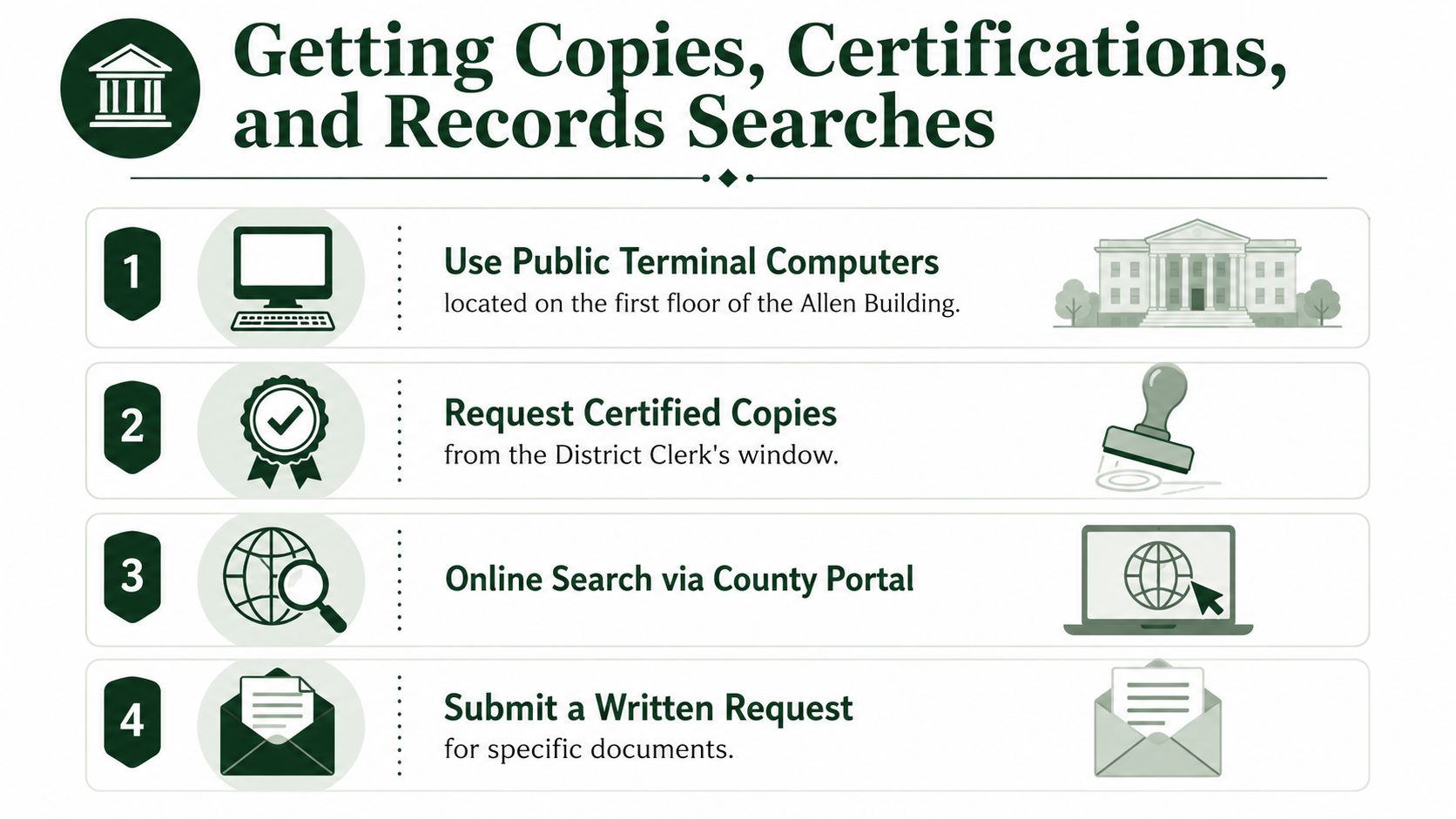
Once a Dallas County family case is filed, the next problem is usually getting the right copy of the right document. The simplest in-person option is the District Clerk's public terminal computers on the first floor of the Allen building, where a person can review non-sealed case information and pull a docket sheet. That helps when you know the case exists but don't remember the exact document title.
A plain copy shows the text of a filing. A certified copy includes the clerk's certification stamp, which is what many institutions want when they need proof that the document is an official court record. Dallas County lets people request these records in person, online through the District Clerk records portal, or by mail for certain requests. The requester usually needs the case number or the full names of the parties, because the clerk has to match the request to the right file.
Four practical ways people get what they need
- Public terminal computers. Use these on the first floor of the Allen building to view docket information and locate the file.
- Certified copies at the window. Ask the District Clerk's counter when you need an official copy with certification.
- Online search. Use the county's records portal when you don't want to go downtown for a basic records check.
- Written request. Mail a clear request for specific documents when in-person pickup isn't practical.
Sealed or restricted documents can't always be viewed the same way as ordinary public filings. Texas law can limit public access to some family-court documents, so not every file is available on a public screen or through a routine copy request. That's where knowing the case number and the document type saves time.
The practical connection to family law is immediate. Service of process, temporary orders, final decrees, and later enforcement motions all leave paper behind. If you need a certified copy for a lender, a school, or another court, you want the District Clerk file, not the County Clerk's recording side.
Practical Next Steps for Dallas County Residents
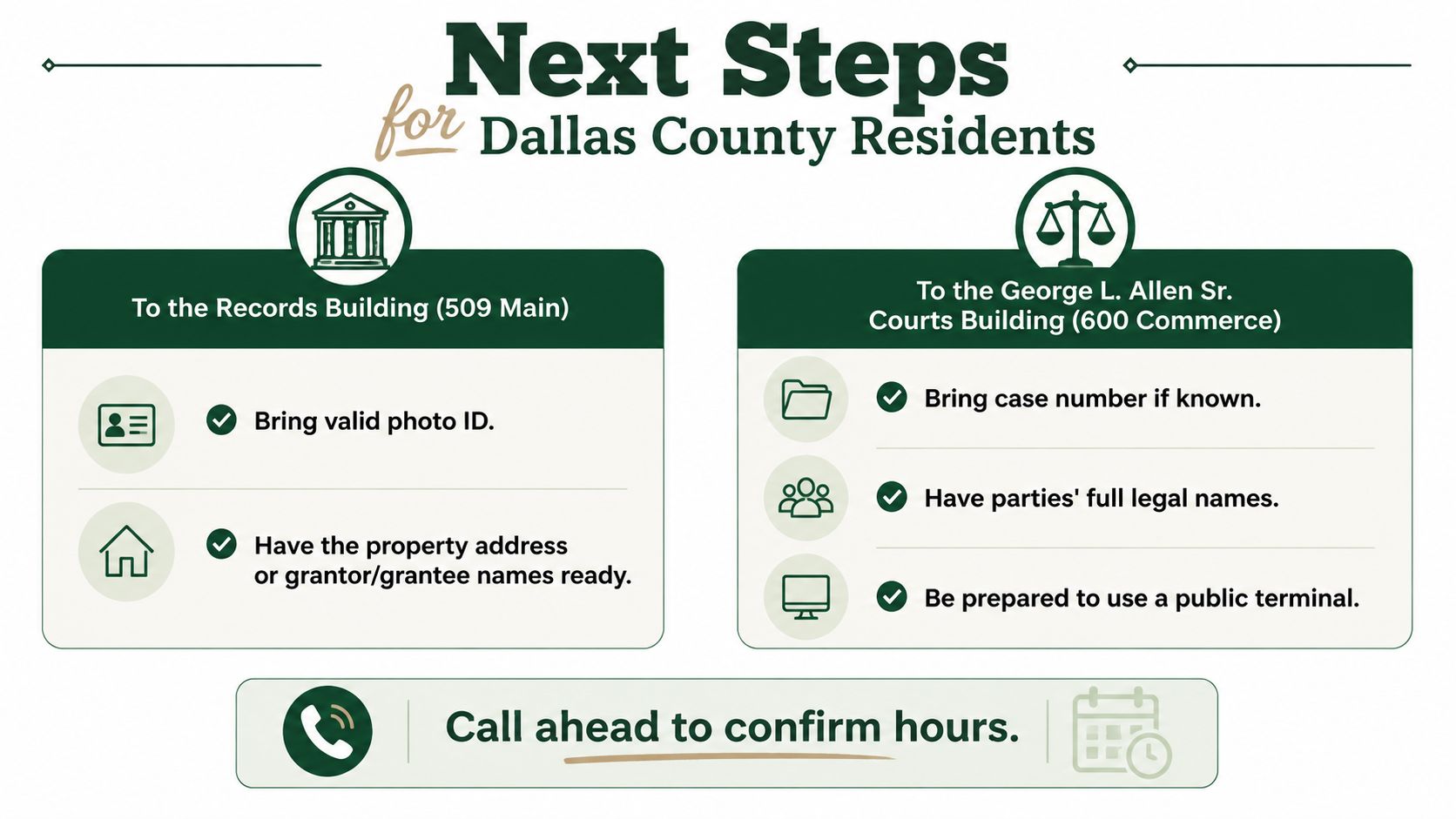
If you're headed downtown, start by deciding what kind of paper you have in your hand. A property record, birth certificate request, or other recording item belongs at the Records Building, 500 Elm Street, Suite 2100. A divorce petition, custody filing, modification, or family-records request belongs at the George L. Allen, Sr. Courts Building, 600 Commerce Street, where the District Clerk handles family records.
What to bring by destination
- To the Records Building: bring a photo ID, your payment method, and the document or the exact property details if you're requesting a recording service.
- To the Allen building family-records desk: bring the case number if you have it, the parties' full legal names, and any proposed order or document title you're trying to locate.
- If you're filing paper documents: keep extra copies with you, because the clerk may need to stamp one for your file and return one to you.
- If you're an attorney: remember that Dallas County requires e-filing in district court, so don't plan on walking a petition into the wrong counter.
The timing also matters. Morning lines can be longer at intake windows, and electronic filing has its own practical rhythm. If you're trying to file something urgent, don't wait until the last minute to figure out which building owns the document.
This Dallas County family-court decision guide is a helpful next stop if you're trying to understand what happens after the file is opened and the court starts making decisions.
If children are involved, if the property division is more than a simple split, or if you need service on someone who lives out of state, that's the point to get legal help before you walk in with the wrong packet. Knowing the difference between recording and filing saves time, and in family law it can also keep a case moving instead of stalling at the counter.
The Law Office of Bryan Fagan, PLLC helps Dallas and Dallas County families sort out court filings, divorce questions, custody issues, and the practical steps that come next. If you're trying to figure out which Dallas County building has your filing, or what to do after your case is opened, visit The Law Office of Bryan Fagan, PLLC to connect with a local team that works through these issues every day.