

You're standing outside a downtown Dallas courthouse with a folder of pleadings, a hearing notice, and no clear idea which elevator to take. That uncertainty is common, especially when “Dallas family court” sounds like one courtroom rather than a group of courts, clerk counters, records offices, and support services spread through the George L. Allen, Sr. Courts Building.
The short answer is this: Dallas County family-law cases are heard at the George L. Allen, Sr. Courts Building, 600 Commerce Street, in downtown Dallas. The building houses the Dallas County Family District Courts and related District Clerk services. Your case may involve divorce, custody, child support, possession and visitation, enforcement, modification, protective orders, paternity, adoption, or another family-law matter, but the correct courtroom depends on the court assigned to your case.
Table of Contents
- A First-Time Visitor's View of the George L. Allen Sr. Courts Building
- Which Family Cases Are Actually Heard Here
- Navigating the Building Floor by Floor
- Filing Fees for Common Family Matters in Dallas County
- Clerk Contacts, Records Desk, and Hours
- What a Typical Family Court Day Looks Like
- Practical Next Steps for Dallas County Family Litigants
A First-Time Visitor's View of the George L. Allen Sr. Courts Building
A first-time visitor may arrive downtown with a hearing notice, a folder of pleadings, and one unanswered question: which door, floor, or counter handles the case? “District Court” on the notice identifies the court level, not every step required inside the building. The courthouse works more like a small service center than a single courtroom. Different floors and offices handle hearings, filings, records, support services, and case-related questions.
For Dallas County family matters, begin at the George L. Allen, Sr. Courts Building, 600 Commerce Street, downtown Dallas. Dallas County places its Family District Courts there, along with related services. The building includes the District Clerk's Civil/Family Division information and file desk, the Domestic Relations Office, and the Child Support Division. The Dallas County family court information provides general guidance about the county's family-court locations and procedures.
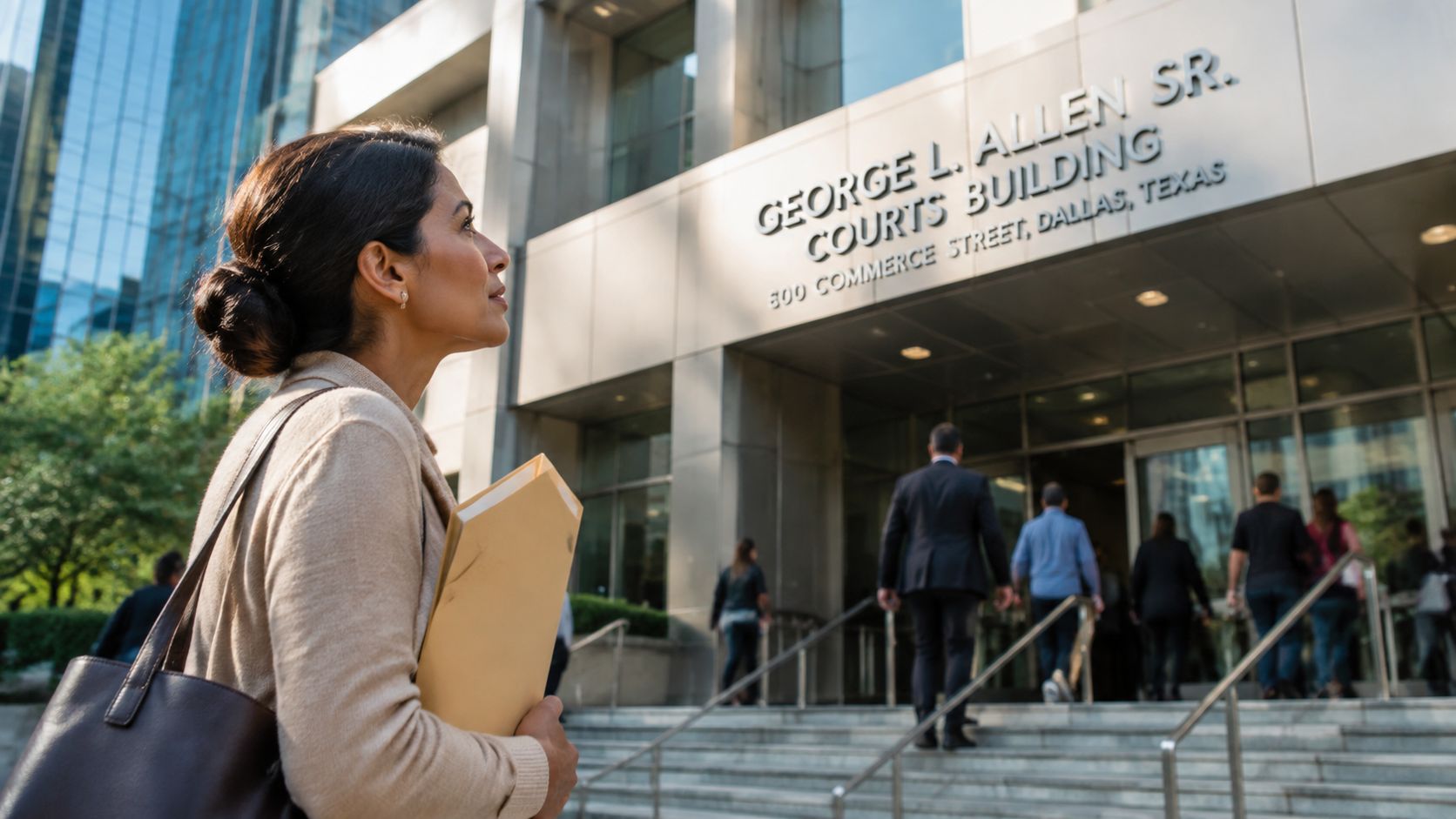
The building is a working court hub
Several family district courts operate in the Allen building, including the 254th, 255th, 256th, 301st, 302nd, 303rd, and 330th District Courts. Each court has its own docket, courtroom, coordinator, and clerk contacts. That is why the courthouse address alone cannot tell you where to report.
A divorce hearing and a child-support enforcement matter may both belong to family court, yet they can involve different courtrooms, floors, and staff. Use the court number, case number, courtroom, and hearing time on your notice. If any detail is unclear, call the assigned court coordinator or clerk before traveling. A general search for “Dallas family court” cannot replace those case-specific instructions.
What you should have before entering
Carry the hearing notice, case number, government-issued identification if requested, and copies of documents relevant to the hearing. Keep an electronic filing confirmation available, either printed or on your device. It shows that a submission was made, but it does not necessarily show that every required procedural step is complete.
Practical rule: Treat 600 Commerce Street as the starting point. Your assigned court, courtroom, docket information, and the particular task you need determine whether you should proceed to a courtroom, a records desk, or a clerk counter.
Which Family Cases Are Actually Heard Here
A divorce hearing, a custody enforcement matter, and an adoption may all involve family law, yet they do not necessarily use the same courtroom or clerk. The George L. Allen, Sr. Courts Building houses Dallas County family district courts for many trial-level matters, including divorces with or without minor children, suits affecting the parent-child relationship, commonly called SAPCR cases, child-support and custody modifications, enforcement actions, protective-order family-violence petitions, adoptions, and termination-of-parental-rights proceedings.
The court number on your notice is your route marker. “Family court” is not one courtroom, so check the court number, case number, courtroom, and hearing time before leaving home. Dallas County's 330th District Court page identifies that court as a family district court located in the Allen building. If your notice is unclear, call the assigned court coordinator or clerk rather than relying on a general courthouse search.
Match the case to the court
| Court | Location in Building | Typical Family Cases Heard |
|---|---|---|
| 254th District Court | Allen building family-court complex | Divorce, custody, support, enforcement, and related family matters |
| 255th District Court | Allen building family-court complex | Divorce, SAPCR matters, support, custody, and related proceedings |
| 256th District Court | 4th Floor New Tower | Family-law matters assigned to the 256th District Court |
| 301st District Court | 3rd Floor New Tower | Family-law matters assigned to the 301st District Court |
| 302nd District Court | Family-court system associated with Dallas County | Family-law matters assigned to the 302nd District Court |
| 303rd District Court | 4th Floor New Tower | Family-law matters assigned to the 303rd District Court |
| 330th District Court | 3rd Floor New Tower | Family-law matters assigned to the 330th District Court |
Dallas County identifies the 301st, 302nd, 303rd, and 330th District Courts among its family courts, with locations that differ by court. The 301st and 302nd are sometimes described in connection with the Old Red Courthouse annex as part of the same family bench. Floor assignments and courtroom information can change, so confirm the location on your hearing notice and with the assigned court before traveling.
Matters routed elsewhere
A case involving a child does not automatically belong in a family district courtroom. Juvenile matters and mental-health commitments may go to other Dallas County buildings or court systems. Appeals go to a separate appellate courthouse, such as the Fifth Court of Appeals, rather than remaining in the trial courtroom that issued the order.
For a first-time Dallas County family filing that is not juvenile in nature, the District Clerk and Allen building are generally the appropriate starting points. Confirm venue, jurisdiction, and filing instructions before submitting papers, especially if another county, an existing order, or an appeal is involved.
An associate judge may handle specific parts of a family case after filing. For a clearer explanation, review what a Dallas County family-court associate judge decides.
Navigating the Building Floor by Floor
The most useful way to approach the Allen building is to separate arrival, filing, records, and hearing tasks. They may all involve the same courthouse, but they don't necessarily happen at the same counter.
Start by confirming the address and your court assignment. Dallas County's George L. Allen Courts Building map shows that family services aren't concentrated behind one universal reception desk.
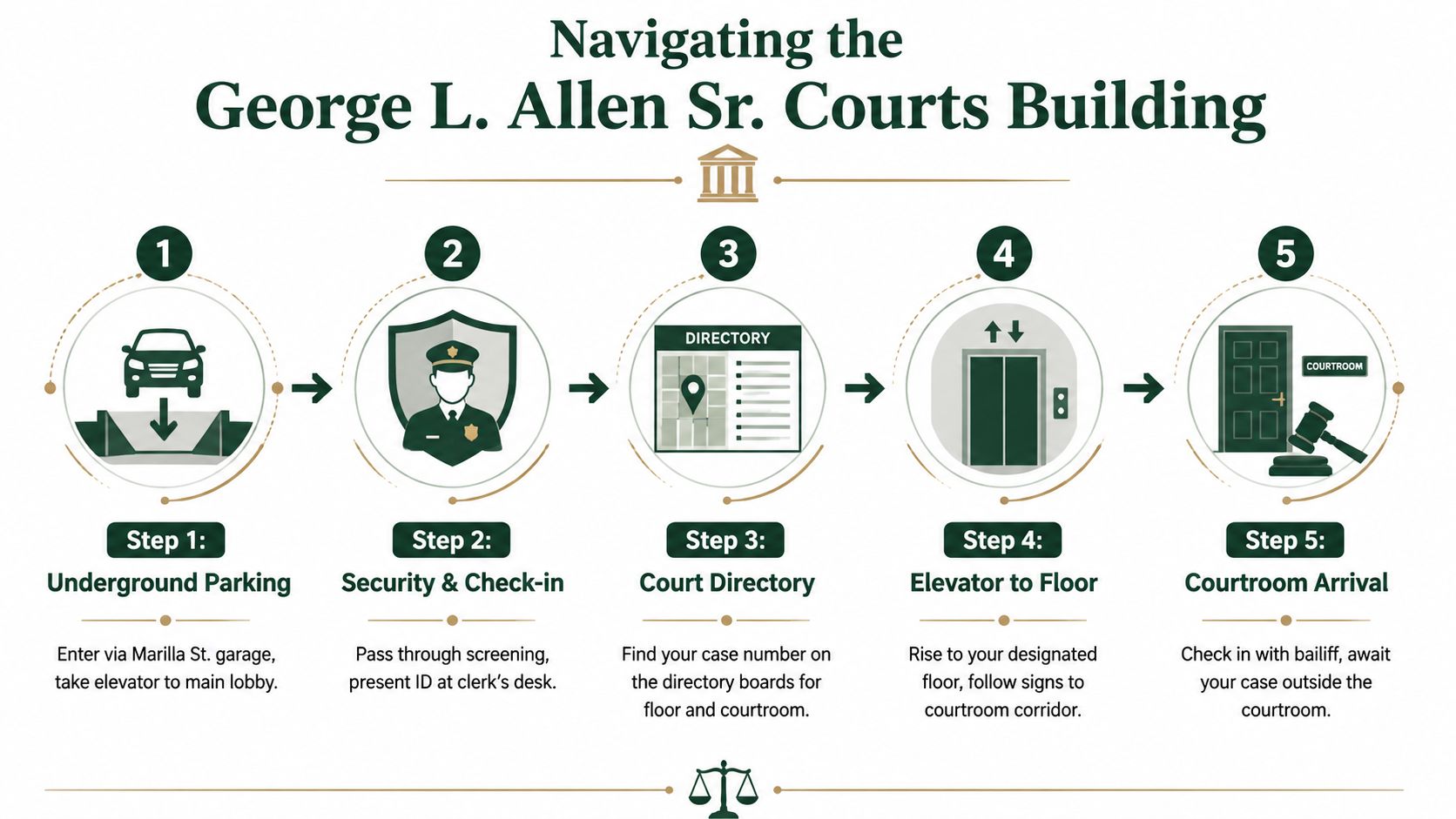
A practical route
Arrive downtown and enter through the public entrance. Use the Commerce Street entrance or follow current courthouse signage. If you're using a garage or surface parking, allow enough time to walk to the entrance and clear security.
Pass through security. Courthouse screening rules restrict weapons and other prohibited items. Avoid bringing unnecessary bags, liquids, or objects that may delay screening, and follow the instructions of courthouse security personnel.
Read the directory before choosing an elevator. The building contains multiple family courts and support offices. Find the court number and courtroom listed on your hearing notice, then confirm the floor on the directory or posted signs.
Use the correct service counter. The county map places District Clerk civil and family filing functions on the first floor, while family case records are handled at the Civil & Family Records Desk on Basement “B” Floor West. The family district courtrooms are located on upper floors, including the 3rd and 4th floors of the New Tower for courts such as the 301st, 256th, 303rd, and 330th.
Check the courtroom corridor. Wait outside the assigned courtroom unless court staff direct you elsewhere. If your case involves a coordinator, associate judge, clerk, or bailiff, ask courteously where you should check in.
The Dallas County 302nd District Court docket procedures can provide court-specific context, but your own notice remains the controlling practical reference for the date, time, and assigned courtroom.
Don't assume that every family visitor needs to go directly upstairs. Someone filing a petition may need a clerk counter first. Someone retrieving an older order may need the basement records desk. Someone attending a hearing may only need security, the directory, and the assigned courtroom.
Filing Fees for Common Family Matters in Dallas County
You arrive ready to file, but the amount depends on the case category you select at the District Clerk's counter. Dallas County's civil and family fee schedule lists $297.00 for a divorce and $348.00 for a divorce with children. It also lists $348.00 for an adoption involving one child, plus $1.00 for each additional child. See the Dallas County's civil and family filing-fee schedule for the published amounts.
| Case Type | Petition or Filing | Approx. Filing Fee |
|---|---|---|
| Divorce | Divorce without children | $297.00 |
| Divorce with children | Divorce involving minor children | $348.00 |
| Adoption | Adoption involving one child | $348.00 |
| Additional child in adoption | Each additional child | $1.00 |
The table says “approximate” because the amount you pay can depend on the filing category and related requests. Service arrangements, additional filings, or other case-specific charges may affect the total. Before making the trip to the courthouse, contact the Dallas County District Clerk to confirm the current amount and accepted payment methods.
Why the case type changes the cost
A divorce without children uses a different filing category from a divorce involving children. Custody, support, and other parent-child orders create additional issues, and the county schedule assigns the latter proceeding a different filing amount.
Adoption has its own category as well. The schedule adds a charge for each additional child after the first. Protective orders, motions, certified records, service, and other requests may follow different fee rules, so a fee from an unrelated case is not a reliable guide.
If the filing fee would be a hardship, ask the clerk about requesting a waiver based on inability to pay. Clerk staff can explain the paperwork and filing process. They cannot choose your legal strategy or tell you what result to request.
Clerk Contacts, Records Desk, and Hours
Before driving downtown, decide whether your task needs a counter, a phone call, or an online search. The Dallas County District Clerk handles filings, maintains court records, answers routing questions, and directs visitors to the correct service point. Its civil section and contact information lists separate contacts for civil, family, and records matters.
The Civil & Family Records Desk is on the basement, “B” Floor West, of the George L. Allen, Sr. Courts Building. Dallas County lists public hours as Monday through Friday, 8:00 a.m. to 4:30 p.m. The records-desk telephone number is 214-653-6076.
Match the task to the right channel
Visit the courthouse for a required in-person transaction. This may include presenting papers that staff instructed you to deliver physically, asking for help locating a record after remote options have not resolved the issue, or completing a counter transaction the clerk specifically requested. The records desk is the right destination for these record-related tasks, not a general legal-help counter.
Call before traveling when you need basic direction. A phone call can confirm the desk's hours, identify the division handling your question, and clarify whether a particular request can be completed remotely. Online filing and case-search tools may also eliminate a trip, although available functions depend on the case and Dallas County's current system.
Keep one distinction clear: clerk employees can explain procedures, while a lawyer evaluates legal choices. Staff may describe how to request a copy or identify where records are maintained. They generally cannot decide whether your motion is legally sufficient, whether service was valid in your circumstances, or which custody request supports your position.
Prepare a precise records request
Have your cause number, party names, and requested document ready. A certified copy is different from docket inspection or a noncertified copy, so state which version you need. That detail helps the records desk identify the correct transaction and avoid an unnecessary second trip.
Before you call: Write down the case number, assigned court, document name, and exact question. Clear information helps staff route you faster.
What a Typical Family Court Day Looks Like
A first appearance can go wrong before anyone discusses the case. A Dallas litigant arrives downtown with a folder, assumes the hearing is on the third floor, and then finds the assigned courtroom in the New Tower. The courthouse functions like a series of handoffs: the notice identifies the case, the directory identifies the destination, and the courtroom staff explains the next step. Missing one handoff can create delay and unnecessary stress.
Before leaving home, read the hearing notice carefully. Confirm the cause number, assigned court, date, time, and courtroom location. Bring the notice, every document received from the opposing party or clerk, and your filing confirmations. After security screening, check the building directory rather than relying on memory. Go to the assigned courtroom and follow the posted check-in instructions.
Court staff may tell you where to wait, when to approach the clerk, or how to submit a document. Do not interrupt a proceeding to ask a question. If the courtroom is in session, wait and ask staff during an appropriate break or before the docket begins.
Mistakes that create avoidable problems
Wrong court or floor: Dallas County has multiple family district courts, and their courtroom locations differ. Confirm the specific court and room on your notice before traveling. A general assumption about the family-law floor can make you late.
Incomplete filing proof: Keep your e-filing confirmation and clerk-stamped documents together. A confirmation may show that you submitted a document, while separate clerk action may determine whether it was accepted, returned, or still requires attention.
Ignoring records verification: If the hearing depends on whether a document was filed, accepted, or entered, check the docket or contact the appropriate records channel before the hearing. Sending a document does not by itself prove that the court's record contains it.
Unprepared presentation: Hearings may involve children, support, property, temporary orders, enforcement, or another urgent issue. Organize notes around the relief requested, the facts supporting it, and the documents you want the judge to review. Keep the explanation focused.
Courtroom conduct still matters
Wear clean, appropriate clothing and leave unnecessary items at home to make security screening easier. Silence your phone, address the judge respectfully, and avoid arguing with the opposing party in the hallway.
If the hearing concerns custody, possession, support, or an alleged violation of an existing order, read the order before attending. The courtroom is not the place to improvise a new schedule in the hallway. The judge will consider the pleadings, evidence, testimony, and applicable law.
Practical Next Steps for Dallas County Family Litigants
走出 George L. Allen, Sr. Courts Building 後,趁記憶清楚,立即記下法官的裁定、指示、期限、要求補交的文件,以及下一次開庭日期。若不確定指示內容,先聯絡承辦書記官或合資格律師,不要自行猜測。
確認案件紀錄
使用 Dallas County District Clerk 的線上案件搜尋工具,核對案件所屬法院、已提交文件及聽證資訊。需要正式文件時,聯絡 Civil & Family Records Desk,詢問如何取得 certified copy。把文件按日期和類型整理在同一個案件資料夾內,方便在電話查詢或到櫃檯辦理時立即找到。
自行代理的當事人可到 George L. Allen, Sr. Courts Building 一樓的 Dallas County Law Library 查找表格資料,也可查看 Office of Court Administration 的 family-law self-help 資源。這些工具適合協助你了解流程,但不能代替針對個案的法律意見。
為下一次出庭準備
需要法庭口譯員時,應盡早提出申請,並向法院確認目前的申請方式。法院可指引你前往正確的申請渠道,但不要等到聽證當天早上才提出語言協助問題。
填寫 Texas 表格時,將文件與 Texas Supreme Court 的 standard form library 逐項核對。涉及企業所有權、退休資產、分別財產追蹤、搬遷、CPS、保護令、爭議性 enforcement 或上訴的案件,表格本身未必能處理案件的法律問題。
對方已聘請律師,或你不明白法院要求完成的事項時,與 Dallas family-law attorney 諮詢可能更合適。Dallas 居民也可查詢 Dallas Bar Association 的 Lawyer Referral Service,以及 Dallas Volunteer Attorney Program,了解是否符合按收入提供的協助資格。若案件在 254th District Court,出發前先閱讀 Dallas County 254th District Court family docket procedures,不要只依照一般法院經驗判斷。
離家前完成三項核對:案件編號、所屬法院,以及你要處理的是 filing 還是 records。需要親身到法院的事項,通常包括提交文件、取得正式副本或處理櫃檯要求;其他案件資訊可先透過 District Clerk 的線上工具或電話確認。最後,直接向 Dallas County 核實當前指示,再安排交通和到場時間。
The Law Office of Bryan Fagan, PLLC 協助 Dallas County 客戶準備離婚、監護權、扶養費、enforcement、修改及其他與 George L. Allen, Sr. Courts Building 有關的 family-law proceedings。可瀏覽 The Law Office of Bryan Fagan, PLLC 的 Dallas family-law 資源,並就下一步申請諮詢。