 Skip to content

You've filed a Dallas County divorce, custody, child-support, paternity, or enforcement case, and the notice says 302nd District Court. Your first question is probably simple: what happens next, and what do you need to do before the first setting? The answer depends on the type of hearing, the court's recurring docket schedule, whether formal requests are required, and whether the court expects you to appear remotely or in person.
The Dallas County 302nd District Court family docket procedures are structured. The court uses recurring time blocks for different matters, and its written policies require formal filings for several sensitive scheduling requests. Treat the assignment and every setting as a procedural deadline, not as a general invitation to contact the court whenever convenient.
Table of Contents
- How Your Case Lands in the 302nd District Court
- The Weekly Docket Calendar and What Each Setting Means
- Filing Requirements and Document Preparation
- Gatekeeping Rules for Sensitive and Complex Matters
- Remote Appearances and Exhibit Handling Rules
- Practical Tips for Self-Represented Parties and Working with Counsel
- Dallas County Resources and Next Steps for Your Case
How Your Case Lands in the 302nd District Court
A Dallas parent may open an e-file notice and discover that a custody modification has been assigned to the 302nd District Court. A spouse filing for divorce may receive the same result. That assignment doesn't mean the filing party selected the judge or court, and it doesn't mean the opposing party can choose a different family court because the case would be more convenient there.
Texas Supreme Court administrative rules direct Dallas County family cases to be docketed numerically in filing order and then assigned randomly among the 301st, 302nd, 303rd, 330th, 254th, 255th, and 256th District Courts. The process is described on the Dallas County 302nd District Court family page. The system covers core family matters, including divorce, paternity, conservatorship, child support, protective orders, and enforcement actions.
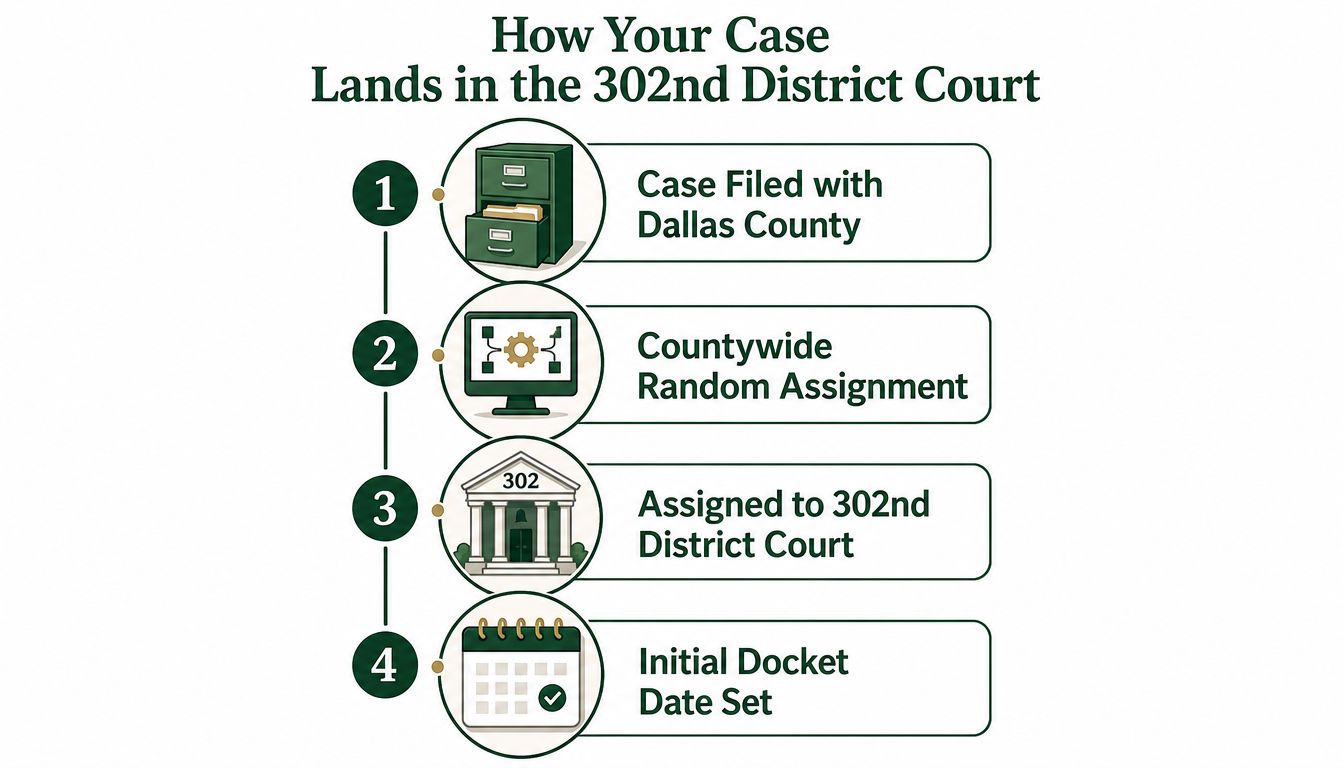
Assignment is administrative, not strategic
The filing party submits the case through the Dallas County filing system. The county then places it into the numerical and random-assignment process. If the result is the 302nd District Court, the case begins there under that court's family docket framework.
That distinction matters in several situations:
- Divorce cases: The court may address temporary orders, property division, discovery disputes, prove-up proceedings, and trial-related settings.
- Custody and conservatorship cases: The docket can involve temporary orders, possession and access, relocation disputes, modifications, and enforcement.
- Child support matters: Establishment, modification, and enforcement issues may proceed through the family-court system.
- Protective orders and enforcement actions: These matters can require quick preparation and strict attention to the assigned setting.
- Paternity cases: Parentage, conservatorship, possession, and support issues may develop within the same countywide assignment structure.
Practical rule: Don't waste time trying to select a different Dallas County family court. Use that time to review the assigned court's procedures and prepare for the first setting.
Continuing jurisdiction affects later disputes
Once a case is assigned, related matters can flow through the same continuing-jurisdiction framework. For example, a later enforcement or modification issue may be connected to an existing family-law case rather than treated as an entirely unrelated filing.
The assignment is therefore a foundational docketing milestone. It tells you where the case will be managed, which court calendar you must monitor, and which written procedures will govern requests for settings, continuances, child interviews, and other court action.
The Weekly Docket Calendar and What Each Setting Means
The 302nd District Court publishes recurring time blocks rather than treating every hearing as an informal scheduling conversation. The court's docket control document identifies the following weekly schedule.
302nd District Court Weekly Docket Schedule
| Day | Time | Hearing Type |
|---|---|---|
| Monday | 9:00 a.m. to 12:00 p.m. | Contempt matters |
| Monday | 1:30 p.m. to 3:30 p.m. | Pre-trials |
| Tuesday through Thursday | 8:45 a.m. to 9:00 a.m. | Prove-ups |
| Tuesday through Thursday | 9:30 a.m. to 12:00 p.m. | Trial docket |
| Tuesday through Thursday | 1:30 p.m. to 4:30 p.m. | Trial docket |
| Tuesday through Thursday | 9:00 a.m. to 9:30 a.m. | Motions |
| Monday and Tuesday | 9:00 a.m. | Temporary orders, TROs, and motion dockets |
| Wednesday | 1:30 p.m. | Temporary orders, TROs, and motion dockets |
| Wednesday | 9:00 a.m. | CPS docket |
A contempt matter generally concerns an alleged violation of a court order. In a custody or child-support enforcement case, preparation usually centers on identifying the order, the specific obligation, the alleged violation, and the evidence supporting each side's position.
A pre-trial setting helps the court identify what remains disputed and what must happen before trial. A divorce may still involve disagreements about separate property, business interests, retirement assets, real estate, reimbursement claims, or the wording of final orders. A custody case may require clarification of conservatorship, possession, geographic restrictions, or requested modifications.
Prove-ups, trials, motions, and emergency settings
A prove-up is commonly used to present an uncontested matter for approval, such as an agreed divorce. Uncontested does not mean unprepared. The documents must still be accurate, complete, and consistent with the parties' agreement.
The trial docket covers trial-related proceedings during the published morning and afternoon blocks. A contested trial involving custody, property division, business ownership, or high-income financial records requires much more than appearing at docket call. Witnesses, exhibits, discovery, proposed orders, and settlement decisions should be organized before the case reaches that stage.
The short morning motions block is distinct from the temporary-orders, TRO, and motion-docket settings listed for other days. Read the specific notice and court instructions carefully. A motion about discovery, temporary relief, enforcement, or another family-law issue may require a particular setting and notice process.
The CPS docket appears on Wednesday morning. CPS matters carry serious consequences for parental rights and should not be approached like routine scheduling events.
Dormant cases can face dismissal
The court states that dismissal proceedings track Texas Rule of Civil Procedure 165A. If a case has been dormant for 180 days, a party must appear before the court and obtain a pre-trial setting to keep it active, as explained in the court's docket-control publication.
That rule creates a practical obligation. Don't assume a filed petition remains active indefinitely. Monitor the docket, respond to notices, attend required settings, and address inactivity before the court treats the case as subject to dismissal.
For comparison, Dallas County has separate procedures for other family courts, including the 301st District Court family docket procedures. Don't transfer instructions from another court to the 302nd without confirming that they apply.
Filing Requirements and Document Preparation
A 302nd District Court case moves through formal filings, service, responses, notices, and proposed orders. The correct document depends on the case and the relief requested. A divorce petition isn't prepared the same way as a motion to modify conservatorship, an enforcement action, a protective-order request, or a request for temporary orders.
Start with the filing itself. Check the case caption, cause number, party names, court designation, requested relief, signature, and required attachments. If you're asking the court to sign an order, prepare a proposed order that accurately reflects the relief sought. Never assume the judge will draft the order for you after the hearing.
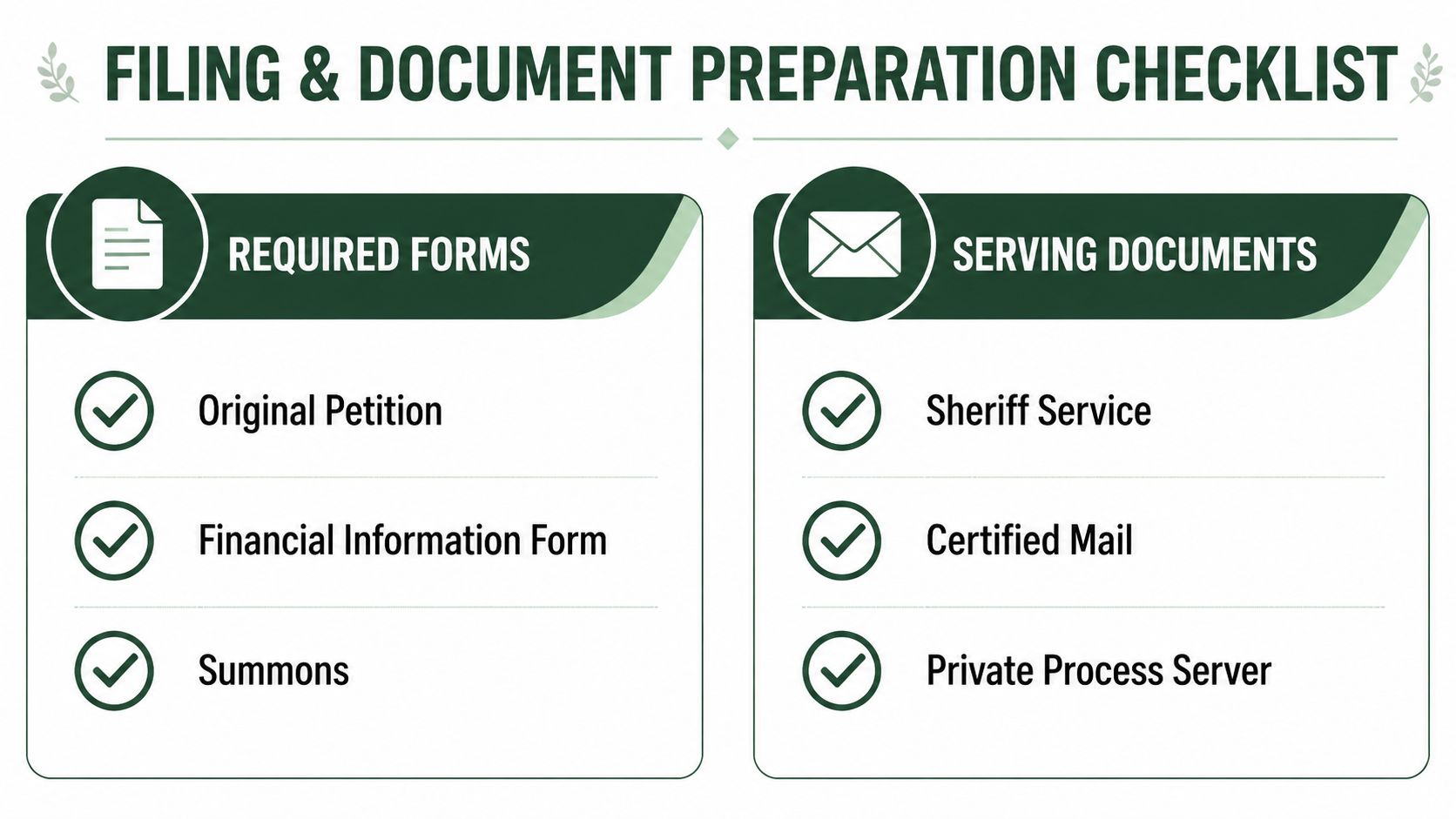
A reliable filing checklist
Use a document-by-document review before submitting anything:
- Caption and court: Confirm that the cause number, party names, and 302nd District Court designation match the existing case.
- Requested relief: State exactly what you want the court to order, whether that's temporary support, a possession change, enforcement relief, or a property-related ruling.
- Supporting material: Attach the records, declarations, pleadings, or exhibits required to support the request.
- Verification: If the filing requires verification, include the correct verification page and make sure it is properly signed.
- Notice: Determine who must receive notice, how notice must be given, and when it must be completed.
- Proposed order: Provide a proposed order when the court's process requires one or when a signed order is necessary to implement relief.
The Dallas County District Clerk processes filings and maintains the court record. After e-filing, review the filing confirmation and docket entry. A submission receipt isn't the same as a completed docket entry, and a rejected filing may leave you without the procedural protection you expected.
Service is separate from filing
Filing a petition with the District Clerk doesn't automatically give the other party legal notice. Service may involve a sheriff, certified mail, or a private process server, depending on the document and the circumstances. An answer, waiver, acceptance, or other response may have different requirements from formal service.
Defective service can create delay and may prevent the court from taking certain action against a party who hasn't received legally sufficient notice. Don't rely on an informal text message or email unless the law and the particular procedure permit that method.
Also review the 254th District Court family docket procedures only as a comparison. Dallas County family courts may publish different calendars and instructions, so the 302nd's current written procedures and the applicable Texas rules control your preparation.
Gatekeeping Rules for Sensitive and Complex Matters
The 302nd's written policies create formal entry points for matters that require special handling. The 302nd District Court policies and procedures state that a child interview requires a filed motion and a hearing on the Associate Judge docket.
That requirement matters in custody disputes. A parent who wants the court to interview a child shouldn't ask for the interview during an unrelated docket call. The request needs to be presented through the required motion and hearing process, allowing the court to address the request deliberately.
Keep children out of the courtroom unless directed
The court's written procedures state that children shouldn't be brought to court unless the court directs otherwise. Parents often think a child's presence will help explain what happened. In practice, bringing a child into parental litigation can create stress, disrupt the proceeding, and conflict with the court's stated procedure.
Prepare adult witnesses and admissible evidence instead. If the court needs information from a child, follow the formal process for requesting an interview.
Trial settings change the planning equation
A continuance after a trial setting generally requires judicial approval. Special settings must be requested in writing to the Associate Judge, rather than informally by phone. These requirements prevent parties from treating trial dates and special settings as flexible calendar placeholders.
A trial setting should trigger preparation, not postponement. Confirm witness availability, complete discovery, organize exhibits, evaluate settlement, and identify conflicts before docket call.
This is especially important in complex Dallas divorces. A business owner may need company records, valuation materials, ownership documents, and tracing evidence. A professional may need records concerning a practice, compensation, retirement accounts, or separate-property claims. A parent seeking relocation may need organized evidence about the proposed move, parenting schedule, and the child's best interests.
The court can refuse resets or continuances once a case is set for trial. That doesn't mean a continuance is never available. It means you should treat it as a formal request requiring a persuasive basis, timely written presentation, and judicial approval.
Self-represented parties face the same scheduling structure as represented parties. If a deadline, witness conflict, discovery problem, or emergency threatens your preparation, address it through the required filing process instead of assuming a phone call will preserve your position.
Remote Appearances and Exhibit Handling Rules
The public guidance on remote participation in the 302nd is fragmented. Dallas County court materials and nearby family-court guidance show that some family courts use Zoom, require exhibits to be exchanged before a hearing, and may require notices to identify whether the setting is remote or in person. Those materials don't create a single, easy answer for every contested 302nd hearing.
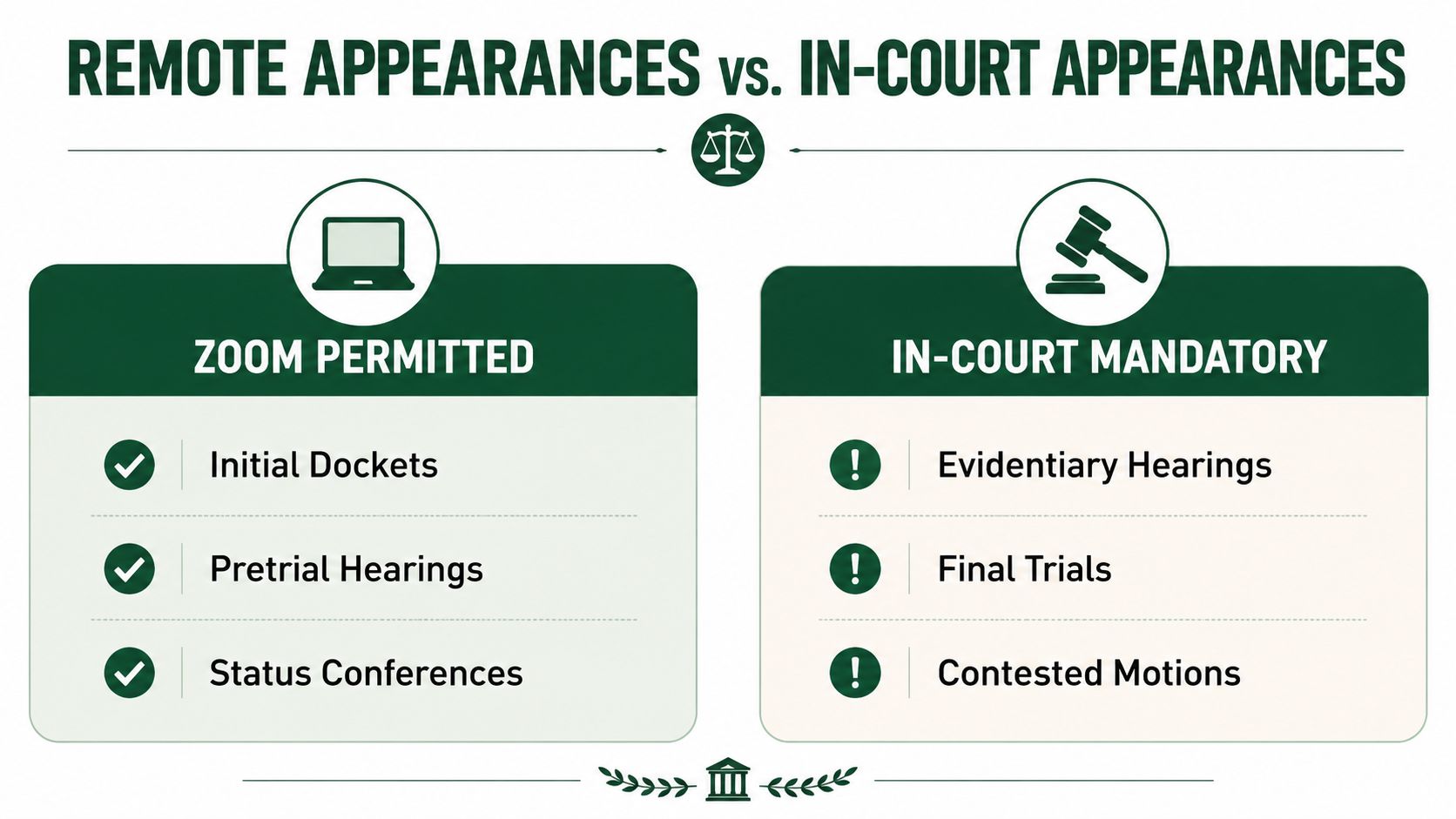
Remote and in-person preparation are different
For a routine status event, a remote appearance may be available if the court's current notice or instructions authorize it. A contested evidentiary hearing presents different concerns. The judge may need to assess testimony, rule on objections, manage exhibits, and ensure that each party has a fair opportunity to participate.
Don't assume that because one Dallas family court permits Zoom for a similar matter, the 302nd permits it for yours. The 302nd-specific docket notice, current court policies, clerk information, and any setting instructions should be checked together.
For every hearing, confirm:
- Appearance method: Determine whether the hearing is remote, in person, or subject to court approval for remote participation.
- Notice language: Check whether the notice must identify the appearance method and contain specific connection details.
- Exhibit exchange: Find out whether exhibits must be emailed or exchanged before the hearing and follow the stated format.
- Technology: Test your camera, microphone, connection, and document access before the setting.
- Backup plan: Know how you'll proceed if the connection fails or the court requires in-person attendance.
The court's docket-control and policy documents were updated in 2025-2026, while Dallas County livestream and court pages were refreshed in August 2026, according to the available court materials. That update activity is a warning against relying on an old Zoom link, an outdated notice, or instructions copied from a prior case.
The 256th District Court family docket procedures can help you understand why Dallas family courts may use court-specific processes, but it isn't a substitute for confirming the 302nd's current requirements.
Exhibit failures can damage an otherwise strong case
If you fail to exchange exhibits as required, the judge may be unable to consider the material when you expect. The consequence depends on the hearing, the court's instructions, the reason for noncompliance, and the other party's response. It can also create avoidable disputes about authenticity, notice, and fairness.
Send exhibits through the required channel, label them clearly, keep proof of transmission, and bring accessible copies for an in-person setting. If your evidence includes financial records, business documents, text messages, photographs, or parenting communications, organize it so the court can identify what each item proves.
Practical Tips for Self-Represented Parties and Working with Counsel
Court preparation starts before the courthouse doors open. A self-represented parent and a represented business owner have different responsibilities, but both must know the setting, organize the evidence, and understand the order they want the judge to sign.
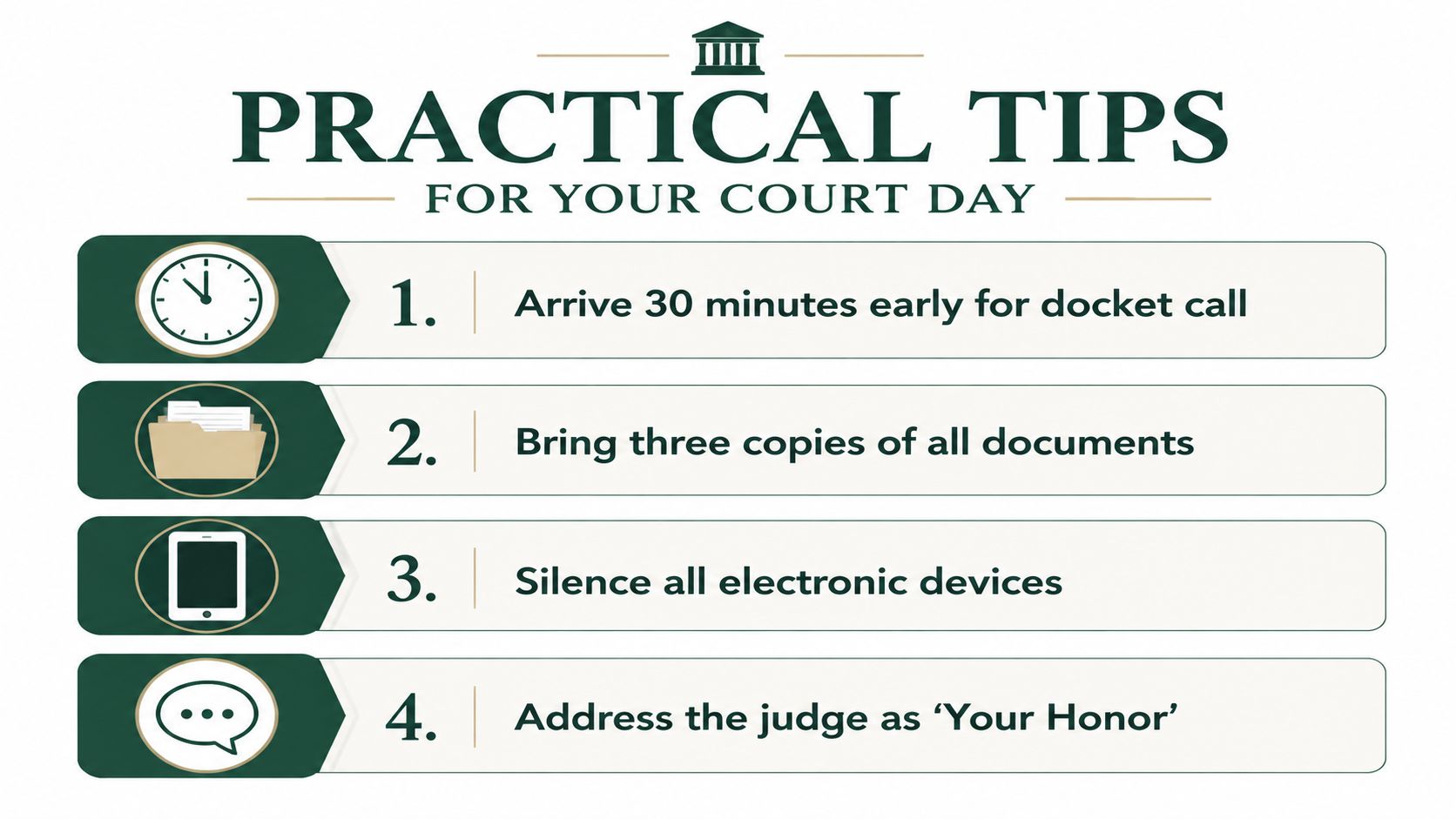
Prepare for docket call
Bring the documents that support your position, your hearing notice, identification, and a way to access the case record. Organize your materials by issue, not by the order in which you found them. A custody case might need separate sections for possession, school information, medical concerns, communications, and requested relief. A divorce case may require separate organization for income, accounts, real estate, business interests, retirement assets, and separate-property tracing.
Use courtroom conduct that helps rather than hurts:
- Arrive early: Give yourself time to pass through security, find the courtroom, and confirm the setting.
- Silence devices: Don't let calls or alerts interrupt the proceeding.
- Address the judge properly: Use “Your Honor” and wait for the judge to recognize you.
- Speak to the court: Direct legal arguments to the judge instead of arguing with the opposing party.
- Stay precise: Answer the question asked, then stop unless the court requests more.
Decide when assistance is necessary
Self-representation may feel manageable during an uncontested prove-up. It becomes riskier when the other party seeks contempt, when a parent requests emergency relief, when CPS is involved, or when the case includes disputed property and financial records.
Temporary orders can affect possession, support, access to property, payment responsibilities, and communication while the case is pending. Emergency requests and protective-order matters may require faster action, but urgency doesn't eliminate the need for accurate pleadings, proper notice where required, and clear evidence.
If the other party violates an existing order, preserve the order, document the alleged violation, and identify the precise language at issue. Don't retaliate by withholding possession, support, property, or communication unless a lawyer advises you that the law permits the response.
Support your lawyer's preparation
If you have counsel, provide complete information early. Tell the lawyer about prior orders, pending cases, property acquired before or during marriage, business ownership, retirement accounts, loans, real estate, unusual compensation, and communications that may help or hurt your position.
Your lawyer can't prepare for a fact they don't know. In a high-asset divorce, withholding financial information can also undermine tracing, valuation, reimbursement, and settlement strategy. Make decisions about settlement authority, witnesses, and acceptable temporary arrangements before the hearing date.
Dallas County Resources and Next Steps for Your Case
Begin with the official Dallas County court ecosystem. The George L. Allen, Sr. Courts Building houses major Dallas County court functions, but the correct location and courtroom depend on the specific proceeding. Confirm the location on the notice and through current Dallas County court information before traveling.
The Dallas County District Clerk maintains district-court filings and records. Use the county's official court resources to review case status, locate docket information, and identify filing or access instructions. The Dallas County Family District Courts pages publish court-specific information, including the 302nd's docket-control and policy documents.
Build a case plan around the next setting
Your next steps should match the type of case:
- Divorce: Gather financial records, identify community and separate-property issues, address temporary needs, and prepare for discovery or mediation.
- Custody or visitation: Organize the current order, possession history, communications, school and medical information, and the specific change requested.
- Child support: Collect payment records, notices, and information relevant to support or medical-support obligations.
- Enforcement: Match each alleged violation to the exact order language and preserve admissible proof.
- Modification or relocation: Identify the changed circumstances, the requested geographic or possession change, and evidence concerning the child's best interests.
- CPS or protective-order matter: Treat the setting as urgent and obtain qualified legal guidance before making statements or agreeing to proposed restrictions.
Mediation may resolve disputed divorce, custody, and property issues without a trial, but preparation still matters. Schedule discovery early enough to evaluate business records, real estate, retirement assets, compensation, and disputed separate-property claims before settlement discussions become decisive.
A final order may also create future work. Modifications, enforcement proceedings, possession disputes, and implementation problems can return a family to court. If a party believes a court made a legal error, the Fifth Court of Appeals may become relevant, but appellate deadlines and procedures are strict and depend on the type of order and the procedural history.
The 302nd's written schedule gives you the court's operating rhythm. The formal policies tell you how to request special handling. Your job is to connect those rules to your own notice, pleadings, evidence, and next deadline. For case-specific guidance, speak with a qualified Dallas family-law attorney before the setting rather than waiting until docket call.
The Law Office of Bryan Fagan, PLLC offers Dallas family-law guidance for divorce, custody, support, enforcement, modifications, CPS matters, and complex property disputes involving businesses, real estate, and retirement assets. Visit The Law Office of Bryan Fagan, PLLC to review Dallas resources and request a consultation focused on your 302nd District Court case.
