 Skip to content

You can walk into the George L. Allen, Sr. Courts Building with a stack of papers, a worried spouse, and the feeling that you're already behind. In the 301st District Court, that feeling is common, because family cases move on a tight local schedule and the court expects people to be ready when their case is called. If your divorce, custody dispute, support issue, or protective order is set there, the most important thing to understand is that this court does not run like a general civil courtroom, it runs like a specialized family docket with its own rhythm and rules.
Table of Contents
- What the 301st District Court Handles in Dallas County
- How Cases Are Assigned and Docketed in the 301st
- Types of Hearings and How the Docket Is Structured
- Filing Deadlines and Exhibit Exchange Requirements
- Continuances and Common Mistakes to Avoid
- Courtroom Etiquette and What Happens After Settlement
- Where to Find Local Rules and Get Help in Dallas County
What the 301st District Court Handles in Dallas County
A parent arriving for a hearing in the 301st often assumes the courtroom is just one more stop in a long Dallas County process. It isn't. The 301st Judicial District Court is one of Dallas County's designated family district courts under Texas Government Code section 24.609, which means it handles the family-law matters that move through Dallas County's specialized docket system rather than a general civil calendar. Dallas County's 301st Family District Court page reflects that structure in the way it describes the court's assignments and daily operations.
That distinction matters because people file in the 301st for matters like divorce, SAPCR, custody, support, protective orders, and enforcement. Dallas County's local assignment rules also place these cases into a random-rotation group of family district courts, including the 301st, 302nd, 303rd, 330th, 254th, 255th, and 256th District Courts. The court is not a general civil court where any case can land anywhere. It is a specialized family docket court with continuing-jurisdiction procedures, which changes how the court manages both new filings and later disputes.
Why that matters to a real family
If you're dealing with a divorce and temporary orders, or a custody enforcement case after a prior decree, the court expects you to understand that family-law cases often stay connected to the original order. Dallas County's rules also provide that matters attacking, avoiding, or setting aside a judgment, order, or decree of a Dallas County Family District Court go back to the court that rendered that order. That's one reason the 301st can feel more procedural than people expect, especially in post-judgment disputes.
A practical example helps. A parent who files a custody case in Dallas County doesn't get to treat the first hearing as a casual appearance and then sort out the rest later. The case is placed within a structured family system from the start, and the court's published policies show that settings are handled through the clerk or coordinator, not by showing up and hoping the case gets called.
Practical rule: in the 301st, the label on your case matters. Temporary, final, and post-judgment matters can be handled differently, and that starts with how the court receives the filing.
How Cases Are Assigned and Docketed in the 301st
The easiest mistake people make is assuming the courtroom assignment is random in the everyday sense of the word. It's not random chaos. It's a controlled docketing system. Dallas County's family district court rules say many core family-law matters are docketed numerically in filing order and then randomly assigned among the family district courts that receive those filings, including the 301st.
Here's the practical sequence:
- A family-law case is filed in Dallas County.
- The clerk places it into the family-district assignment system.
- The case is routed into one of the designated family courts.
- Once assigned, the case follows that court's local procedures and hearing settings.
That assignment framework covers matters such as divorce, paternity, managing conservatorship, termination and adoption, possession and access, child support, enforcement or interpretation of divorce-related agreements and decrees, protective orders, and related attorney-fee matters. It also matters that the court's published rules make an exception for attacks on prior judgments, because those cases return to the court that entered the original order. The Dallas County archived administrative order is the place to look for that assignment framework.
What the daily docket looks like
The 301st's public docket information shows a tightly managed schedule, with docket entries organized by party name, floor or court, time, and case number. The court's policy sheet also says dockets generally begin at 9:00 a.m. and 1:30 p.m. each day. The 301st docket information page shows how the court presents its daily settings to the public.
| Court | Assignment Type | Case Types |
|---|---|---|
| 301st District Court | Random assignment within Dallas County family docket system | Divorce, custody, support, protective orders, enforcement |
| 302nd District Court | Random assignment within Dallas County family docket system | Divorce, custody, support, protective orders, enforcement |
| 303rd District Court | Random assignment within Dallas County family docket system | Divorce, custody, support, protective orders, enforcement |
| 330th District Court | Random assignment within Dallas County family docket system | Divorce, custody, support, protective orders, enforcement |
| 254th District Court | Random assignment within Dallas County family docket system | Divorce, custody, support, protective orders, enforcement |
| 255th District Court | Random assignment within Dallas County family docket system | Divorce, custody, support, protective orders, enforcement |
| 256th District Court | Random assignment within Dallas County family docket system | Divorce, custody, support, protective orders, enforcement |
If your case is in the 301st, the message is simple. The court isn't waiting for a walk-in explanation. It is running a docket with named settings, organized entries, and specific case management rules. That's why people who understand the daily schedule tend to avoid the most preventable delays.
See also our related guide to the Dallas County 254th District Court family docket procedures for a comparison of how another Dallas family court manages its docket.
Types of Hearings and How the Docket Is Structured
The 301st does not treat every family-law hearing the same way. A temporary orders hearing is about immediate structure while a case is pending. A final trial is about resolving the case on the merits. A post-judgment matter is about enforcing, clarifying, or modifying something that already exists. Those differences matter because the court's published policies route certain matters by subject matter, and the way you prepare should match the hearing type, not just the case title.
Temporary, final, and post-judgment settings
Judge Brown's docket handles final trials, final custody modifications, contempts, appeals from associate judges, and IV-D matters. Judge Ten Eyck's docket handles temporary hearings, TROs, final protective orders, discovery disputes, and many post-judgment matters. That subject-matter routing is not a formality. It tells you that procedure changes depending on whether the court is dealing with a short-term protection issue, a final merits hearing, or a dispute after judgment.
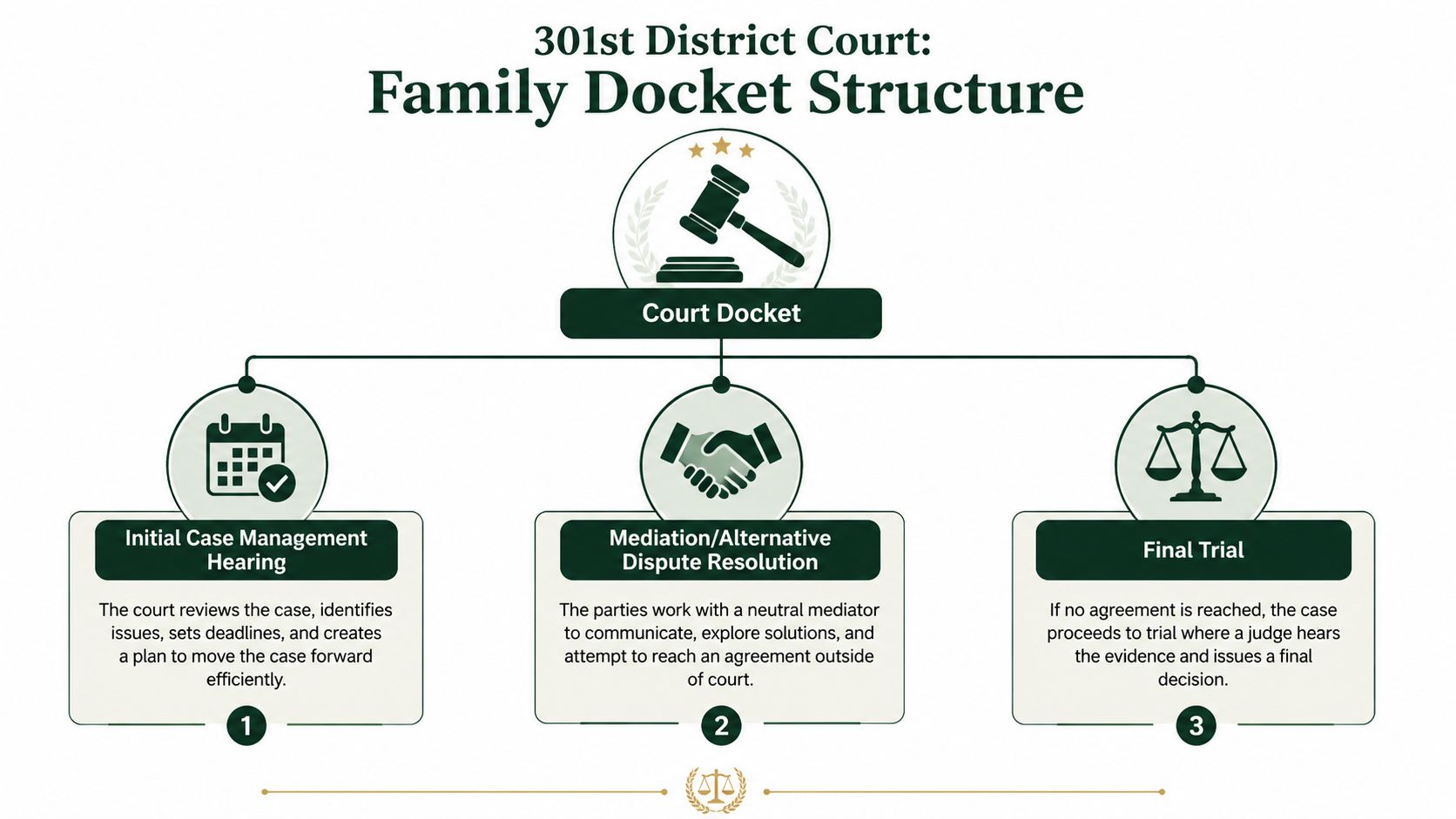
A parent asking for temporary custody orders is usually fighting for immediate stability, not a final answer. A spouse in a final trial is usually facing broader issues like property division, conservatorship, and child support. A party returning on enforcement, contempt, or discovery disputes is dealing with a different layer of procedure again. The court's published structure reflects that reality.
Settlement in this court can still require another step. If the matter resolves, the case may move to an entry setting so the order can be signed later.
That point is important because a verbal agreement in the hallway is not the same thing as a signed order. In a Dallas divorce, custody modification, or enforcement case, the court may still need a later entry hearing to turn the deal into something enforceable. A client who understands that distinction is far less likely to leave court thinking the case is done when the paper isn't finished yet.
See our related discussion of the Dallas County 256th District Court family docket procedures for another example of how Dallas family courts separate temporary and final work.
Filing Deadlines and Exhibit Exchange Requirements
The 301st moves fast enough that waiting until the morning of the hearing is usually a bad plan. The court's published policies require exhibits to be emailed to the court reporter and all counsel or pro se parties no later than 2 business days before the hearing. The TexasLawHelp Dallas County family-court guide also reports an exhibit and witness-list exchange deadline of 5 p.m. the business day before the hearing, except CPS hearings. TexasLawHelp's Dallas County family court guide is useful because it reinforces how seriously the local courts treat pre-hearing preparation.
What that means in practice
If you're bringing photos, text messages, school records, pay stubs, bank records, or protective-order exhibits, you need to get organized early. In contested family cases, the issue is rarely whether the evidence feels important to you. The issue is whether it got exchanged on time and whether the court can rely on it without a last-minute scramble.
The 301st also makes the continuance issue very clear. No continuance or pass will be granted without obtaining a new date from the court. That means you should not assume a reset will happen automatically because someone is unavailable, because you're still gathering records, or because the other side hinted they might agree later. If the case stays on the docket, the hearing can still go forward.
Key preparation points usually include:
- Email exhibits early: Send them to the court reporter and the other side within the deadline the court requires.
- Exchange witness lists: Don't wait until the hearing day to reveal who will testify.
- Confirm the setting: Make sure the hearing date and time match the docket entry.
- Check the proof of service: If notice is defective, the court may still expect the matter to proceed unless it has been properly reset.
Missing the exhibit deadline doesn't just create inconvenience. It can leave you trying to prove a custody, support, or enforcement issue without the documents that actually support your position.
That risk is especially real for self-represented parties, because a family case can move from “we're still talking” to “the hearing is happening” much faster than expected. The 301st's administrative rules are built around the idea that the courtroom schedule is firm, and the parties are expected to adapt to it.
See our related Dallas court guide on the Dallas County 255th District Court family docket procedures for another look at local preparation expectations.
Continuances and Common Mistakes to Avoid
A lot of people think a continuance is something they can ask for at the last minute if the day goes badly. In the 301st, that assumption can cost you. The court's policy says no case will be withdrawn from the docket without the specific agreement of both sides communicated to the court before the hearing or trial begins, and it also says continuances are not granted without obtaining a new date from the court.
The mistakes that cause the most trouble
The most common error is treating a hearing date like a soft deadline. A parent may believe that because the other side is “okay with resetting,” the court will automatically take the case off the docket. That's not how this court's procedure works. If the court has not approved the reset and the matter is still on calendar, you need to prepare as though the hearing is happening.
Another common mistake is failing to coordinate on the record. If both sides intend to withdraw or reset a matter, the court expects that agreement to be communicated before the hearing begins. If that communication doesn't happen, the case may remain set. That can create immediate pressure in a custody, enforcement, or temporary orders dispute where witnesses, exhibits, and travel plans were built around the original date.
A third mistake is missing the pre-hearing exchange and then hoping the court will forgive the omission. That's risky in any family court, and especially risky in a court that publishes firm administrative deadlines. If evidence is late, the court may still proceed, and the missing material may become a real problem instead of a minor inconvenience.
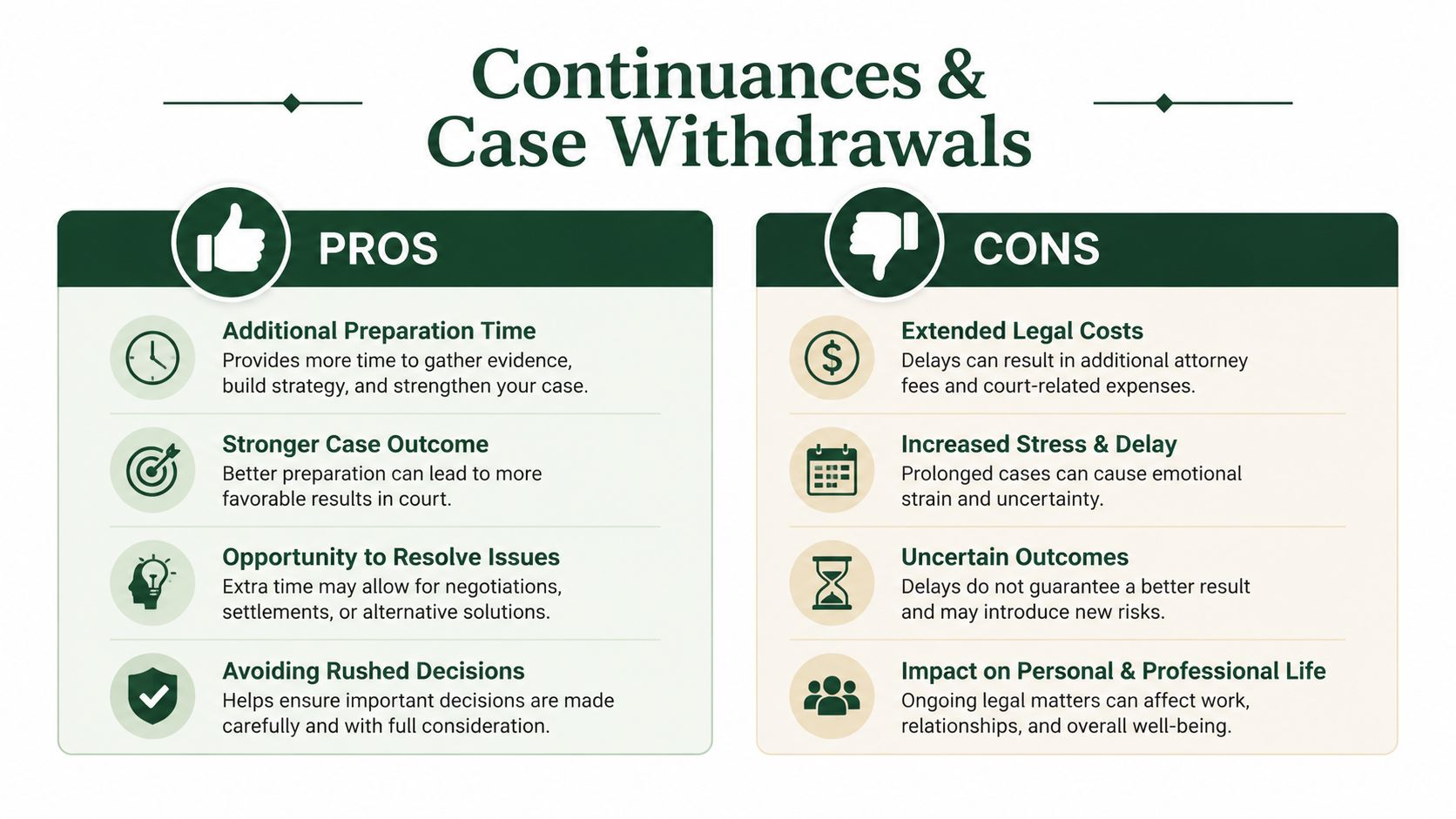
Practical rule: if your hearing is set in the 301st, assume the court expects the case to go forward unless you've gotten a new date directly from the court.
That approach may feel strict, but it's predictable. Predictability helps people who prepare and hurts people who rely on informal conversations. In family cases, that difference can affect temporary possession schedules, protective orders, and even whether a motion gets heard at all.
Courtroom Etiquette and What Happens After Settlement
The 301st is not a place where casual behavior helps your case. Be early, dress conservatively, and keep your paperwork organized by issue. If you're represented, make sure your lawyer knows the filing history, the current order, and any deadlines that were already set by the court. If you're on your own, be ready to answer the court's questions clearly and briefly.
Once a settlement is announced or rendered, the court places the matter on an entry docket under Local Rule 8.02 so the order can be signed later if needed. That step matters because family cases often resolve in principle before they become enforceable on paper. A spouse may think the agreement ended the fight, but the court still needs the signed order to make the settlement real in practice.
What happens after the hearing
The initial hearing is best treated as a scheduling control point, not just a merits hearing. If the case resolves, the court still uses the follow-up entry setting to turn the agreement into a final order. That protects both sides from the problem of an agreement that was discussed but never reduced to something enforceable.
For parents, that can mean a custody agreement still needs later review so the order accurately reflects conservatorship, possession, child support, exchange times, and any special terms. For divorcing spouses, it can mean the final decree still needs clean drafting to reflect property division, retirement accounts, reimbursement claims, or other implementation details. The settlement may be real, but the paperwork still has to be done.
A good courtroom habit is simple: don't leave until you know what the next date, next filing step, or next signature requirement is. That habit keeps people from assuming the case is closed when the court expects one more appearance or one more order.
Where to Find Local Rules and Get Help in Dallas County
The most useful place to start is the court's own public material. The 301st Family District Court publishes its policies and docket information online, and Dallas County also provides public docket access and livestream viewing for the family district courts. The court's docket page is especially helpful if you need to confirm the party name, floor or court, time, and case number before heading downtown. The 301st docket information page is the best starting point for current settings.
If you need a physical courthouse reference point, the George L. Allen, Sr. Courts Building is where many Dallas County family-law appearances begin. You may also need the Dallas County District Clerk for filings and the court's own coordinator or clerk for setting questions. People who are handling divorce, custody, child support, modification, enforcement, protective orders, paternity, or adoption often end up checking several sources because the local procedure is layered.
When legal help is worth it
A Dallas family-law attorney makes the most sense when the case is not simple, especially in high-asset divorce, business ownership, retirement assets, separate property tracing, relocation disputes, custody modifications, enforcement, or CPS-related matters. Those cases usually involve more than getting a date on the calendar. They involve evidence, order language, implementation, and the practical consequences of missing a local deadline.
If you're trying to understand whether your case is in the right court, whether a continuance can still be requested, or whether your exhibits are ready on time, you should speak with a Dallas family law attorney before the setting, not after it. That's especially true in the 301st, where the published rules make timing and coordination central to how a case moves.
If you need help preparing for a hearing in the 301st or figuring out what the court expects next, The Law Office of Bryan Fagan, PLLC works with Dallas families on divorce, custody, support, enforcement, and complex property issues. Visit The Law Office of Bryan Fagan, PLLC to review Dallas family-law resources and connect with a team that can help you prepare for the next step in your case.
