

You've just received notice that your divorce, custody, child support, or modification case has been assigned to the 255th District Court in Dallas County. Your first questions are usually practical: Where do you go? Who schedules the hearing? Will you appear before the district judge or the associate judge? What happens if your case isn't reached?
The answer depends on the type of family-law matter involved. The 255th uses a structured weekly docket and a two-tier scheduling process. Understanding that structure can help you avoid a missed setting, bring the right materials, and recognize whether your matter belongs on the judge's docket or in the associate judge's hearing lane.
Table of Contents
- Understanding Your Case Assignment to the 255th District Court
- Weekly Docket Schedule and Hearing Types
- How Hearings Are Scheduled and Routed
- What Happens at Temporary Orders Trials and Prove-Ups
- Common Procedural Mistakes to Avoid
- Preparing for Your Court Date and Next Steps
Understanding Your Case Assignment to the 255th District Court
The 255th District Court is one of seven Dallas County family district courts that receive family-law filings through random assignment under Dallas County local rules. The other courts are the 301st, 302nd, 303rd, 330th, 254th, and 256th District Courts. The county's assignment rule covers divorce, SAPCR cases, paternity, conservatorship, possession and access, child support, enforcement, protective orders, and related attorney-fee matters. You can review the Dallas County random-assignment rule for family courts for the governing framework.
Random assignment means a new case isn't placed in a particular court because one party prefers that judge. The system distributes new family cases across the county's family-court structure, which has operated under Dallas County's local family-court rules for decades. Your assignment therefore determines the court that initially receives the case and the local docket procedures that will affect scheduling.
What the assignment means for your case
The 255th can handle a broad range of family matters, including:
- Divorce and property disputes: This includes contested and uncontested divorces, separate-property claims, business ownership issues, retirement assets, real estate, and reimbursement claims.
- Child-related cases: Conservatorship, possession and access, relocation, paternity, child support, and modifications may fall within the court's family-law jurisdiction.
- Post-judgment matters: Enforcement proceedings, contempt matters, protective orders, and other requests involving an existing order may be routed through the court's published procedures.
- Related financial issues: Attorney-fee requests and other matters connected to a family case may also be handled within the family-district-court system.
Being assigned to the 255th doesn't determine the result. Texas law applies across the Dallas County family courts, although each court can organize its docket and publish procedures differently. The practical difference is often case management, including which day a matter is heard, whether the associate judge handles it, and how lawyers request a setting.
Practical rule: Court assignment affects procedure and scheduling, not a guaranteed outcome. Prepare for the specific court's published workflow while presenting the facts and legal issues that control your case.
Where you'll find court information
The 255th's public docket information is organized by case party names, court and floor, time, and case number. That format helps attorneys and self-represented litigants identify the daily schedule, but you should still verify your specific setting before appearing.
The court's published docket materials provide more useful information than a generic courthouse search. They show that the 255th manages family cases through fixed hearing windows rather than treating every request as an informal, open-ended appointment. For a comparison with another Dallas County family court, review the guide to Dallas County 254th District Court family docket procedures. The comparison can help you see why the assigned court's own procedures matter.
Weekly Docket Schedule and Hearing Types
The 255th's published procedures divide the week by hearing type. Monday is used for enforcement and contempt at 9:00 a.m., with a motion docket at 1:00 p.m. Tuesday and Wednesday have trial dockets at 9:00 a.m., followed by motion dockets at 1:00 p.m. or as time permits. Thursday includes a trial docket at 9:00 a.m. and a motion docket at 1:00 p.m. Friday includes a morning dismissal docket and prove-ups at 9:00 a.m. The court's posted policies also state that dismissal dockets are held Friday mornings at 9:30 a.m. The court's published procedures should control your preparation for a particular setting.
| Day | Hearing Type | Purpose | Typical Duration |
|---|---|---|---|
| Monday | Enforcement and contempt, motion docket | Address alleged violations of orders and other motions | Depends on the setting and court availability |
| Tuesday | Trial docket, motion docket | Manage trials and hear motions | Depends on the matter |
| Wednesday | Trial docket, motion docket | Manage trials and hear motions | Depends on the matter |
| Thursday | Trial docket, motion docket | Manage trials and hear motions | Depends on the matter |
| Friday | Dismissal docket and prove-ups | Address dismissal settings and uncontested prove-ups | Depends on the matter |
The published schedule identifies docket windows, not a guaranteed amount of time for every individual case. A motion hearing may involve legal argument and limited evidence. A temporary orders hearing can involve testimony and exhibits concerning interim custody, possession, support, exclusive use of a residence, or payment of expenses. A final trial addresses the evidence needed for final relief, such as a final divorce decree, conservatorship orders, property division, or a modification.
What the common settings mean
A trial docket may be a time for the court to manage cases set for trial, confirm readiness, or reach a contested matter if the court has sufficient time. A final trial can be a bench trial or, where properly requested and available under the governing rules, a jury setting. A prove-up is generally used for an uncontested matter, such as an agreed divorce, where a party gives testimony establishing the facts needed for the court to approve the requested relief.
An enforcement or contempt docket concerns alleged violations of an existing order. The evidence and requested remedy matter greatly. A party seeking enforcement may need to identify the order, the obligation, the alleged violation, and the relief requested. A party responding should review the wording of the order and prepare any defenses or explanations.
The court also uses a dismissal docket as a case-management milestone. The published procedures state that within one week of an original filing or reopening filing, all cases are set on the dismissal docket. That setting doesn't necessarily mean your case will be dismissed immediately, but it does mean you must understand what the court expects before the dismissal setting.
If your case isn't reached, don't assume the setting disappeared or that you can return whenever convenient. Ask the coordinator or the assigned judicial office what happened, confirm any reset, and obtain the new setting in a form you can verify. The Dallas County family docket resource can also help you locate related docket information and procedural guidance.
How Hearings Are Scheduled and Routed
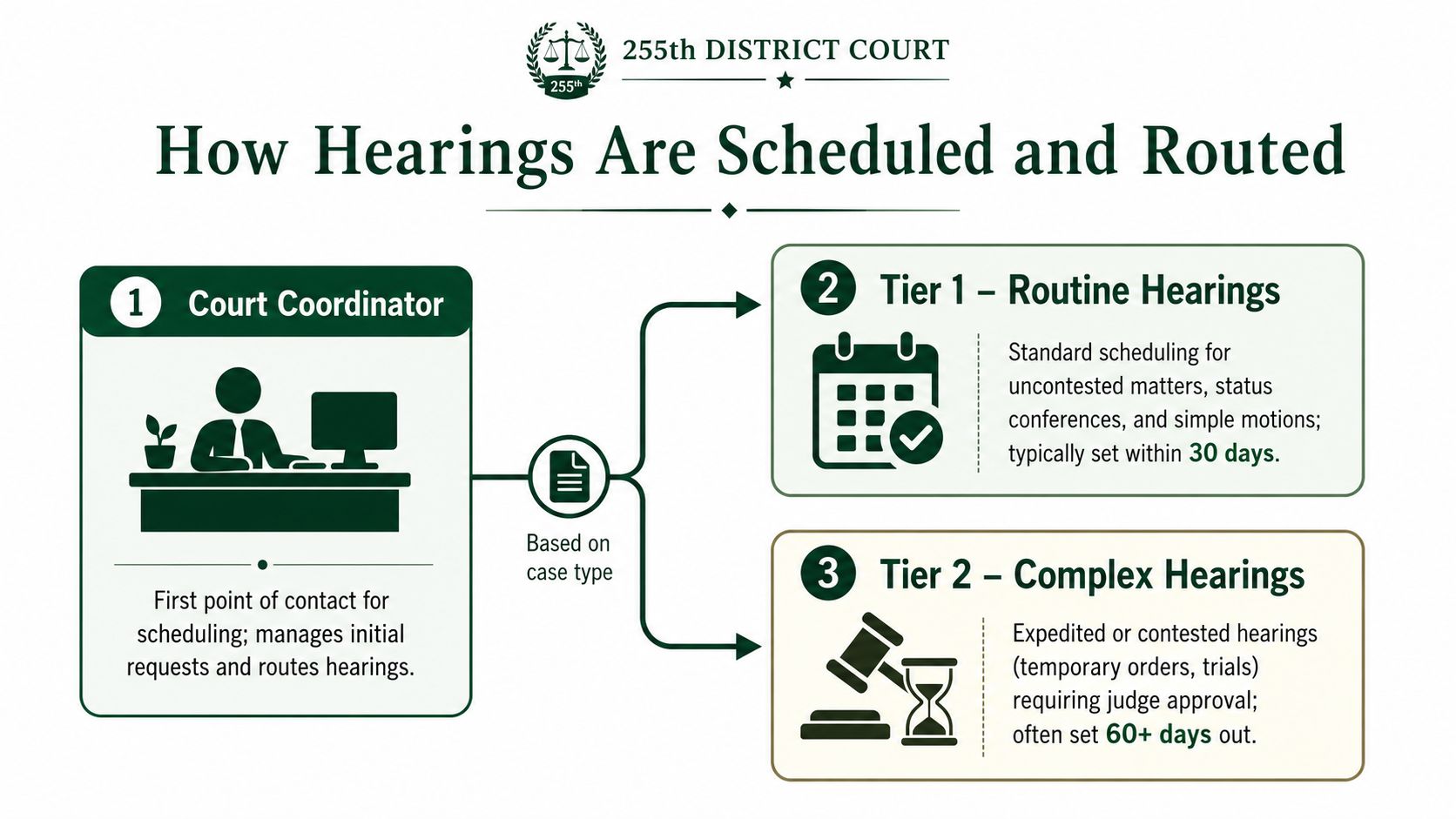
The 255th uses a two-tier scheduling workflow. Most settings on the district judge's docket are obtained by emailing the court coordinator. Final trials are different. They aren't placed by email because the published policies state that the associate judge resets final trials at the pretrial conference.
That distinction matters. Sending a request to the wrong office can delay the setting, create confusion about whether a hearing is confirmed, or place a matter on a docket that isn't designed for it.
The district judge's scheduling lane
Start by identifying the relief you need and the judicial officer assigned to that type of hearing. For a routine motion or a setting on the judge's docket, the coordinator is generally the first contact. A useful scheduling request should identify the case number, parties, motion or matter, estimated hearing time, requested dates, and whether opposing counsel has been consulted about availability.
Don't treat an email as a confirmed setting unless the court confirms it. Keep the confirmation with your case file, and check whether the court requires a proposed order, filed motion, notice, certificate of conference, exhibits, or other materials before the hearing can proceed.
The associate judge's hearing lane
The published policies assign the associate judge a separate lane for temporary hearings, TROs, final protective orders, final modification hearings involving child support and possession but excluding custody, writs of attachment and habeas corpus, discovery disputes, post-judgment matters other than contempt, prove-ups, 8.02 order-entry hearings, pretrial and appeal conferences, and dismissal hearings.
That list creates practical routing questions. A temporary hearing involving custody may require careful coordination because the type of requested relief can affect which judicial officer handles it. A discovery dispute, post-judgment motion, or prove-up shouldn't be scheduled as if it were an ordinary district-judge motion. Before requesting a date, read the current published procedures and confirm the appropriate office.
The available materials don't establish a universal lead-time rule for every setting. Don't rely on an assumed time period, such as a fixed number of days, without checking the current order, notice requirements, and the nature of your hearing. Your filing, service, conferral, proposed order, and exhibit obligations may differ depending on whether the matter is contested, expedited, or referred to the associate judge.
What Happens at Temporary Orders Trials and Prove-Ups
A parent asks for temporary custody, child support, and a possession schedule. A spouse requests exclusive use of the marital residence while the divorce is pending. Another couple has reached an agreement and needs the court to approve an uncontested divorce. These matters may look different, but each requires preparation specific to the type of setting.
A temporary orders hearing
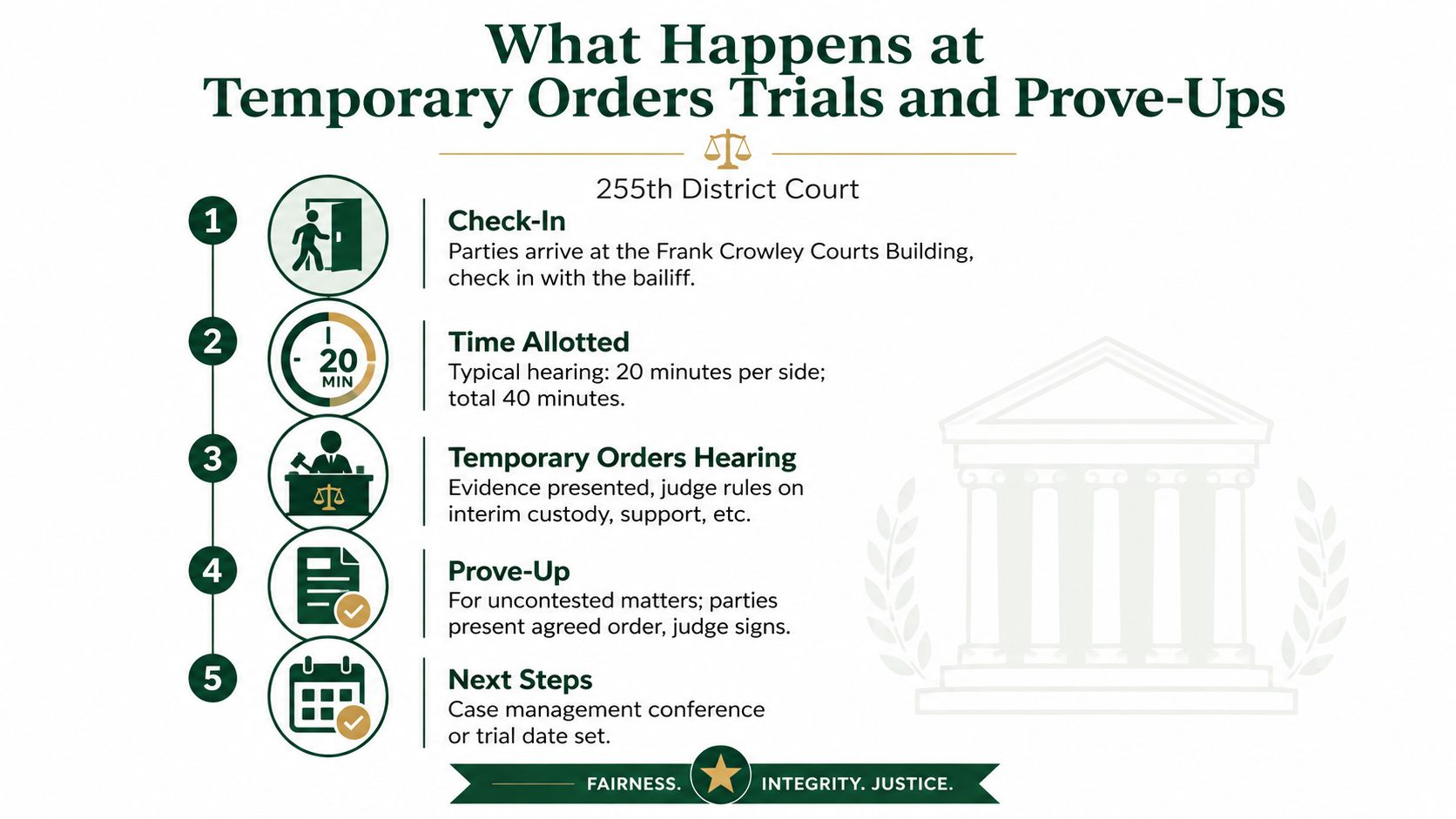
On the hearing date, parties typically check in according to the court's instructions and wait for the case to be called. The judge or associate judge may hear testimony, review exhibits, listen to legal argument, and issue temporary relief. Temporary orders aren't the final resolution of the divorce or custody case. They establish rules while the case continues.
A parent seeking temporary conservatorship should be ready to explain the requested arrangement and support it with admissible evidence. A spouse requesting exclusive use of the home should be prepared to address the practical need for that relief, along with financial and household concerns. Child support requests require accurate financial information and a clear explanation of the requested order.
The court may rule from the bench or take the matter under advisement. Taking a matter under advisement means the court hasn't ruled yet and will consider the evidence and arguments before issuing a decision. You should ask how and when the ruling will be delivered and how proposed orders should be submitted. Don't leave assuming that silence means you won.
Trials and prove-ups
A final trial is different from a temporary orders hearing because the court is deciding permanent relief. The issues may include the final divorce, conservatorship, possession, child support, property division, separate-property claims, business interests, retirement accounts, and other disputed matters. Financially complex cases often require organized records, tracing evidence, valuation information, and testimony that connects the documents to the legal claims.
An uncontested prove-up is more efficient, but it still requires accurate testimony. In a hypothetical agreed divorce, one attorney may ask the filing spouse questions about residency, the marriage, children, property, debts, and the agreement. The judge then decides whether the evidence supports signing the proposed order. An agreement can reduce conflict, but it doesn't eliminate the need to prepare the paperwork correctly.
The court expects parties to exchange exhibits and witness information well before the hearing date when the applicable procedures require it. Waiting until the morning of court to organize documents can make even an agreed or focused matter harder to present.
Common Procedural Mistakes to Avoid
A large share of avoidable courtroom problems starts before the hearing. The 255th's published procedures divide responsibilities between the district judge and associate judge, so a filing strategy that works for one setting may be wrong for another.
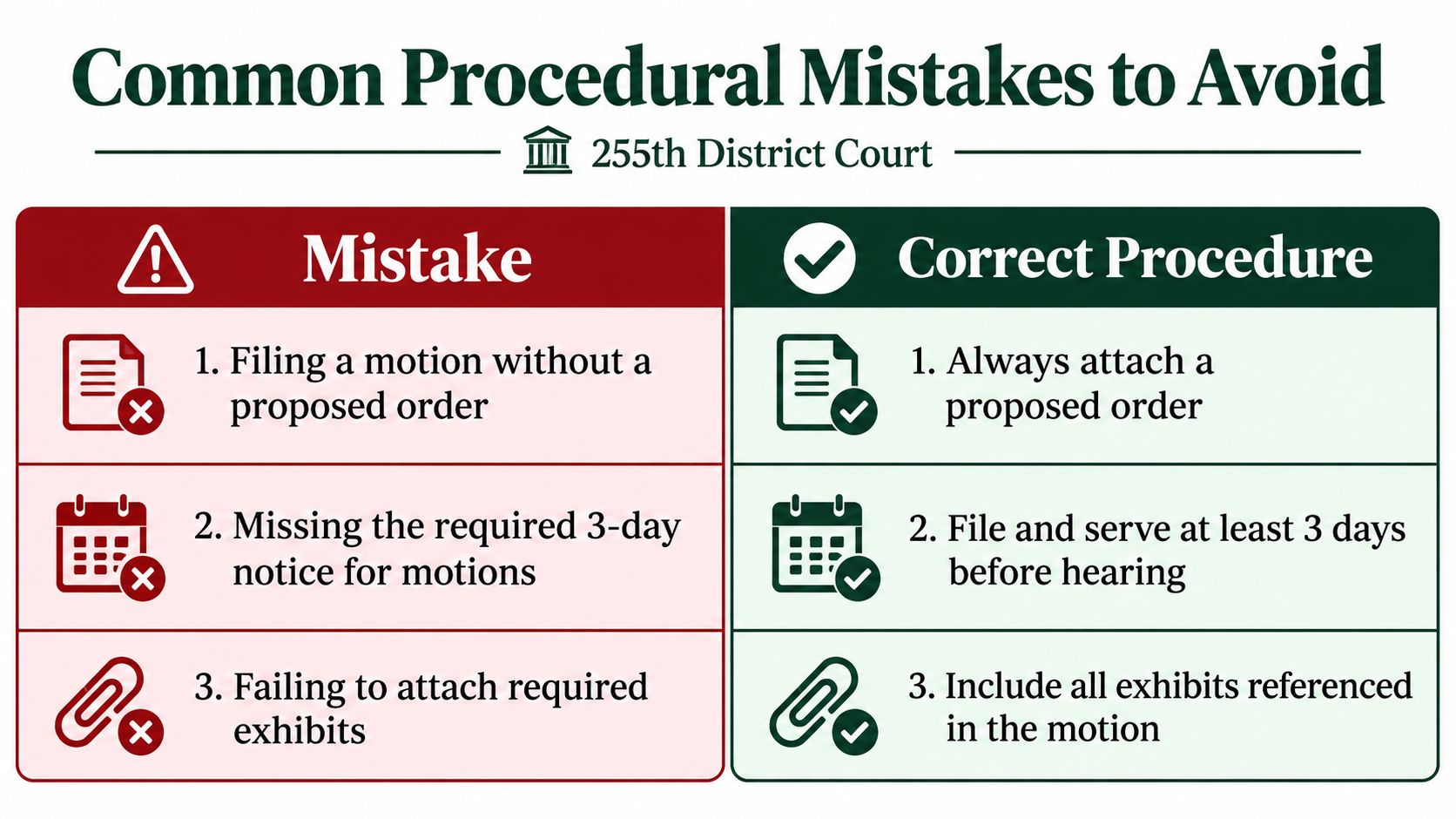
Compare the mistake with the better approach
| Common mistake | Better approach |
|---|---|
| Filing a motion without the supporting materials the court requires | Review the applicable procedures and prepare the proposed order, exhibits, and other required documents before requesting a setting |
| Requesting a hearing without consulting opposing counsel | Confer about available dates and preserve a record of the communication |
| Treating a coordinator email as final confirmation | Wait for court confirmation and keep the confirmed setting with the case file |
| Sending exhibits for the first time at the courthouse | Exchange and organize exhibits in advance under the applicable procedure |
| Using the district judge's scheduling path for an associate-judge matter | Identify the assigned hearing lane before contacting a scheduling office |
| Appearing without proof of service or a filed return | Confirm that citation, service, waiver, or other authorized notice is complete and reflected in the record |
A proposed order deserves special attention. The correct document depends on the hearing and the relief requested. A proposed order for temporary support won't serve the same purpose as an agreed final decree or an order addressing discovery. Use the court's current procedures and the facts of your case, rather than recycling an old form.
Service problems can also stop a hearing from moving forward. A party may have filed a motion but still lack proper notice to the other side. In another situation, service may have occurred but the return hasn't been filed or isn't sufficient to show what happened. Those defects can lead to a reset, a refusal to reach the merits, or other consequences authorized by applicable law.
Before court: Confirm the hearing type, judicial officer, notice, service, filed documents, exhibits, proposed order, and setting. If one of those pieces is uncertain, resolve it before traveling to the courthouse.
Don't assume that a status or dismissal setting is harmless. The court may require an announcement about readiness, a plan for moving the case forward, or compliance with a prior directive. If you're self-represented, consider obtaining legal advice before the hearing so you understand what the court can decide and what relief you can properly request.
Preparing for Your Court Date and Next Steps
The week before a 255th hearing, preparation should become concrete. Verify the setting, identify the hearing lane, review the applicable court procedures, and reduce your position to the specific relief you want the court to grant.
The infographic below summarizes the basic courthouse and document checklist.

A practical preparation checklist
- Verify the courthouse: Confirm whether your setting is at the Frank Crowley Courts Building, and check the current court information for the correct courtroom and floor. The infographic identifies the building at 133 N. Riverfront Blvd, Dallas, but courthouse information can change, so verify before leaving.
- Confirm the setting: Contact the appropriate court office or coordinator and preserve the confirmation. Make sure the case number, date, time, and hearing type match your notice.
- Review the procedures: Read the current 255th policies, local rules, and any standing order that applies to your case. The court's published materials explain the weekly docket and the distinction between judge and associate-judge settings.
- Organize exhibits: Label documents clearly, arrange them in a logical order, and bring copies required by the court and the parties. Include the proposed order in the materials you plan to use.
- Prepare your testimony: Write a short outline of the facts that support your request. Separate what you personally know from what someone else told you, and bring records that support important statements.
- Plan for security and delay: Allow time for security screening, parking, finding the courtroom, and checking in with the bailiff. Docket calls can take longer than expected, so arrange work, transportation, childcare, and medication needs accordingly.
- Follow courtroom etiquette: Dress professionally, silence your phone, stand when required, address the judge respectfully, and wait until the court recognizes you before speaking.
What to do after the hearing
Find out whether the court ruled from the bench, took the matter under advisement, or directed a party to prepare an order. Obtain a signed copy and review it carefully. A verbal understanding in the hallway isn't a substitute for a written order that states the parties' rights and obligations.
If the ruling may be appealable, ask a qualified attorney about the applicable appellate deadlines immediately. Family-law appeals can involve strict procedural requirements, and the Fifth Court of Appeals may have jurisdiction over an appeal from a Dallas County court depending on the order and posture of the case.
For certified copies, filing questions, and record matters, contact the Dallas County District Clerk through its current official channels. Self-represented parties should also look for Dallas County self-help resources, but those resources generally can't provide the individualized strategy, evidence assessment, or courtroom representation that a contested divorce, custody case, enforcement action, protective order, CPS matter, or high-asset property dispute may require.
For broader guidance on divorce, custody, support, adoption, enforcement, and related issues, review the Dallas family law services available through the firm. A case involving a closely held business, professional practice, investment property, retirement assets, stock compensation, or disputed separate property deserves early financial and legal organization, not last-minute document gathering.
The Law Office of Bryan Fagan, PLLC offers Dallas family-law assistance with divorce, custody, child support, temporary orders, enforcement, protective orders, modifications, and complex property matters that may proceed in the 255th District Court. Visit The Law Office of Bryan Fagan, PLLC to review available resources and request a consultation about your hearing, filing, or next procedural step.