 Skip to content

If your case has landed in the Dallas County 256th District Court, or you've just been served and the paperwork says that court name at the top, the first thing to understand is simple, the docket controls the pace. In family court, the calendar is not background noise. It's the system that decides when temporary orders get heard, when a divorce can be finalized, and whether a parent gets a chance to speak at all.
That is especially true in the George L. Allen, Sr. Courts Building at 600 Commerce Street, 4th Floor New Tower, Dallas, TX 75202, where the 256th operates as one of Dallas County's family district courts and uses a formal calendar-based process rather than casual walk-in scheduling (Dallas County's 256th District Court page). If you're trying to figure out what happens next in a divorce, custody case, support dispute, enforcement action, or emergency motion, the answer usually starts with one question, what docket is your matter on?
Table of Contents
- What the 256th District Court Family Docket Does
- Which Family Cases Belong on This Court's Docket
- How a Case Gets on the 256th's Docket
- Common Hearing Types the Court Handles
- Docket Calls, Pre-Trials, and Continuances
- A Hypothetical Dallas Family Case Step by Step
- Remote Hearings, Exhibits, and Common Mistakes
- Practical Next Steps for Dallas County Families
What the 256th District Court Family Docket Does
A case can be filed, but nothing moves until it is placed on the 256th's working calendar. That calendar tells everyone who must appear, what kind of hearing is set, and which matters the judge or associate judge will take up that day. In a Dallas family case, the docket works like the court's traffic signal. It controls when a matter stops, when it goes forward, and whether the parties need to be ready with papers, witnesses, or an agreement.
The docket is different from the case file. The file holds the petition, answers, motions, orders, and exhibits. The docket tells you when those papers are considered and by whom. The court's posted schedule is organized by case number, party name, courtroom or floor, and time, so counsel and self-represented parties can tell where the matter belongs (Dallas County 256th District Court page).
If a setting is not on the calendar, it is usually not being heard that day.
That is why the docket matters so much in family law. A divorce may move from filing to temporary orders, then to a pre-trial setting, then to final prove-up. A SAPCR may begin with custody requests and later bring in support, possession, enforcement, or modification issues. Each step has to be placed in the right slot, and that is what the docket does.
For families who want help understanding how those settings fit together, the firm's Dallas family law practice area gives a useful overview.
Which Family Cases Belong on This Court's Docket
A family case does not reach the 256th by accident. Dallas County uses random assignment rules for qualifying matters, and that assignment decides where the case starts, which docket it joins, and which courtroom procedures control the path forward.
What kinds of disputes show up here
The 256th handles the family-law disputes Dallas residents file most often. Those cases include divorce, SAPCR, child support disputes, possession and access issues, paternity questions, enforcement motions, modifications, and other Family Code matters that grow out of earlier orders. Once the case is assigned, the court's process determines whether a request goes before the presiding judge, the associate judge, or a separate setting such as a pro se conference.
The court's split-calendar setup matters in practice. Judge Sandre Streete handles trial settings and dispositive matters, while Associate Judge Moore hears temporary hearings, TROs, non-custody final modification hearings by agreement, writs of attachment and habeas corpus, discovery disputes, and motions for withdrawal (256th procedures and policies). If a request belongs on the wrong track, it usually does not speed anything up. It creates delay.
For a parent who files a custody case, the difference shows up fast. A motion for temporary possession may be set on one docket, while a later trial issue stays with the presiding judge. Filing the right request is only half the job. It also has to reach the right courtroom calendar.
The 256th's public materials help show how that assignment works day to day, including the court's general structure and scheduling approach (Dallas County 256th District Court page).
A parent does not need to guess, but the court does expect precision. If a hearing request is routed to the wrong docket, the court may wait until it is properly set.
Bottom line: the 256th is a specialized family docket with split responsibilities, and the route matters as much as the request.
If you want to compare that workflow with another Dallas County family court, this related guide on the Dallas County 255th District Court family docket procedures can help you see how the county's family courts are organized.
How a Case Gets on the 256th's Docket
A case does not land on the 256th's calendar the moment someone files it. Filing starts the process, but the case still has to be opened, assigned, served, and matched to the right hearing track before anyone walks into court.
From filing to assignment
The first step is the original petition, filed with the Dallas County District Clerk in person or through the county's e-filing system at the George L. Allen, Sr. Courts Building. Once the clerk accepts it, the case gets a cause number and is randomly assigned under Dallas County's family-court rules. Fees must be paid or waived, and service on the respondent has to be completed or waived before the case can move cleanly into later settings.
The countywide standing order applies automatically to every divorce and every SAPCR filed in Dallas County. The Dallas County family-courts page shows the revised standing-order PDF was updated in FY2026, with a March 11, 2026 posting date and a later August 20, 2026 update on the county family-courts page (Dallas County family-courts page). That order governs early conduct, so parents should read it before they make informal promises about children, property, or contact.
Where the hearing request actually goes
The 256th does not treat every request the same way. A setting for Judge Streete's docket must be scheduled by emailing the court, while separate matters are handled by the associate judge or through clerk contact. The court's published procedures explain that routing difference in detail (256th procedures and policies).
That split matters because a temporary orders request, a discovery dispute, and a motion for withdrawal do not belong on the same calendar. If the request goes to the wrong place, it may sit until it is properly set. For a side-by-side comparison with another Dallas County family court, the Dallas County 254th District Court family docket procedures page shows how another court organizes its settings.
The court also expects hearing materials for Judge Streete to be emailed by noon the day before the hearing. That means the file needs to be ready before the setting, not after a problem comes up. In practical terms, the 256th wants the request, the route, and the paperwork lined up before the hearing date arrives.
Common Hearing Types the Court Handles
A family case can land on the 256th's docket for different reasons, and the hearing type usually tells you what the court is trying to decide. Some settings are about short-term stability. Others are about finishing the case, enforcing an order, or handling an urgent problem that cannot wait.
Temporary orders, finals, enforcement, and emergencies
Temporary orders hearings deal with the day-to-day issues that need a ruling while the main case is still open, such as possession, child support, exclusive use of the home, or protective orders. Those requests usually move through the court's split calendar, so the filing has to be routed correctly before anyone expects a hearing date.
Final hearings work differently. A contested divorce or SAPCR may go through docket call and pre-trial before it reaches trial, while an agreed matter, including some default divorces, is often handled on a prove-up docket instead of being signed right away. Enforcement and contempt come later, after there is already an order in place and one side says the other has not followed it. Emergency requests, such as TROs, writs of attachment, or habeas corpus matters, need careful scheduling because the court treats them as immediate relief and sends them to the proper judicial track.
The court's split docket structure matters in practice. If a request belongs with Judge Streete, it has to be emailed and set through that track. If it belongs elsewhere, it should go through the associate judge or the proper clerk process. That is the same kind of routing problem you can see in other Dallas County family courts, including the Dallas County 254th District Court family docket procedures page, which shows how another court organizes its settings.
| Hearing Type | Typical Motion | Heard By | How Set |
|---|---|---|---|
| Temporary orders | Possession, child support, TROs | Often Associate Judge Moore for temporary matters | Scheduled through the correct court contact and hearing process |
| Final trial setting | Contested divorce or SAPCR | Judge Streete | Trial settings arise through pre-trial and docket procedures |
| Enforcement or contempt | Motion to enforce prior order | Court track depends on setting | Routed through the proper docket and noticed for hearing |
| Emergency relief | TRO, habeas corpus, writ of attachment | As assigned under court procedures | Requires prompt scheduling and correct submission route |
| Agreed final modification | Non-custody agreed modification | Associate Judge Moore | Set on the associate judge's calendar when appropriate |
If a case already has an order, the court expects the hearing request to match the problem. Child custody, support, and enforcement issues usually need the right packet and the right route, not just a general request for a hearing. That is where many self-represented parties get stalled.
Docket Calls, Pre-Trials, and Continuances
A family case can stall even when the law is strong if the lawyer or party is not ready for the court's calendar step. In the 256th, that usually means docket call or pre-trial.
Why docket call matters
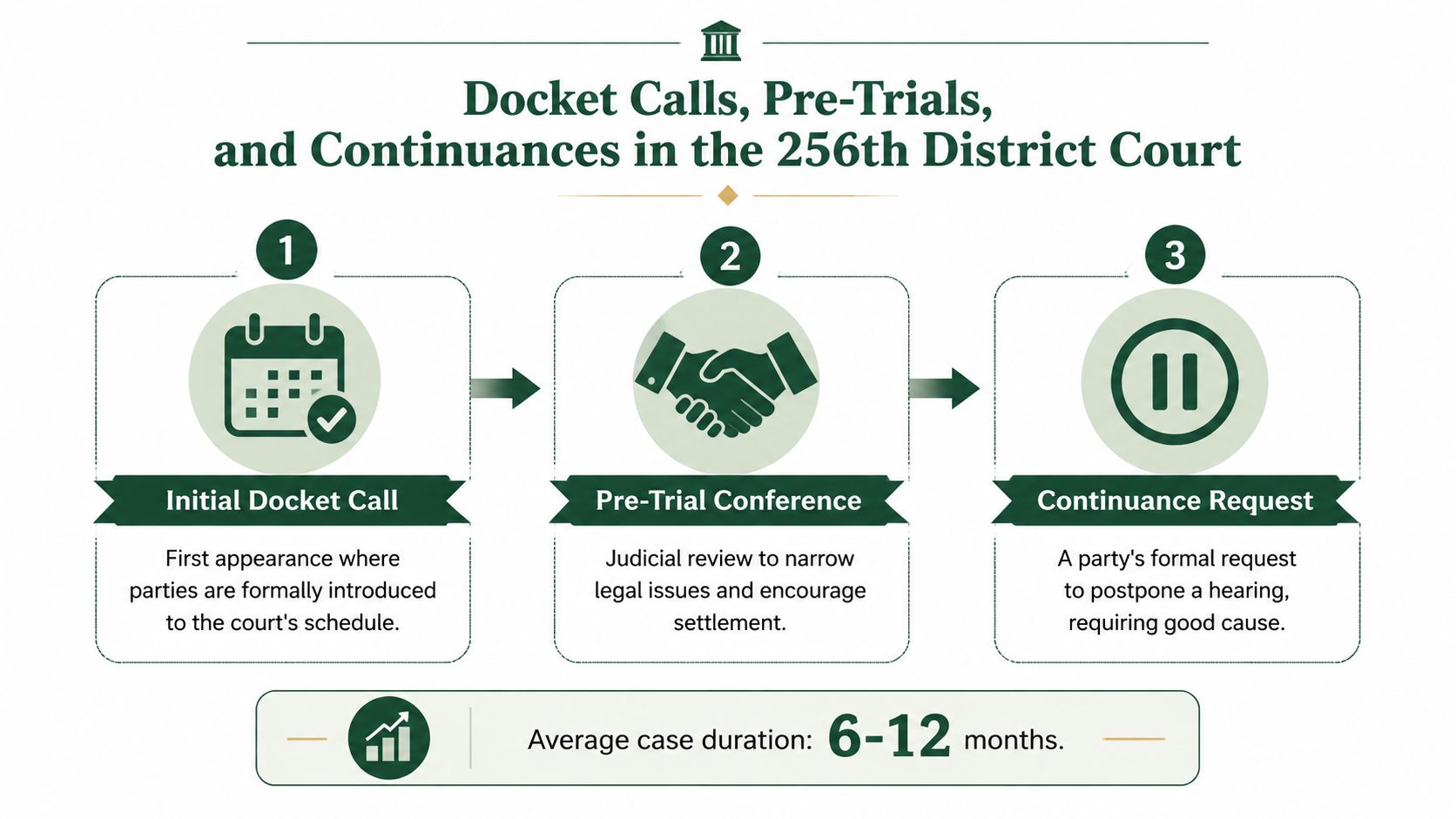
Dallas County local family-court rules treat docket call as the trial-setting checkpoint for contested final hearings. Parties and counsel must appear and announce ready unless they already received a specific trial date at pre-trial (Dallas County local rules, Rule 701). In practical terms, the court is asking a simple question, is this case ready to be tried?
Pre-trial serves a different job. It gives the court and the lawyers a chance to narrow disputes, discuss settlement, confirm witnesses, and identify what still has to be resolved before trial. That is where the case plan gets sorted out.
Practical rule: if you are not ready to announce ready, you need a real reason and a proper motion, not a hallway explanation.
Continuances and discovery disputes
A continuance request has to follow the Dallas County Local Rules and be filed in writing on the proper motion form, with good cause and a certificate of conference where required. Discovery disputes usually belong in motions to compel, and sanctions can be on the table if a party ignores discovery obligations. Waiting until the hearing to raise document problems or witness problems usually creates avoidable trouble.
The 256th also expects exhibit packets to be emailed to the court coordinator by noon the business day before each hearing under the standing order and court procedures. If the packet is not there, the court may pass the matter or reset it.
If you are appearing without a lawyer, the 256th pro se checklist is the best guide for what the court expects before a setting. It lays out the filing and conference steps that keep a case from getting delayed on a technical miss.
A Hypothetical Dallas Family Case Step by Step
A North Dallas parent files a SAPCR because the other parent has stopped following the existing possession schedule. The petition is filed at the George L. Allen, Sr. Courts Building, the case is randomly assigned to the 256th, and the standing order applies at once. Service is completed on the other parent, so the case can move from filing to the court's first active settings.
How the calendar unfolds
The parent asks for a temporary orders hearing on conservatorship and child support. Because the 256th uses a split docket, that hearing goes to the correct judicial track, and it may be set by Zoom depending on the court's current procedure and the type of request. For a self-represented parent, the court's pro se checklist lays out the sequence: file the petition, complete service or obtain a waiver, prepare a final order draft and affidavit of testimony, then request a pro se conference.
The checklist also says the first pro se conference is held via Zoom every Thursday and the second Friday morning, with reset dates sometimes set in person. That matters because the conference is the court's readiness check. It is the judge or coordinator confirming that the file is in shape before anyone spends time on a final hearing.
After mediation, the parties exchange the paperwork needed for final hearing. If the case becomes uncontested, the parent appears briefly for a final prove-up, and the court can render the SAPCR order after reviewing the proposed decree and testimony. The District Clerk then keeps the certified copy, which becomes the working order for later enforcement or modification.
The final hearing is not a formality. It is the court's last check that the paperwork, service history, and hearing packet match the relief being requested.
The court also looks for the practical details that often trip people up. A missing order draft, an incomplete service file, or a hearing packet that does not match the requested relief can slow the case down just as much as a legal dispute can.
Remote Hearings, Exhibits, and Common Mistakes
A Zoom setting in the 256th still runs like court. The judge, coordinator, and parties are all working from the same docket information, so the hearing only goes smoothly if everyone uses the right meeting details and comes prepared. If the court sets the matter in person or in a hybrid format, the preparation changes in logistics, not in seriousness.
What to have ready before the call starts
For a remote appearance, have your photo ID, copies of any orders, a calculator if financial questions are involved, and child-related documents if the hearing concerns custody or support. Dress as if you are in court, because you are. Keep your camera on unless the court directs otherwise, and choose a quiet place where the judge can hear you clearly.
Exhibits are where many people get tripped up. The court expects PDFs to be emailed to the coordinator by noon the day before, and the packet needs to be organized so the judge can tell what is being offered and why. The court's 256th pro se checklist makes the same point in practical terms, a missing exhibit packet can lead to a reset or a passed hearing.
Mistakes that derail hearings
A few problems show up again and again in Dallas County family settings:
- Missing docket call: the court can treat that as a readiness problem.
- Announcing ready without being ready: if discovery is incomplete or exhibits are missing, the hearing can fall apart quickly.
- Ignoring standing-order requirements: parenting classes, financial disclosures, and related obligations still apply.
- Filing at the last minute: same-day motion practice rarely helps.
- Serving subpoenas incorrectly: if service is bad, the witness problem becomes your problem.
The 256th's checklist is the best guide for both Zoom and in-person appearances. Follow it closely, then confirm the hearing format before court day. That simple review helps avoid the kind of reset that wastes everyone's time.
Practical Next Steps for Dallas County Families
If your case is on the 256th's docket, start with the court's own materials. The 256th page, the standing order, and the pro se checklist are the most direct sources for local procedure, and the Dallas County District Clerk eFileTexas portal is where many filings and status checks begin. For self-help resources, the Dallas County Law Library at the George L. Allen building can be useful when you need forms, packet access, or a place to confirm the court's public resources.
Some matters are realistic for a self-represented litigant, especially an uncontested prove-up with compliant waivers or an agreed modification. Other matters are not good DIY candidates. Contested custody trials, complex property division, enforcement cases that could involve contempt, and any SAPCR with interstate issues under the UCCJEA deserve careful legal review.
A practical first move is to attend a docket call once before your own appearance if you can do so lawfully and without disrupting any active case. Watching the cadence of the courtroom makes the process less mysterious. Then calendar every deadline from the scheduling order, check whether mediation is required or ordered, and make sure any hearing packet is complete before the noon-before-hearing cutoff.
Procedures change, and local practices can shift with updated standing orders or court notices, so verify the current rules before relying on an older form or outdated calendar. If your case is contested, time-sensitive, or financially complicated, talk with a Dallas family-law attorney before the next setting so you know exactly what the court expects.
The Law Office of Bryan Fagan, PLLC helps Dallas and Dallas County families prepare for divorce, custody, support, enforcement, and final-hearing settings with practical guidance aligned to local court procedure. If you need help understanding the 256th's docket, organizing your hearing packet, or deciding what to do before your next court date, visit The Law Office of Bryan Fagan, PLLC to learn more about your options and next steps.
