 Skip to content

A Dallas County muniment of title is filed at the George L. Allen, Sr. Courts Building, 600 Commerce Street, 7th Floor, Dallas, TX 75202, with the County Clerk's Probate Courts Division. The division's listed filing hours are 8:00 a.m. to 4:30 p.m., Monday through Friday.
You may be trying to transfer a deceased parent's Dallas home into your name, refinance it, or prepare it for sale. The confusing part is that there are two separate filing steps. First, you file the probate application and original will with the Dallas County probate court. After the judge signs the order, you record certified copies in the property records for the county where the home is located. Filing in the courthouse starts the case, but recording the order is what helps perfect the title.
Table of Contents
- Filing a Dallas County Muniment of Title Starts at the George Allen Courts Building
- What a Muniment of Title Actually Does in Texas
- Documents You Need Before You File
- Step-by-Step Filing Procedure in Dallas County Probate Court
- Filing Fees, Court Costs, and the Post-Order Deadline
- Common Mistakes Dallas Families Make When Filing
- After the Order Recording Title and Getting Help
Filing a Dallas County Muniment of Title Starts at the George Allen Courts Building
Suppose an adult child in Lake Highlands inherits a parent's Lakewood home under a clean will, and the estate has no unpaid unsecured debts. The family may not need a full estate administration, but the child still needs court authority to establish the transfer. The correct starting point is the Dallas County Clerk's Probate Courts Division, not a general civil filing desk or the deed-records counter.
The probate courts are located at the George L. Allen, Sr. Courts Building, 600 Commerce Street, 7th Floor, Dallas, Texas 75202. Dallas County has three statutory probate courts, Probate Courts No. 1, No. 2, and No. 3, housed at that courthouse. The County Clerk's Probate Courts Division maintains the records and routes the application to the appropriate probate court. Dallas County identifies muniment of title as a Texas procedure used through probate to transfer ownership of Texas real estate. Dallas County Probate Courts information provides the courthouse and division details.
For filing questions, the county lists 214-653-7090 as the probate clerk contact line. Plan around the listed business hours, 8:00 a.m. to 4:30 p.m., Monday through Friday. The county's public information about the courthouse and related family-court facilities is also available in this George Allen Courts Building guide.
What to expect at the courthouse
Go to the Probate Courts Division on the 7th floor with the original will and filing packet. The clerk accepts and processes the probate filing, while one of the three probate courts handles the later hearing. Ask the clerk to confirm the assigned court and obtain a file-stamped copy or docket information before leaving.
Parking downtown can fill quickly, especially during busy courthouse hours. Check current parking availability before driving in, allow time for security and elevators, and avoid arriving near the end of the filing window.
What a Muniment of Title Actually Does in Texas
A muniment of title is a simplified Texas probate procedure. Instead of appointing an executor to administer the estate, the court admits a valid will and signs an order that serves as evidence of how estate property should pass. Texas Estates Code Chapter 257 contains the statutory framework for this procedure, but eligibility still depends on the facts of the estate and the proof submitted to the court.
Dallas County describes muniment of title as a Texas-specific method for transferring ownership of Texas real estate through probate. The procedure can be useful when the main problem is a title record that still names the deceased owner. The court order gives a title company, lender, or buyer's escrow team a formal document showing why the beneficiary can move the property into the next owner's name. Dallas County's probate FAQ explains the procedure's purpose in plain terms.
The estate generally must have a valid will, and the court must be satisfied that the estate doesn't require full administration. The estate also generally must not have unpaid unsecured debts, other than permitted obligations such as a mortgage or another lien tied to real property. If creditors need to be handled, assets require broader management, or someone may challenge the will, muniment of title may be the wrong vehicle.
Practical rule: A muniment of title transfers title through a court order. It isn't a substitute for handling estate debts, disputes, or ongoing administration when those issues require court supervision.
This option is limited. A Dallas applicant should evaluate the estate's debts, property locations, beneficiaries, and potential disputes before filing. Choosing the wrong probate path can create delays and additional expense that a careful review could have avoided.
Documents You Need Before You File
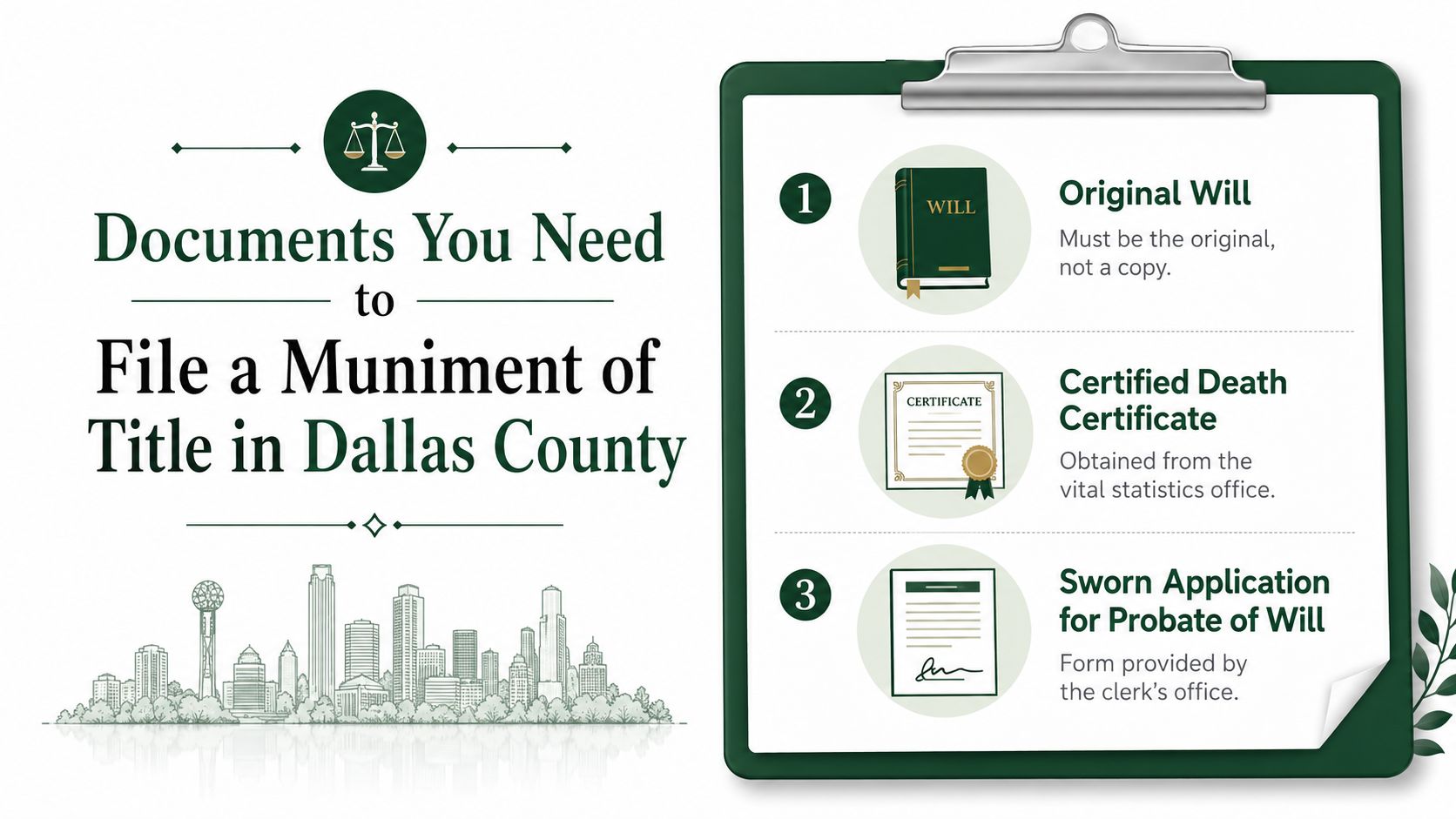
A short trip to downtown Dallas can become a second trip if the filing packet is incomplete. Gather the original will, not merely a photocopy, and obtain a certified death certificate. The court needs reliable evidence of both the testamentary document and the death that triggered the proceeding.
Your packet should generally include:
- Sworn application: Prepare the Application for Probate of Will and Issuance of Muniment of Title.
- Original will: Bring the document signed by the decedent. A copy may not be enough when the original is available.
- Certified death certificate: Use a certified copy issued by the appropriate vital-records authority.
- Facts and heirship affidavit: Identify the decedent's family, heirs, beneficiaries, and other information needed by the court.
- Self-proving affidavit: Include it if the will has one. If it doesn't, additional proof from witnesses may be necessary.
- Secured-debt records: Bring mortgage or lien information for debts secured by the home.
- Proposed order: Provide a proposed Order Admitting Will to Probate and Issuing Muniment of Title for the judge's consideration.
- Filing materials: Include the required cover sheet, photo identification, and a method of payment for applicable filing and copy charges.
The applicant must be a person with a legally recognized interest in the proceeding, such as a named executor or another interested party. The precise packet can vary based on the will, heirs, property, and court requirements, so don't rely on a generic form without checking the current Dallas County process.
Step-by-Step Filing Procedure in Dallas County Probate Court
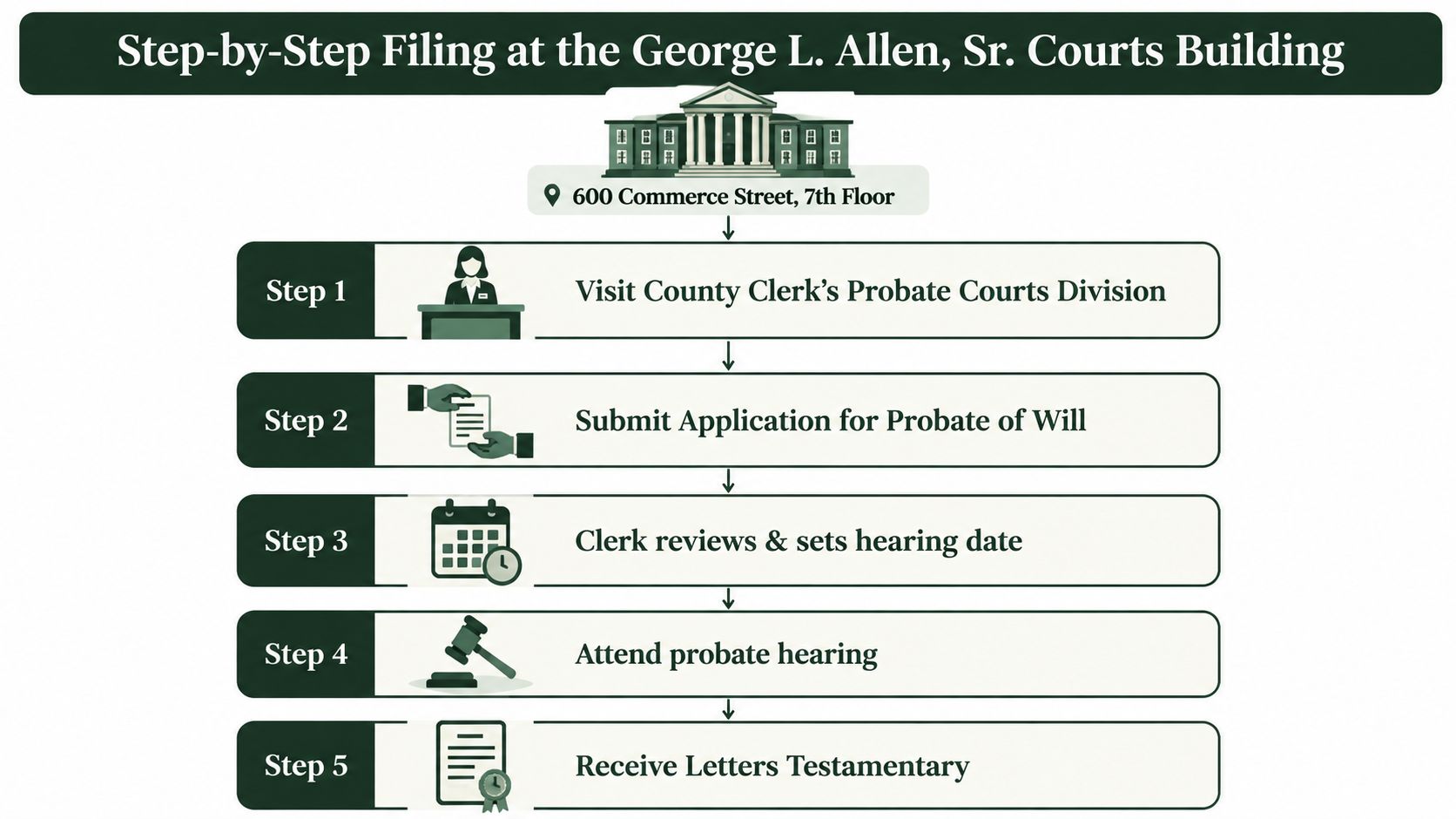
Start with the probate filing, not the deed records. At the George L. Allen, Sr. Courts Building, submit the application, original will, death certificate, sworn statements, and proposed order through the County Clerk's Probate Courts Division. Dallas County's probate system is the proper channel because the case concerns admitting the will and authorizing the title transfer.
The basic sequence is:
- Prepare the application. Confirm the decedent's domicile, collect the original will, and identify the property and interested persons.
- File with the Probate Courts Division. Submit the application and supporting papers at the county's probate filing office on the 7th floor.
- Confirm the assigned court. Dallas County's probate system includes Probate Court No. 1, No. 2, and No. 3. Check the clerk's docket information to learn where the hearing will occur.
- Watch for the hearing setting. An uncontested matter may receive a hearing date after filing, but the actual setting depends on the court's schedule and the requirements of the particular case.
- Attend and prove the application. The applicant presents sworn proof supporting the will, death, heirship, and the estate's eligibility for muniment of title.
- Obtain the signed order. If the court grants the application, the judge signs the order admitting the will to probate and issuing the muniment of title.
- Request certified copies. Order enough certified copies for every county where real property must be recorded, plus copies for a title company, lender, or other institution that requests one.
Dallas County's probate process is separate from general district-court filing. This Dallas County probate court filing guide can help you distinguish the probate division from other courthouse offices.
The order is the key result, but obtaining it doesn't finish the estate work. You still need to record the certified order in the correct deed records.
Here is a visual outline of the courthouse sequence:
Filing Fees, Court Costs, and the Post-Order Deadline
Dallas County's current filing and copy charges can change, so confirm the amount with the County Clerk before submitting the application. The filing cost commonly includes the new probate application charge, local and state components, and additional charges for certified copies or other clerk services. If property is located in multiple counties, order enough certified orders for each recording office.
| Cost Item | Estimated Amount |
|---|---|
| New probate application | Commonly around $400 or more, depending on the current schedule |
| Certified copies of the order | Additional clerk charge for each copy |
| Recording certified order | County recording charges vary by document and pages |
| Publication or special service | May apply if the facts require it |
These amounts are estimates, not a quote. Dallas County's clerk provides separate contacts for filing questions, citations, and certified copies, so ask for the current fee schedule before you arrive. Don't assume the probate filing charge includes recording the order in deed records.
The post-order compliance step deserves equal attention. Texas practice materials explain that the applicant commonly must file a sworn statement confirming that the will's terms have been carried out and known debts have been addressed, generally within 180 days unless waived. Missing that deadline can undermine administrative closure of the estate. Texas muniment-of-title guidance discusses this post-order requirement and the distinction between probate filing and later land-record recording.
Keep proof of every submission, certified copy, recording receipt, and sworn filing. A clean paper trail helps if a title company later asks how ownership changed.
Common Mistakes Dallas Families Make When Filing
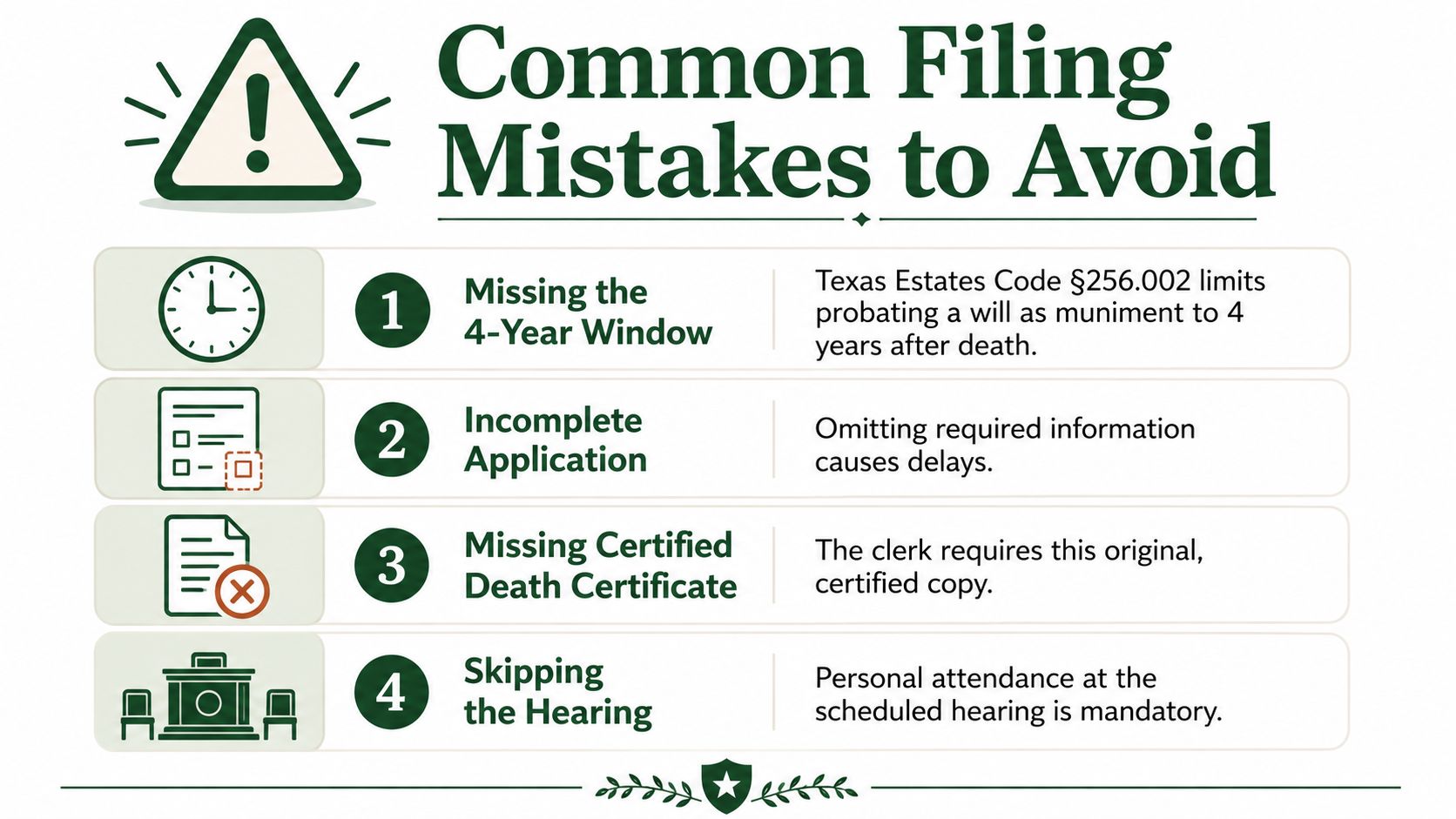
The most serious mistake is waiting past the general four-year deadline for filing the will. Texas law generally requires the will to be filed for probate within four years after the decedent's death, although an exception may apply when the applicant proves they weren't in default for failing to present it sooner. The simplified muniment procedure doesn't eliminate that rule. Texas probate deadline guidance explains the qualification for late filings.
Other errors are less dramatic but still cause avoidable delay:
- Wrong county: Verify where the decedent resided at death. The probate case generally belongs in the county tied to the decedent's domicile, not automatically the county where the house sits.
- Wrong record stream: File the application and original will with probate. Record the certified order later in the deed records where the property is located.
- Incomplete will proof: A will without a usable self-proving affidavit may require witness testimony or additional evidence. Review the execution pages before filing.
- Missing people: Identify heirs, beneficiaries, and interested persons accurately. An incomplete heirship presentation can prevent the court from approving the application.
- Too few certified orders: One certified order may not cover property in multiple counties or satisfy every title company and lender. Request copies based on the estate's actual needs.
- Assuming no debt means no review: A mortgage or real-estate lien may be treated differently from an unpaid unsecured debt, but the court still needs accurate information about the obligation.
Filing in Dallas County doesn't automatically transfer a house located in another county. Probate and land records serve different legal functions.
Confirm the decedent's domicile before paying a filing fee. If the home is in Dallas but the decedent lived in another Texas county, the probate action may belong elsewhere, while the certified order may later need recording in Dallas County.
After the Order Recording Title and Getting Help
Once the judge signs the muniment-of-title order, obtain certified copies from the County Clerk. Then record the certified order in the county's real-property or deed records where the home is located. This is the step families often miss when they search Dallas County muniment of title where to file. The probate application opens the court case, but recording the certified order updates the public land records and helps establish the chain of title.
For Dallas County property, ask the County Clerk where the current Recording Division accepts real-property instruments and confirm whether electronic recording is available for your situation. The county's records information can help you distinguish courthouse probate records from documents filed in the Dallas County Records Building. Keep the stamped recording receipt and request a file-back copy for your records.
Property outside Dallas County requires a separate recording step in the county where that property sits. A Dallas probate order doesn't replace that county's recording requirements. If the decedent owned property in Collin County, Tarrant County, Denton County, Ellis County, or another Texas county, send the certified order to that county's real-property records office and confirm its formatting, fees, and submission method.
Out-of-state real estate is a different problem. It may require a proceeding or recording process in the state where the property is located, so address it before relying on the Texas order for a sale or refinance.
Get legal advice before filing if the will may be contested, heirs are missing, debts are disputed, the decedent lived outside Dallas County, or the estate includes property outside Texas. A lawyer can also assess whether muniment of title is appropriate or whether the estate needs a broader probate administration.
The Law Office of Bryan Fagan, PLLC helps Dallas County families evaluate probate options, prepare filings, and address title-transfer issues involving Texas real estate. For help confirming the proper venue, gathering the right documents, and recording the order correctly, visit The Law Office of Bryan Fagan, PLLC to request a consultation.
