 Skip to content
You're driving into downtown Dallas with a folder of bank records, school messages, and proposed parenting schedules on the passenger seat. Your spouse has asked for different possession terms, you're worried about support and the family home, and you're trying to understand what will happen before the divorce or custody case is finished. A Dallas County temporary orders hearing can feel overwhelming because the court may decide the rules your family follows while the larger case remains pending.
The practical answer to Dallas County temporary orders hearing what to expect is this: expect a focused, fast-moving hearing in which the court reviews evidence and makes temporary decisions about children, support, safety, property use, and sometimes attorney's fees. These orders aren't final, but they can control daily life for a substantial part of the case. Preparation matters because Dallas County family courts use scheduled temporary-orders dockets, and some courts hear these matters multiple days each week.
Table of Contents
- What a Dallas County Temporary Orders Hearing Is and Why It Matters
- Issues Courts Commonly Decide at a Temporary Orders Hearing
- How the Hearing Gets Scheduled in Dallas County
- Inside the Dallas County Courtroom on Hearing Day
- Evidence and Witnesses That Actually Move the Judge
- Common Pitfalls and Short Deadlines to Watch For
- Your Preparation Checklist and Practical Next Steps
What a Dallas County Temporary Orders Hearing Is and Why It Matters
A North Dallas parent arrives at the George L. Allen, Sr. Courts Building, perhaps carrying the same questions many parents bring to court. Will the child remain on the familiar school-week routine? Who will pay the mortgage? Can one parent use the family vehicle? What happens if there are allegations of violence or a serious safety concern?
A temporary orders hearing is a court proceeding held while a divorce, custody, support, or modification case is still pending. Under Texas Family Code Chapter 105, the court can address immediate issues involving child safety, conservatorship, possession, support, geographic restrictions, property preservation, and attorney's fees. Temporary orders can also be available in modification cases, not just original divorce or custody filings.
Temporary orders create structure, not a final outcome
The court's job at this stage is usually to create workable rules for the period before final trial or final agreement. That may include:
- Conservatorship and possession: Which parent has decision-making rights, where the child primarily lives, and when each parent has possession.
- Child and spousal support: What financial obligations apply while the case proceeds.
- Property and household expenses: Who uses the home or vehicles, who pays specific bills, and how parties must preserve property.
- Safety protections: Restraining provisions or protective relief when the facts support immediate protection.
- Attorney's fees: Whether one party should contribute to the other party's ability to participate in the case.
A temporary order can be changed because Texas law gives courts broad authority to modify an earlier temporary order. That flexibility doesn't make the first hearing unimportant. A schedule that begins during temporary orders may become the routine the child experiences, and financial arrangements can affect the family's stability while the litigation continues.
Practical rule: Treat the hearing as an important interim decision, but don't confuse it with the final trial. Bring the evidence needed to solve the immediate problem, not every grievance from the marriage.
Dallas County's centralized family-court system operates from the George L. Allen, Sr. Courts Building in downtown Dallas. Family district court procedures show that temporary hearings are placed on dedicated dockets, and at least one court, the 302nd District Court, lists temporary-orders and TRO motion settings on Monday, Tuesday, and Thursday at 9:00 a.m. and Wednesday at 1:30 p.m. The Texas statute governing temporary orders provides the statewide authority, while local docket practices shape how quickly and narrowly a Dallas hearing may move.
Issues Courts Commonly Decide at a Temporary Orders Hearing
A judge or associate judge typically approaches the hearing through practical questions. The court isn't trying to resolve every disputed issue in the divorce at once. It's deciding what arrangement will protect children, preserve property, and keep financial responsibilities manageable until the case moves forward.
Questions about children and parenting time
The first question may be, “What parenting arrangement is workable and safe right now?” The court can address conservatorship, decision-making authority, the child's primary residence, possession, visitation, geographic restrictions, and communication between parents.
For a child attending school near the Dallas ISD, Richardson ISD, or Plano ISD boundaries, evidence about transportation, attendance, homework, childcare, and existing routines may be more useful than broad claims that one parent is “better.” The court may also consider whether a requested schedule is realistic given work hours and school logistics.
Child support is a separate question: “What support should be paid while the case is pending?” The calculation generally depends on legally recognized income and resources, with possible adjustments based on circumstances such as childcare or extraordinary medical needs. A party should support the request with reliable financial records rather than an estimate made from memory.
Questions about housing, support, and safety
The judge may ask who should remain in the family home, who should use a vehicle, and who should pay particular household expenses. In a high-asset Dallas divorce, temporary property orders may also involve business records, investment property, retirement accounts, or restrictions designed to preserve disputed assets until valuation and tracing are complete.
Temporary spousal support and temporary attorney's-fee requests may arise when one party lacks access to funds needed for living expenses or participation in the case. Eligibility and amount depend on the facts and applicable Texas law, so a party should present a clear budget, income information, and evidence of available resources.
If family violence is alleged, the court may consider protective relief. Texas law allows a temporary ex parte protective order without notice and without a hearing when the court finds a clear and present danger of family violence. That emergency process differs from an ordinary temporary-orders hearing, where the parties generally receive notice and an opportunity to present evidence.
| Issue | Typical standard or order | Key Dallas County detail |
|---|---|---|
| Conservatorship and possession | Interim decision-making and parenting schedule based on safety, stability, and the child's needs | School, transportation, and work schedules can matter on a fast local docket |
| Child support | Temporary support based on legally relevant financial information and child-related needs | Organized income records help the court address the issue efficiently |
| Property use | Temporary possession or use of a home, vehicle, or other property | Dallas courts may address property preservation before full discovery |
| Spousal support and fees | Interim financial relief when supported by the facts and law | A clear budget is more useful than a general claim of hardship |
| Protective relief | Restrictions or protective orders supported by legally sufficient safety facts | Emergency ex parte relief is procedurally different from a noticed hearing |
For a more detailed explanation of the role of the associate judge, review what a Dallas County family court associate judge may decide. The precise issues available at your hearing depend on the pleadings, notice, existing orders, and facts presented.
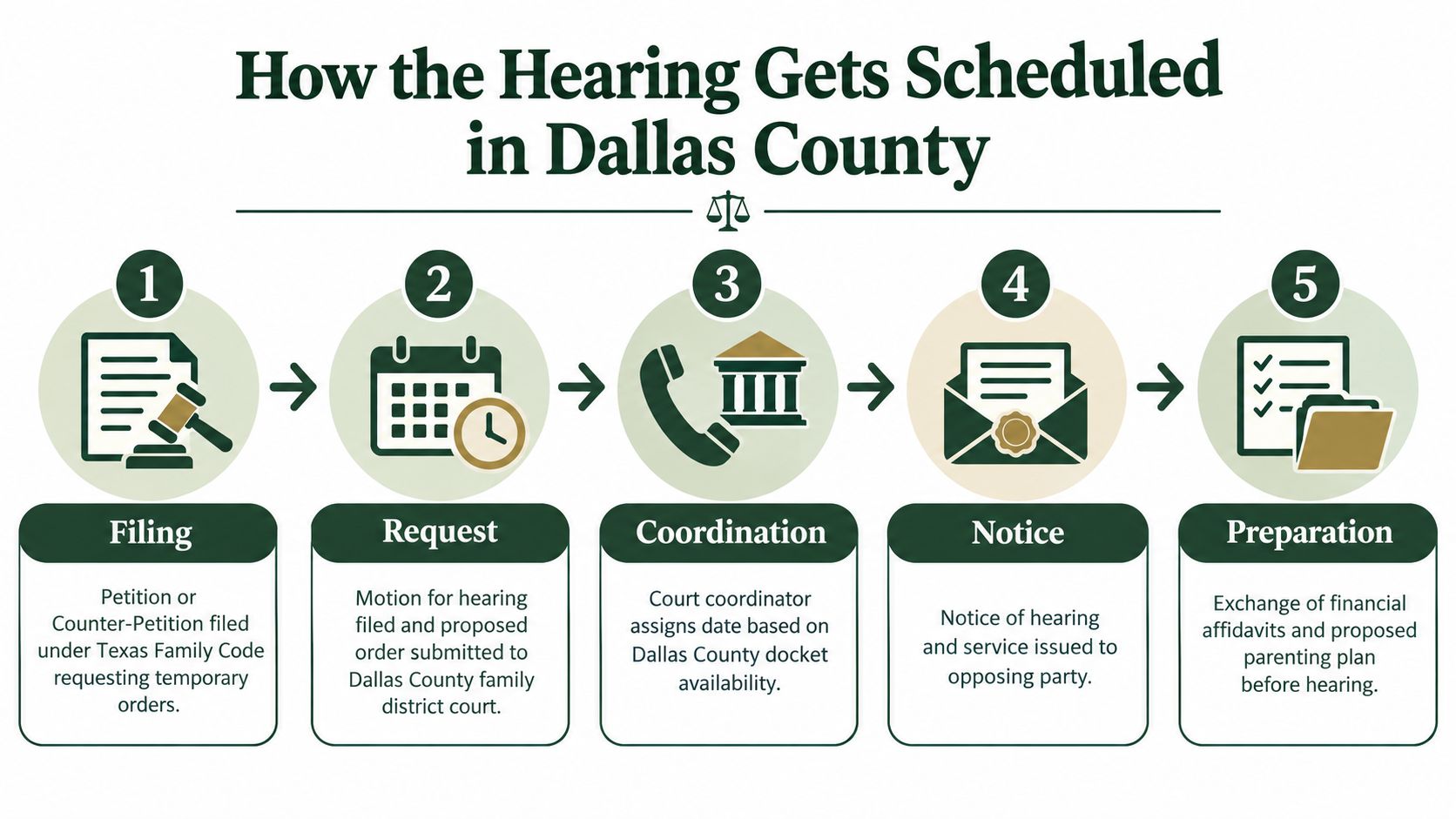
How the Hearing Gets Scheduled in Dallas County
Filing a request doesn't automatically mean you'll walk into court the next morning. Dallas County's process has separate stages for filing, setting, and, in some situations, obtaining judicial approval before a hearing can be placed on the calendar.
A party generally begins with a petition, counter-petition, or modification pleading and a request for temporary relief filed through the Dallas County District Clerk at the George L. Allen, Sr. Courts Building. The exact filing requirements, fees, service requirements, and available fee-waiver procedures can depend on the case and the filing party's circumstances. Don't assume that submitting a motion by itself guarantees a setting.
The local checkpoint can affect timing
Texas law requires a court to set a hearing time and place when sufficient pleadings support the request. Dallas County practice adds local coordination. Texas Law Help explains that some Dallas County filings, including a motion to modify that requests temporary orders when the modification is filed, require judicial approval before the motion can be set. That approval requirement is a procedural checkpoint, not a minor administrative detail.
The centralized courthouse system means the court coordinator, clerk, associate judge, and referring district court may all have roles in moving a request toward a hearing. Publicly available Dallas family-court procedures also show that courts don't all handle temporary matters identically. One court may use recurring motion-docket times, while another may require temporary hearings and TROs to be submitted in person to the associate judge on duty.
What to do after filing
After submitting the request, confirm:
- The assigned court: Identify the family district court handling the case and whether an associate judge is involved.
- The setting procedure: Ask the clerk or coordinator how the motion is placed on the temporary-orders docket.
- Approval requirements: Determine whether the judge must approve the request before a hearing date can be obtained.
- Notice and service: Confirm how the opposing party must receive notice and whether emergency relief changes that process.
- Documents due before hearing: Check the court's procedures for proposed orders, financial information, and any required conference documentation.
The safest approach is to verify the procedure for the specific court rather than relying on a general Dallas County assumption. Dallas County family court coordinator procedures can help explain the setting process, but case-specific requirements should be confirmed with the clerk, coordinator, or counsel.
Inside the Dallas County Courtroom on Hearing Day
Hearing day usually begins before your case is called. You'll pass through security at the George L. Allen, Sr. Courts Building, locate the family-court elevator bank, and check in with the appropriate clerk or courtroom personnel. Families, attorneys, witnesses, and other litigants may be waiting for different matters on the same docket.
The bailiff calls each case, and the judge or associate judge takes the bench. When your case is called, the court may ask counsel for a short roadmap. That opening should identify the temporary relief requested, the evidence supporting it, and the decision the court needs to make today.
The presentation is focused and sworn
Temporary hearings often rely on concise sworn testimony and properly offered documents. Your lawyer may call you as a witness, ask targeted questions, and use exhibits to establish the facts. The other side can cross-examine you, present its own witnesses, and offer competing documents.
Exhibits should be organized before you enter the courtroom. Text messages, emails, school records, medical notes, police reports, calendars, and financial documents may be useful, but the court still needs a proper foundation before relying on them. A judge may interrupt a long narrative and ask for the specific fact, document, or legal authority supporting the request.
Witnesses may wait outside the courtroom and, if sequestration applies, remain in the hallway until called. A focused witness who can describe school attendance, a specific safety event, or a concrete parenting fact may be more useful than several people repeating general opinions.
At the end, the judge may announce the ruling on the record. Written temporary orders might be signed that day or within a few days, depending on the court and the work required to prepare the document. Don't leave based only on an oral understanding. Read the signed order and confirm what has been filed.
An associate judge's ruling also creates a short post-hearing decision window. A party seeking de novo review generally must file the request no later than the third working day after receiving notice of the associate judge's order or report, under the applicable Texas procedure. This Texas Family Code provision addressing temporary orders and review should be reviewed with counsel because the correct deadline can depend on the order, notice, and procedural posture.
For courthouse logistics, including where Dallas family cases are heard, consult the George L. Allen, Sr. Courts Building guide.
Evidence and Witnesses That Actually Move the Judge
A temporary-orders judge usually needs a clear answer to a narrow question: What should the court order now, and what reliable proof supports that request? Emotional context matters, especially in family disputes, but a broad account of the relationship rarely replaces documents tied to a specific request.
Bring evidence that connects directly to the issue:
- Income records: Recent pay stubs, W-2 forms, account statements, and other records relevant to support.
- Parenting information: A proposed possession calendar, school schedules, daycare records, transportation details, and a practical exchange plan.
- Communications: Screenshots of relevant texts or emails that show a specific agreement, missed exchange, threat, or safety concern.
- Safety records: Police reports, medical records, or DFPS-related documents, when properly available and relevant.
- Property records: A sworn inventory, account information, vehicle documents, bills, and records supporting exclusive-use or preservation requests.
Build an exhibit system the court can use
A binder with labeled tabs makes a compressed hearing easier to follow. Keep the documents in the same order as the witness questions and proposed temporary order. Bring extra copies for the court and opposing party, while recognizing that the specific number and submission method can vary by court.
| Evidence type | Issue it supports | How the court may view it |
|---|---|---|
| Pay stubs and financial records | Child support, temporary support, fees | Useful when current, complete, and connected to the requested relief |
| Proposed possession calendar | Custody and visitation | Stronger when it accounts for school, work, transportation, and exchanges |
| Texts and emails | Communication, agreements, missed possession, threats | More persuasive when complete and authenticated rather than selectively quoted |
| School, daycare, and medical records | Stability, attendance, health, and care | Concrete records can clarify disputes about the child's routine |
| Police or agency records | Safety and family violence concerns | Relevance and admissibility still matter |
| Property inventory and account records | Property use and preservation | Helps identify what the court must protect while discovery continues |
You may need to authenticate a document through your testimony or another witness. A screenshot without context can create questions about who sent it, when it was sent, and whether the full conversation has been provided. The court may limit evidence that isn't properly offered or that falls outside the temporary relief requested.
Witnesses should be selected for knowledge, not emotional loyalty. The parties themselves are often central. One focused teacher, counselor, relative, or other firsthand witness may be more helpful than a group of people who can only describe the marriage generally.
Common Pitfalls and Short Deadlines to Watch For
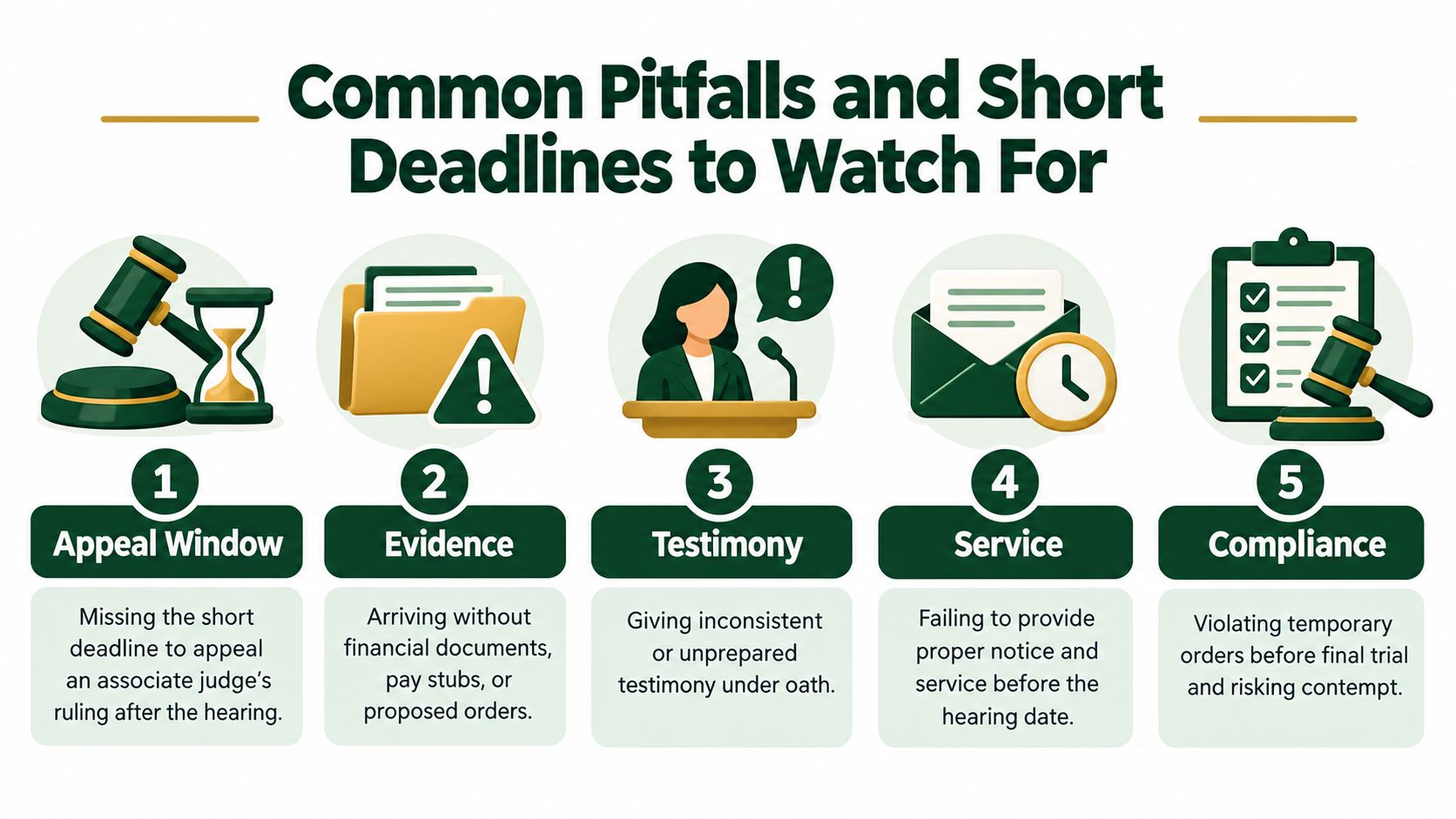
The most damaging mistakes often happen outside the courtroom. A party may have a valid concern but lose the chance to present it effectively by missing a setting requirement, failing to provide notice, or waiting too long after an associate judge's ruling.
Procedural errors can overshadow good evidence
Dallas County litigants should confirm whether the court requires a prehearing conference, a Certificate of Conference, proposed orders, financial worksheets, or other materials before the matter can be heard. Requirements can vary by court and case type. A missing document may delay the setting or leave the judge without the information needed to decide a request.
Other common problems include:
- Unprepared exhibits: Arriving without organized financial records, parenting calendars, or copies for the court.
- Overbroad testimony: Trying to tell the entire story of the marriage instead of proving the temporary issue.
- Surprise evidence: Offering a new witness or allegation without giving the other side a fair opportunity to respond.
- Social-media activity: Posting about the dispute, spending, alcohol, dating, or the children during an active case.
- Unclear requests: Asking for “fairness” without identifying the specific schedule, payment, restriction, or property order sought.
After the ruling: If an associate judge issues an unfavorable temporary order, obtain the signed order and notice information immediately. The de novo review deadline can be extremely short, and waiting for a later status conference may forfeit an important procedural option.
Temporary orders require compliance
A temporary order remains effective until it is superseded or changed by the court. An informal conversation with the other parent doesn't replace the written order. If the order requires a particular exchange, payment, communication method, or property restriction, follow the language unless the court changes it.
Document possible violations calmly. Save messages, payment records, exchange details, and relevant dates. Don't respond to a missed possession period by withholding the next one, because one violation doesn't authorize another.
The correct post-hearing action may involve de novo review, a motion to modify, enforcement, or another procedural request. Don't assume that a notice of appeal, motion for new trial, or request for findings is interchangeable with the others. The appropriate deadline depends on the type of ruling and the applicable procedural rules, so obtain prompt case-specific advice.
Your Preparation Checklist and Practical Next Steps
Preparation starts with the request you want the judge to understand. Write down the temporary decisions that matter most, such as a school-week possession schedule, temporary support, exclusive use of a home, limits on property transfers, or safety restrictions. Then gather proof for each request and remove documents that don't help answer the immediate question.
What to bring to court
Use a clearly indexed packet and confirm the assigned court's current procedures before hearing day. Your checklist should include:
- Exhibits: Financial records, calendars, communications, school or medical records, and safety documentation organized by tab.
- Copies: Extra copies for the court and opposing party, following any court-specific submission instructions.
- Identification: Valid identification and the case information needed to check in.
- Proposed orders: A proposed order that states the requested terms in clear, enforceable language.
- Logistics: Time for security, the correct family-court elevator bank, and compliance with courthouse cell-phone rules.
- Presentation: Clean, professional clothing and a plan for answering questions directly and respectfully.
After the hearing, read every line of the signed temporary order. Check possession times, exchange locations, geographic restrictions, support obligations, bill responsibilities, communication provisions, injunctions, and property restrictions. Calendar every deadline and ask how child-support withholding will be established through the Texas Office of the Attorney General child support program.
If the order came from an associate judge, confirm immediately whether de novo review is available and what filing deadline applies. Also schedule the next case-management or status event, preserve all financial and parenting records, and follow every injunction clause until a later written order changes it.
The Law Office of Bryan Fagan, PLLC helps Dallas County clients prepare for temporary orders involving divorce, custody, child support, possession, property use, and protective relief. If your hearing is approaching, gather your pleadings and evidence, then visit The Law Office of Bryan Fagan, PLLC to learn about arranging a consultation focused on your case and the Dallas County procedure that may apply.
