 Skip to content
An associate judge in Dallas County commonly decides temporary orders involving custody, possession, child support, and enforcement recommendations, while a contested final ruling typically requires approval from the referring district judge unless the parties agree or waive review. That means the associate judge may control what happens immediately, even when the district judge retains final authority.
You may be walking into the George L. Allen, Sr. Courts Building with a hearing notice, a proposed parenting schedule, or a dispute over support. You look at the case caption and expect the district judge named there, but an associate judge is on the bench instead. That's normal in Dallas County family court, not a sign that your case has been downgraded or mishandled.
The practical question behind Dallas County family court associate judge what they decide is more precise than a simple yes or no. The answer depends on whether the hearing concerns a temporary order, a recommendation, an agreed or default matter, or a contested final decision subject to review.
Table of Contents
- What Happens When Your Case Goes Before an Associate Judge
- Legal Authority of Dallas County Associate Judges
- Hearings and Orders Associate Judges Commonly Handle
- Temporary Rulings Versus Final Decisions
- How De Novo Review Works in Dallas County
- Preparing for Your Associate Judge Hearing and Next Steps
What Happens When Your Case Goes Before an Associate Judge
A parent arrives downtown, clears security, finds the assigned courtroom, and waits for the case to be called. The courtroom may feel formal, but the hearing often focuses tightly on the immediate dispute, such as where a child will stay, whether support should be paid, or whether someone violated an existing order.
Dallas County's family courts use associate judges as part of their regular structure. The county publicly identifies associate judges assigned to several family district courts, including the 255th, 256th, 301st, 302nd, 303rd, and 330th District Courts, with separate court contact information. You can review local docket information and procedures through the Dallas County 330th District Court family docket resource.
The associate judge is a judicial officer
An associate judge is a licensed attorney authorized under Texas Family Code Chapter 201 to conduct hearings, receive evidence, examine witnesses, make findings, and recommend orders. The associate judge may handle the first substantial review of your evidence, even if a district judge later reviews the recommendation.
The rules of evidence and courtroom procedure still matter. Bring admissible documents, organize your testimony, and answer questions directly. A temporary-orders hearing isn't casual because it may be shorter than a final trial.
Practical rule: Treat the associate judge hearing as a real merits hearing. The record and recommendations developed there can shape the rest of the case.
The associate judge generally operates under the authority of the referring district court. The district judge remains central to final review in contested matters, particularly when a party requests de novo review. Dallas County's court structure is designed to move family-law litigation through busy dockets while preserving review by the referring district judge.
Legal Authority of Dallas County Associate Judges
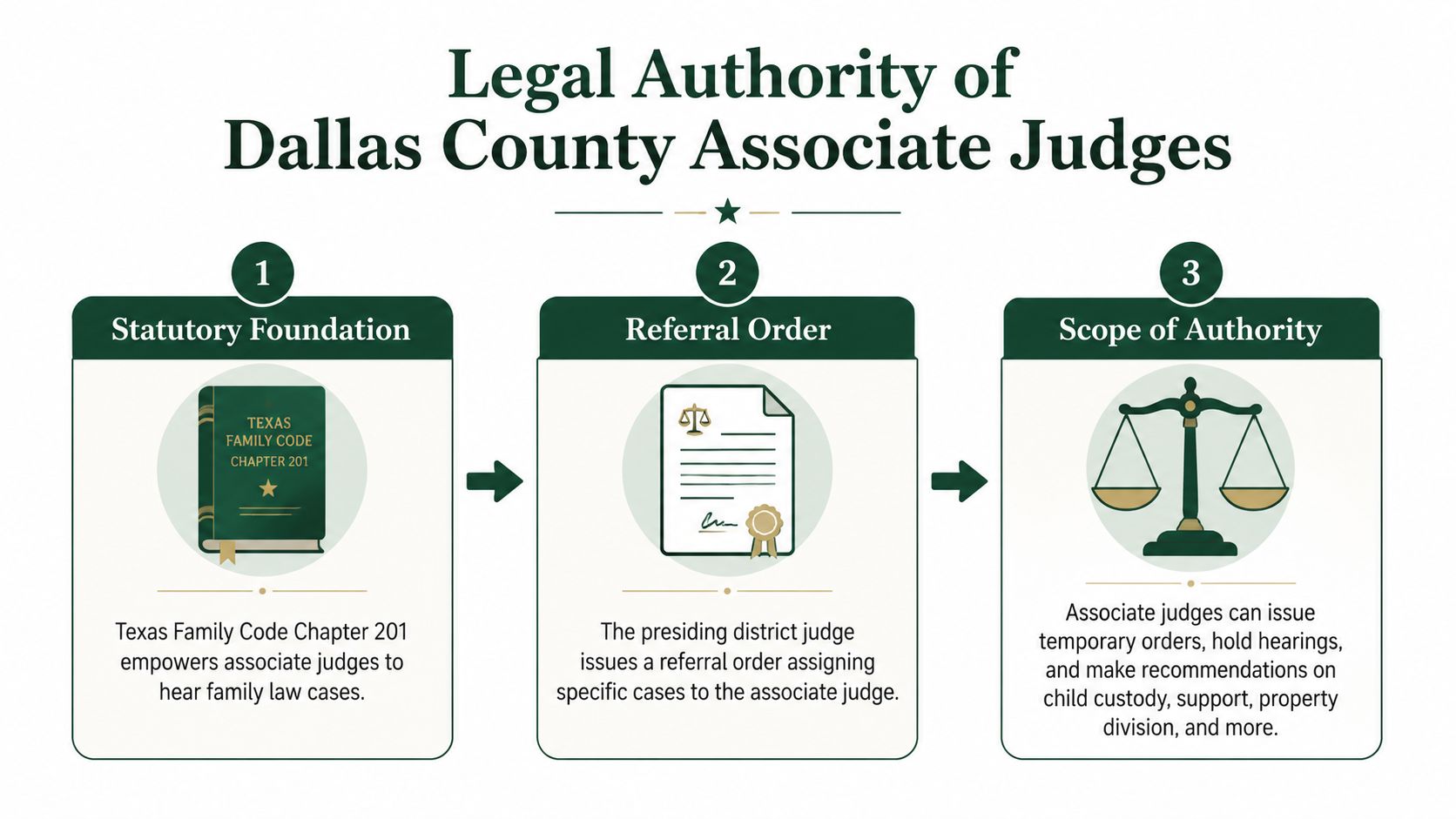
Texas Family Code Chapter 201 gives associate judges substantial courtroom authority. Under Texas Family Code Section 201.007, an associate judge may conduct hearings, hear evidence, compel the production of relevant evidence, rule on admissibility, examine and swear witnesses, make findings of fact and conclusions of law, and recommend orders to the referring court. The statute also permits an associate judge to render and sign certain final orders, including agreed final orders, default final orders, and final orders supported by an unrevoked waiver of notice or appearance, as described through the Dallas County 301st District Court resource.
Authority begins with the referral
The referring district judge assigns the matter to the associate judge through a referral. That referral defines which issues the associate judge may hear and what type of order the associate judge may enter or recommend. The scope therefore depends on both the statute and the referral.
During a hearing, the associate judge can:
- Receive evidence: Parties may present testimony, records, messages, financial documents, medical information, and other relevant evidence, subject to courtroom rules.
- Control the proceeding: The associate judge can regulate the hearing, rule on admissibility, question witnesses, and manage the presentation of evidence.
- Make findings: The associate judge may prepare findings of fact and conclusions of law for the referring district court.
- Recommend relief: The associate judge may recommend orders addressing custody, possession, support, enforcement, or other referred family-law issues.
The critical limitation is final authority in contested matters. Under Texas Family Code Section 201.308, an associate judge may recommend an order, but the referring court remains responsible for final review when the law or procedure requires it. The statutory framework for associate-judge recommendations shows why a recommendation is powerful but not always the last word.
A party who disagrees with the result may have a right to request de novo review. That review gives the referring district judge an opportunity to reconsider the matter rather than treating the associate judge's recommendation as automatically final.
Hearings and Orders Associate Judges Commonly Handle
Dallas County associate judges commonly hear the issues that require prompt courtroom attention. The most consequential are temporary orders, because they establish enforceable rules for the family while the divorce, custody case, or modification remains pending.
| Hearing Type | Immediate Effect? | Typical Outcome |
|---|---|---|
| Temporary orders | Often, once reduced to a signed order | Temporary custody, possession, support, or maintenance terms |
| Custody and possession disputes | Often through temporary orders | A parenting schedule, exchange terms, or interim restrictions |
| Child-support establishment or review | Depends on the order and referral | A recommended or temporary support obligation |
| Modification matters | The resulting order depends on the proceeding | A recommendation or order addressing changed custody or support terms |
| Enforcement and contempt | The recommendation may require district-court action | Findings concerning a claimed violation and recommended remedies |
| Protective-order hearings | The effect depends on the order entered | Temporary or recommended protective relief |
| Discovery disputes and other pretrial matters | Usually during the litigation | Orders compelling information, limiting discovery, or organizing the case |
| Agreed or default matters | Often capable of becoming final under Chapter 201 | An agreed or default order that can be signed under statutory authority |
Temporary orders set the operating rules
A temporary hearing may address where a child lives, when each parent has possession, who pays child support, and whether a parent must follow specific exchange or communication requirements. The order can govern daily life while the case continues, so preparation matters even when neither party is asking for a final divorce decree.
Associate judges also hear support-related disputes and matters involving modifications, including cases affecting a parent-child relationship. The Child Support and Title IV-D provisions of Chapter 201 authorize associate judges to render and sign certain non-final orders and to hear specified postjudgment and modification matters tied to child support and parent-child litigation.
Enforcement requires serious preparation
An enforcement proceeding may concern missed support, denied possession, or another alleged violation of a prior order. The associate judge can hear evidence and make recommendations, but the precise path depends on the referral, the relief requested, and whether the matter requires action by the referring district judge.
Protective orders and CPS settings demand the same discipline. Bring the orders, notices, messages, records, and witnesses that directly address the issue. Do not assume that a short setting means the court will overlook missing evidence.
Temporary Rulings Versus Final Decisions
The difference between a temporary ruling and a final decision determines what happens next. A temporary order can control parenting time, support, possession, and exchanges while the case remains unresolved. A final contested decision, such as a final custody determination or divorce decree, generally requires the referring district judge's approval or falls within a statutory exception.
| Feature | Temporary Rulings | Final Decisions |
|---|---|---|
| Purpose | Establish workable rules while the case continues | Resolve the legal dispute permanently, subject to later remedies |
| Common subjects | Custody, possession, child support, maintenance, exchanges | Divorce, final conservatorship, final support, property division |
| Associate judge's role | Hear evidence and enter or recommend temporary relief | Recommend contested relief or sign certain agreed, default, or waiver-based orders |
| Practical effect | May govern the family immediately after entry | Creates the final judgment or decree when properly signed |
| Review | A party may have a right to de novo review | Review may involve postjudgment or appellate procedures |
Consider a parent who receives a temporary possession schedule and a support obligation beginning the following week. That parent must generally follow the signed temporary order while the case proceeds, even if the parent believes the associate judge misunderstood the evidence. The practical impact is immediate, not theoretical.
A final modification of that arrangement is different. The associate judge may conduct the hearing, evaluate evidence, and issue findings or a recommendation, but the referring district judge may need to approve the contested result. The Dallas County 302nd District Court family docket resource can help a litigant identify local docket information, but it won’t replace legal advice about the effect of a particular order.
Why temporary orders matter so much
Temporary orders often create the routine that everyone follows for months. Children develop an exchange pattern, parents arrange work schedules around possession, and support payments become part of the household budget. A later court may consider the existing arrangement and the parties’ compliance when evaluating the broader dispute.
That doesn’t mean a temporary order decides the final case. It does mean you should present your strongest organized evidence at the temporary hearing rather than treating it as a preliminary formality.
How De Novo Review Works in Dallas County
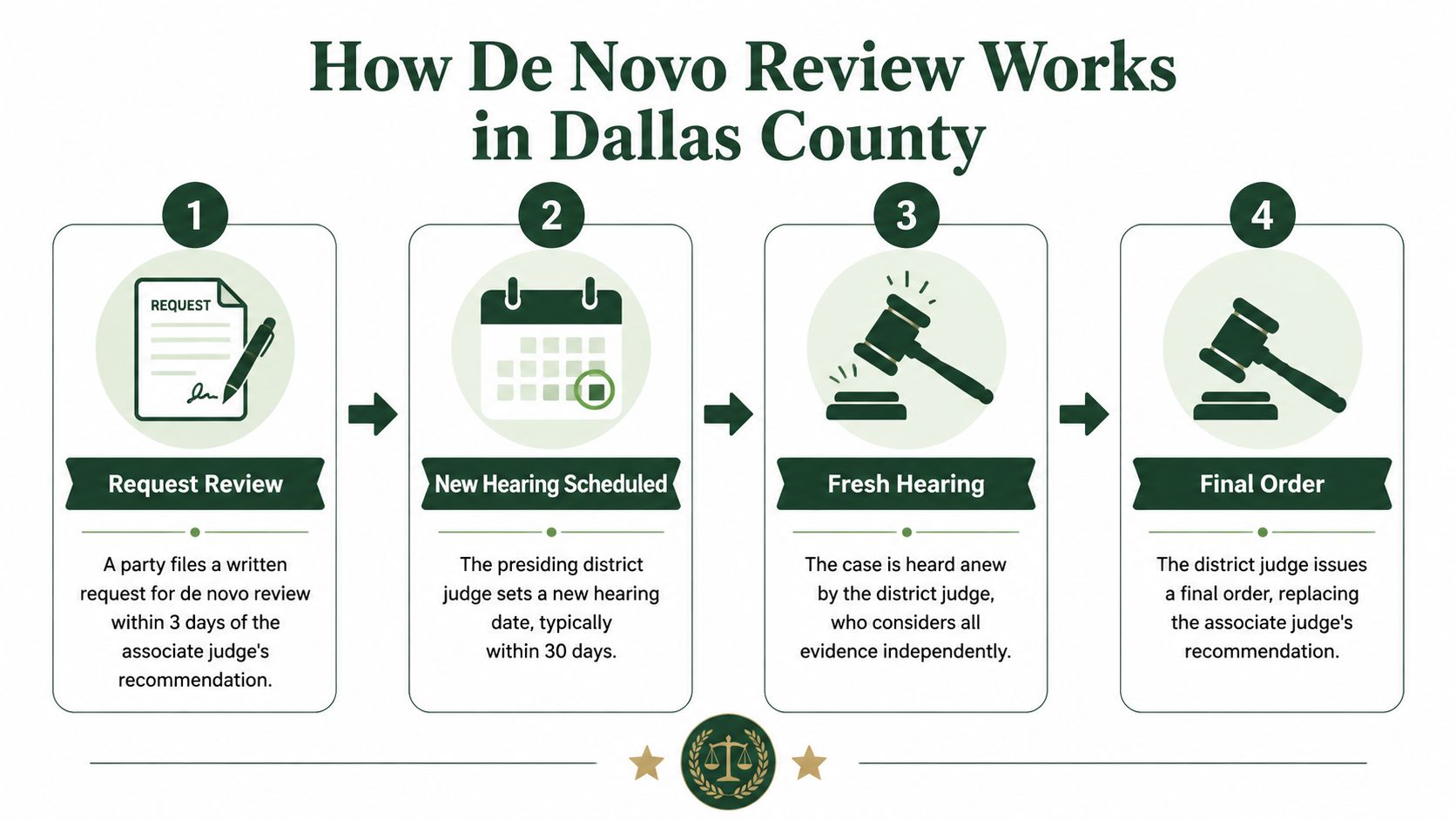
If you disagree with an associate judge’s recommendation or ruling, determine immediately whether you have a right to de novo review and what deadline applies. Under Texas Family Code Section 201.012, the deadline to request de novo review is generally three business days after the party receives notice of the associate judge’s report, as reflected in the Texas Family Code provision governing the request. The exact calculation and applicable procedure should be verified for the specific proceeding.
Start with the written request
A party typically files a written request for de novo review with the district clerk and serves the other parties. Do not rely on a conversation in the hallway, an objection stated only during the hearing, or an assumption that the district judge will automatically review the ruling.
The notice, report, and local court procedures matter. Read the associate judge’s paperwork as soon as you receive it, identify the date and method of notice, and confirm where the request must be filed.
The order may remain effective
Seeking review doesn’t automatically erase the associate judge’s temporary ruling. Dallas County family-court policy materials explain that temporary rulings may be reduced to a signed temporary order and remain in full force pending appeal unless a stay is granted. That can mean the custody schedule, support obligation, or exchange arrangement continues while the request is pending.
A de novo request changes the review path. It doesn’t necessarily pause the order controlling your family today.
The referring district judge may review the record or hearing summary and may take further evidence, recommit the matter, adopt the recommendation, modify it, or reject it. The review isn’t a courtesy confirmation of what the associate judge did.
Prepare for the review hearing
Gather the evidence that matters to the disputed issue. A de novo hearing isn’t an opportunity to complain generally about the associate judge. Explain what finding or order should change, identify the evidence supporting that change, and request a practical replacement order.
If the dispute involves a possible appeal beyond the trial court, review the available Dallas family-law appeals information promptly. Deadlines and remedies vary, so a party should obtain case-specific advice rather than assume every associate-judge ruling can be appealed in the same way.
Preparing for Your Associate Judge Hearing and Next Steps
Preparation should begin with the hearing notice, not the night before court. Confirm the date, courtroom, assigned associate judge, issues set for hearing, and whether the setting concerns temporary relief, enforcement, discovery, support, or another referred matter.
Arrive early at the George L. Allen, Sr. Courts Building. Allow time for security, finding the courtroom, checking in, and speaking with counsel or the clerk if the docket requires a particular procedure. Court settings can move quickly, and arriving late can leave you trying to explain your position after the court has already called the case.

Build a focused hearing file
Bring organized copies of the documents tied to the issues before the court. Depending on the case, that may include:
- Financial records: Pay information, account records, support payment history, and documents relevant to income or expenses.
- Parenting materials: A proposed possession schedule, school information, calendars, transportation details, and communication records.
- Existing orders: Every order the other party allegedly violated or seeks to modify.
- Safety evidence: Protective-order documents, messages, photographs, reports, or witness information relevant to family-violence allegations.
A proposed parenting plan gives the court a workable alternative instead of leaving the judge to design every detail from the bench. Keep it realistic. A schedule that ignores school, work, transportation, or the child’s needs won’t help your position.
Avoid the mistakes that cause preventable damage
Don’t treat temporary orders as unimportant. Don’t miss the deadline for a de novo request. Don’t arrive without knowing what relief you want, and don’t bring a stack of unrelated documents without identifying what each document proves.
Self-representation may be workable for an agreed temporary order, but legal counsel is strongly recommended for contested custody, enforcement involving possible jail time, family-violence allegations, CPS proceedings, relocation disputes, complex property division, or high-asset divorce. Business records, retirement assets, separate-property tracing, and reimbursement claims can require financial and legal analysis beyond what a short hearing allows.
Use this checklist before leaving for court:
- Review the notice. Know the issues and requested relief.
- Organize evidence. Separate documents by issue and mark the most important pages.
- Prepare your proposal. Bring a workable parenting, support, or enforcement solution.
- Evaluate representation. Obtain advice before a contested hearing when the consequences are substantial.
- Calendar post-hearing options. Read the signed order or report and act promptly if review may be available.
The Law Office of Bryan Fagan, PLLC helps Dallas County clients prepare for associate judge hearings involving temporary orders, custody, child support, enforcement, and de novo review. Visit The Law Office of Bryan Fagan, PLLC to learn about Dallas family-law services and request a consultation about your next court step.
