 Skip to content

The first time a Dallas parent walks into the George L. Allen, Sr. Courts Building for the 330th District Court, the confusion usually starts before they ever find a courtroom. They've got a divorce, custody, or enforcement case, they've heard a hearing is “set,” and they're trying to figure out whether they need to be there, where to sit, and whether the judge will even hear them that day.
The short answer is this, the 330th runs on a published family docket, fixed settings, and a split between the district judge and the associate judge. If you know how the calendar works, what each setting means, and who hears which type of matter, the whole process gets a lot less stressful.
Table of Contents
- What to Expect on the Dallas County 330th Family Docket
- How Family Cases Reach the 330th District Court
- Hearing Days and Settings on the 330th Calendar
- Which Judge Hears Your Family Matter in the 330th
- Filings, Forms, and the Path to Final Orders
- Common Mistakes Dallas Litigants Make at the 330th
What to Expect on the Dallas County 330th Family Docket
A first trip to the Dallas County 330th District Court can feel like arriving at a train station with a posted schedule, a ticket in hand, and no clear idea which platform to use. The court sits in the George L. Allen, Sr. Courts Building at 600 Commerce Street, Dallas, TX 75202, and Dallas County publishes the daily docket so you can check the party name, floor or courtroom, time, and case number before you leave home. That public calendar is your first map through the building (Dallas County 330th docket page).
The family court pool is not random in the everyday sense
The 330th is part of Dallas County's family court pool, along with the 301st, 302nd, 303rd, 330th, 254th, 255th, and 256th District Courts. Under the local rule, qualifying family cases are docketed in filing order and then randomly assigned to a family court, which is why the filing step matters so much (Dallas County family court assignment rule). The court you start in is a procedural result, not a choice most parties get to make.
That pool covers the matters people usually expect in family court, divorce, annulment, suits to declare a marriage void, SAPCR cases involving paternity, conservatorship, termination, adoption, possession and access, child support, enforcement or interpretation of divorce-related agreements, protective orders, and other Family Code matters when there is no continuing-jurisdiction court (Dallas County family court assignment rule). If your case falls inside that group, it moves through the family docket system, not the general civil line.
What people actually experience at the courthouse
Most litigants pass through security, check the daily docket information, and then head toward the assigned courtroom. The timing can still be confusing, because family cases move by setting, not by first-come, first-served order. A matter may be listed for a later call, and a party who arrives early still has to wait for the court to reach that setting.
Punctuality matters because the docket is not just a list of names. It is the court's working schedule for the day. If your case is called and you are not there, the court can pass over your matter and move on.
Dress should be respectful and courtroom-ready. Families who need help understanding settings or procedure can also use the courthouse coordinator resources Dallas County provides.
The 330th's calendar becomes easier to read when you compare it with another Dallas family court's docket structure. A practical example is the 254th District Court family docket procedures, which shows how another court organizes its family settings. The details differ from court to court, and those details control who gets heard, when, and in what order.
How Family Cases Reach the 330th District Court
A Dallas family case reaches the 330th through the county's filing and assignment process, not because someone picks that courtroom. As noted earlier, qualifying family matters are docketed in filing order and then assigned within the family court pool, so the clerk's routing step shapes where the case starts.
Filing starts the chain
A new family case is usually e-filed through the Dallas County clerk system, then sent into the family department for assignment. From there, the case is placed into one of the family district courts, which may include the 330th or another court in the rotation. That first courtroom is a procedural result, not a choice the parties usually make.
The filings that most often begin this process are the ones people expect in family court, Original Petitions for Divorce with children, SAPCR petitions, Petitions to Modify, Motions to Enforce, and family-law protective-order applications tied to pending SAPCRs. If a case is re-filed or transferred, it may follow a separate reassignment order signed by the local administrative judge instead of the ordinary rotation.
| Filing Type | Where Filed | Routed Through |
|---|---|---|
| Original Petition for Divorce with children | Dallas County clerk e-filing or clerk office | Family department, then random assignment to the family pool |
| SAPCR petition | Dallas County clerk e-filing or clerk office | Family department, then random assignment to the family pool |
| Petition to Modify | Dallas County clerk e-filing or clerk office | Family department, then random assignment to the family pool |
| Motion to Enforce | Dallas County clerk e-filing or clerk office | Family department, then random assignment to the family pool |
| Protective-order application tied to a pending SAPCR | Dallas County clerk e-filing or clerk office | Family department, then random assignment to the family pool |
Why the routing matters
Routing decides which judge sees the file first, but it does not decide who wins. That matters in divorces involving children, custody disputes, support issues, relocation requests, and enforcement matters, because the first judge usually handles the case procedurally before the bigger disputes are heard.
A lot of people assume the first courtroom stays with the case forever. Dallas County family practice does not always work that way. The initial assignment sets the opening move, then later settings, referrals, or transfers can change where the case is heard.
Hearing Days and Settings on the 330th Calendar
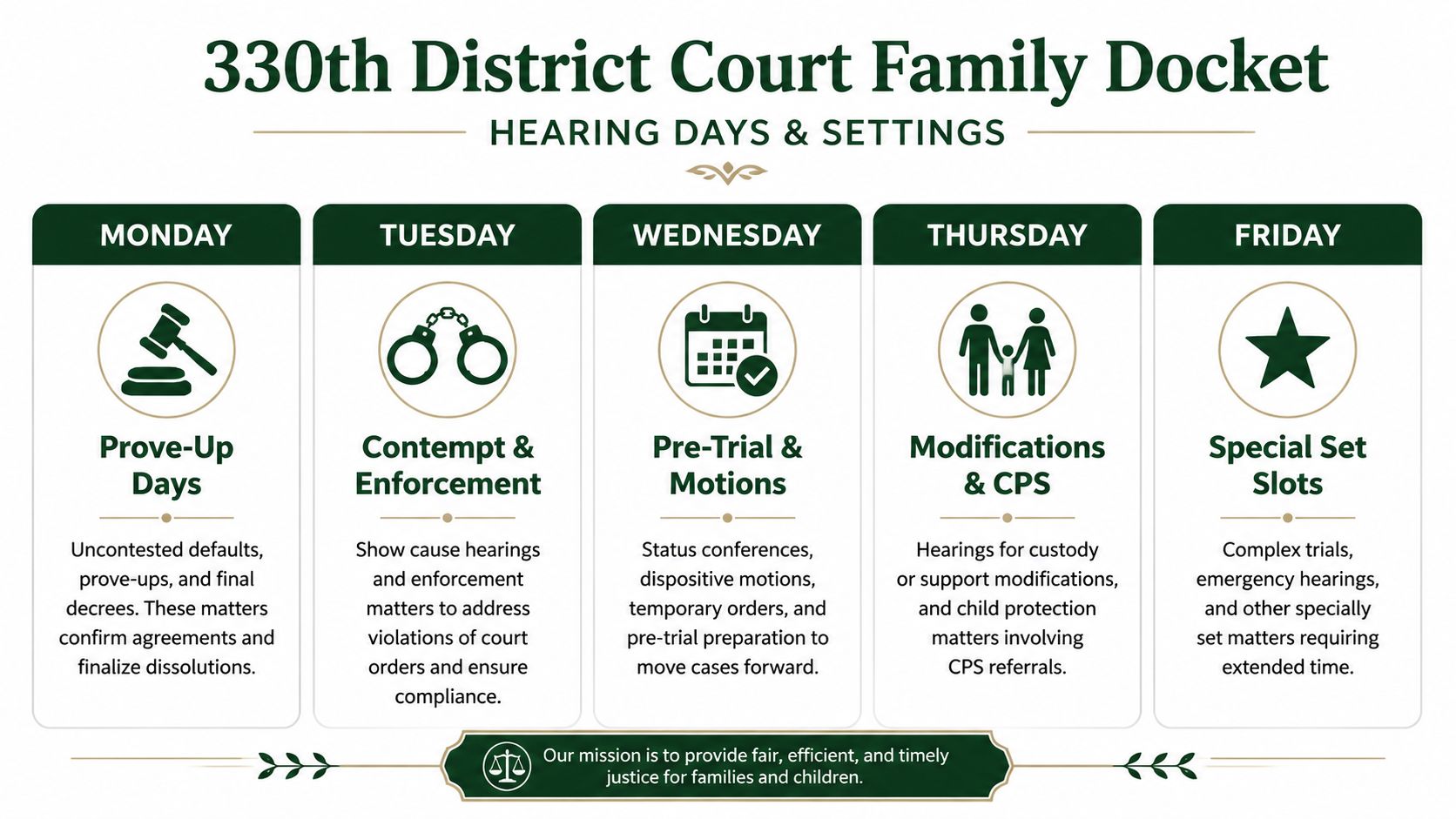
A lawyer looking at the 330th calendar for the first time usually starts with the same question, “Which day is mine?” The answer depends on the hearing type. The court's published schedule sets out fixed days for prove-ups, contempts, pre-trials, modifications, CPS matters, motions, and special settings, and the docket information page confirms how those settings are organized (330th Court PDF, 330th docket information).
What people experience at the courthouse
The 330th calendar is easier to read once you stop treating every family hearing like the same kind of setting. Prove-ups are for matters that can be finished with brief testimony and the right paperwork, and the published schedule places them on Tuesday and Thursday at 8:30 a.m. Contempts are set for Monday at 9:00 a.m., which is where enforcement and compliance disputes usually land (330th Court PDF).
The court also places pre-trials on Monday starting at 1:30 p.m., modifications and CPS matters on Tuesday at 1:00 p.m., and special settings on Monday, Wednesday, and Thursday at 1:30 p.m. plus Tuesday at 9:00 a.m. Motions appear Tuesday through Friday at 9:00 a.m. or whenever the docket permits (330th docket information).
A hearing type and a hearing day have to match. If they do not, the court may not be prepared to take it up.
When a special setting is the right path
Some matters need more time than a regular docket slot can handle. The court says hearings expected to take more than 1.5 hours should be specially set, and that special setting requires both sides to agree before it is placed on the docket (330th Court PDF).
That rule matters in contested custody trials, complicated property divisions, business-owner divorces, and other hearings that cannot be resolved in a quick appearance. A short agreed divorce can often fit a prove-up setting. A disputed property case involving retirement accounts, a closely held business, and tracing issues usually needs a formal setting instead.
For readers comparing courts, the 256th District Court family docket procedures show a familiar family-court structure, but each court still keeps its own calendar rules and hearing assignments. The date on your notice is not just a placeholder, especially once a case is already on a trial track.
Which Judge Hears Your Family Matter in the 330th
A lawyer sitting with a new client usually has to answer the same question first, who is going to hear this case. In the 330th, that answer depends on whether the matter is final or temporary, contested or routine. The court's published calendar draws a line between the district judge and the associate judge, and that line controls what gets heard, when it gets heard, and who has authority to sign off on it (330th Court PDF).
The district judge handles final trials, final custody modifications, contempt and enforcement, appeals from the associate judge and IV-D, motions for new trial, and certain dispositive motions. The associate judge handles temporary hearings, TROs, writs, protective orders, CPS status and permanency hearings, and discovery disputes.
District judge and associate judge are not interchangeable
That split is not just clerical. It works like a courthouse traffic pattern, one lane for the big, final turn and another for the shorter detours that keep a case moving. If your matter is headed for a final trial, a contempt punishment hearing, or an appeal from the associate judge, you should expect the district judge to make the key ruling. If the issue is temporary relief, a protective order, or a discovery fight, the associate judge is usually the first stop.
The practical effect is speed and order. Interim disputes can be handled faster, while final and dispositive matters stay with the district judge. That affects how quickly the case moves and what kind of record gets made.
| Matter Type | District Judge | Associate Judge |
|---|---|---|
| Final trial | Yes | No, unless later referred |
| Final custody modification | Yes | No, unless later referred |
| Contempt and enforcement | Yes | No, for the main hearing |
| Appeals from associate judge | Yes | No |
| Temporary hearings | No | Yes |
| TROs | No | Yes |
| Protective orders | No | Yes |
| CPS status and permanency hearings | No | Yes |
| Discovery disputes | No | Yes |
What happens if you object to an associate judge ruling
If a party disagrees with an associate judge ruling, that party can ask for a de novo hearing before the district judge within the applicable window after the ruling is rendered. A de novo hearing means the issue is heard again, not just checked against a paper record.
That step trips up a lot of litigants. They treat the associate judge's ruling like the end of the road, then miss the short deadline to object. If you want the district judge to hear it again, the request has to be made promptly and correctly.
The result is a court system with two decision-makers, each with a defined role. Some matters can be handled by the associate judge in uncontested or temporary settings, while contested finals and later review stay with the district judge. Know which room your hearing belongs in before you walk in and start talking.
Filings, Forms, and the Path to Final Orders
A family case in the 330th often begins with an e-filed petition or motion, but that is only the first filing. The clerk system, including eFileTexas, gets the case into the courthouse, then the family department places it in the family pool by random draw. After that, the job shifts to matching the case with the right setting, the right paperwork, and the right path to a final order.
The paperwork has to fit the setting
In ordinary divorce and custody cases, the court expects the standard family-case paperwork to be in place. That can include the Dallas County family case information sheet, the standing order on children, the certificate of completion of parenting class where applicable, the inventory and appraisement in divorce, and a proposed order uploaded as a Word attachment.
Service matters too. A respondent can be served by certified mail, constable, or private process server. If the respondent does not answer, the clerk may issue a citation by publication after a documented search, but that is not the same as assuming silence will move the case forward.
Practical rule: the judge can only sign a final order when the paperwork tells a complete story. Missing service, missing proposed language, or missing required attachments can stop the case cold.
Four common paths to final orders
The 330th's procedures point to four finishing paths. One is the agreed prove-up on the published prove-up docket, where both spouses testify briefly and sign the decree on the record. Another is the default prove-up when the other side fails to appear, which requires a proof of service, a default judgment motion, and supporting affidavits.
A third path is an uncontested agreed order rendered by the associate judge on the short-set docket. The fourth is a special-set final trial before the district judge after the pretrial conference. Each path has its own approval point, and using the wrong packet for the wrong setting is a common reason families get sent home.
For agreement-based matters, the 330th's procedures say agreed orders can be finalized by affidavit and filed through the District Clerk, while default orders require a scheduled prove-up and a complete packet, including the Final Order, Certificate of Last Known Address, Military Affidavit, and Austin form accepted before the hearing (330th policies PDF).
The published court calendar and required forms are set out in the 330th Court PDF, so it helps to read that document the way you would a hearing notice, line by line. If you want another useful Dallas court comparison, the 302nd District Court family docket procedures show how much the local path to final orders can vary even inside the same county. Lawyers who practice here pay attention to the individual court's published process, not just the general Texas Family Code baseline.
Common Mistakes Dallas Litigants Make at the 330th
Most problems at the 330th don't come from the merits of the case. They come from procedure, and procedure can shut a case down before anyone reaches the substance of a divorce, custody fight, or enforcement issue.
The errors that cause the most trouble
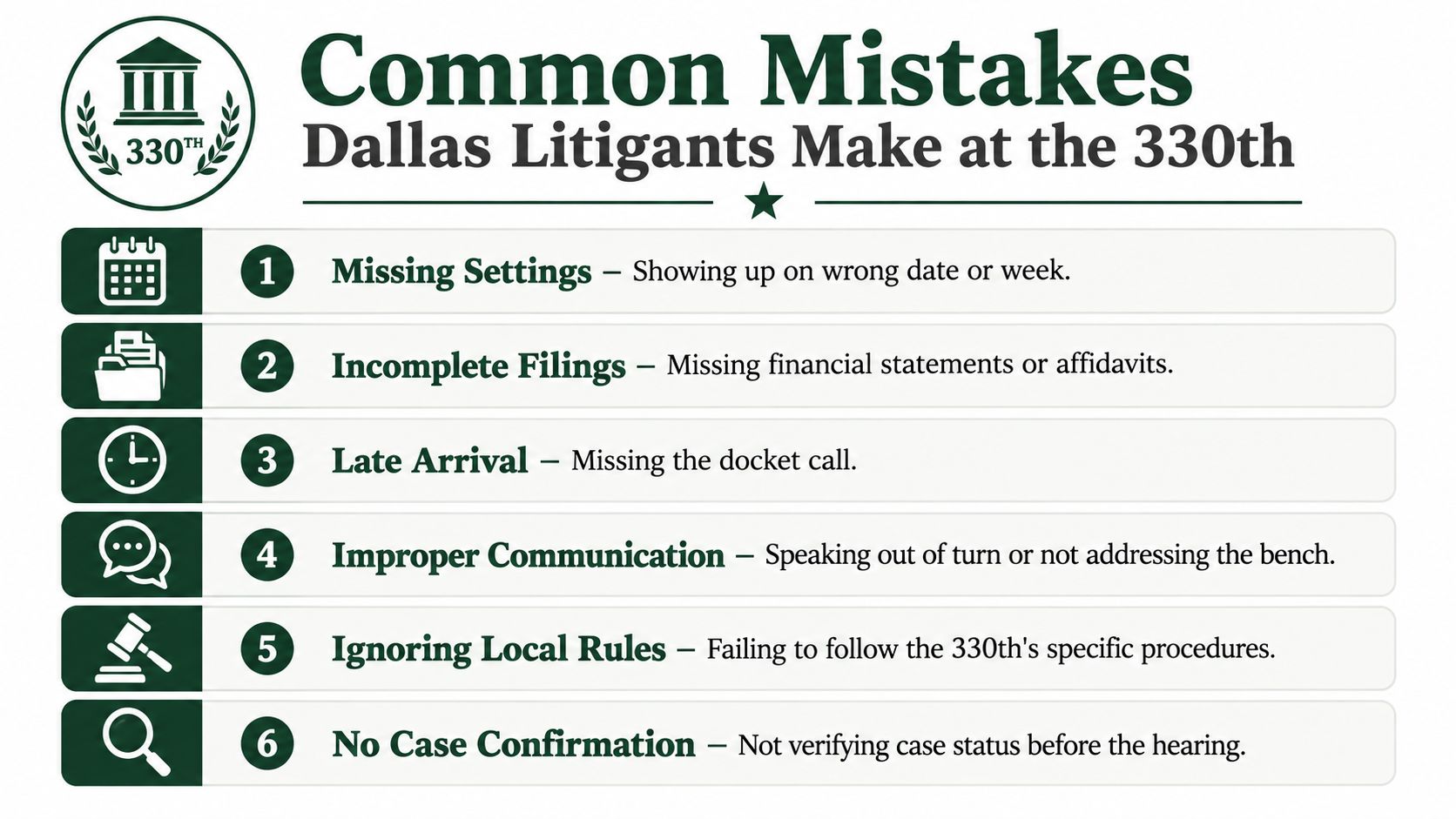
The first mistake is missing the setting. People show up on the wrong date, the wrong week, or without checking whether the case moved from the associate judge's docket to the district judge's docket after a referral. A docket notice matters more than a memory, and a phone confirmation the day before can save a wasted trip.
The second mistake is asking for a special set without showing a real reason or without first trying the published prove-up or short-set slots. The 330th can deny that request quickly, especially when the issue really belongs on one of the court's existing calendar lanes.
The third mistake is bringing a default prove-up with an incomplete packet. Missing proof of service, no military affidavit, no default judgment motion, no proposed decree, or testimony that doesn't line up with the petition's jurisdictional allegations can all derail the hearing. A default hearing isn't a formality, it's a proof process.
The fourth mistake is agreeing to a continuance after a trial setting and then assuming the hearing stays alive in the same form. The 330th disfavors that path, and it often means a party has to re-set and re-serve. Once the case is on the trial track, the date has weight.
The fifth mistake is ignoring the associate judge's order and failing to ask for a de novo hearing on time. If you want the district judge to revisit the ruling, the request has to be made within the allowed window. Letting that deadline pass can forfeit the objection.
The sixth mistake is filing without the Dallas County standing order on children attached, which can lead to the clerk rejecting the petition. That's a painful lesson because it's preventable.
What to do before you walk into court
Prepare the decree language before a prove-up, confirm the setting by phone or docket notice the day before, and make sure you know which judge is hearing the matter. If the hearing is on the associate judge's docket, treat that ruling as something you may need to respond to quickly.
A family case in Dallas County doesn't usually fail because the legal issue was impossible. It usually fails because the timing, forms, or setting didn't match the court's published procedure.
If you're facing a divorce, custody, modification, or enforcement hearing in the 330th District Court, The Law Office of Bryan Fagan, PLLC can help you make sense of the docket, the paperwork, and the next step. If you want guidance specific to your Dallas County family case, visit The Law Office of Bryan Fagan, PLLC to connect with a team that handles Texas family law every day.
