 Skip to content
You've stepped off the elevator into the George L. Allen, Sr. Courts Building with a folder of papers, a phone full of screenshots, and no lawyer beside you. You may be trying to start a divorce, establish custody or support, change an existing order, or protect yourself and your children. The first practical question is usually simple: where do you get the right Dallas County family forms, and what happens after you get them?
The Dallas County Law Library is often the best first stop. It provides organized, fill-in-the-blank family-law packets for self-represented litigants, including forms for divorce, SAPCR matters, modification, name change, and paternity, with Dallas County materials added where appropriate. The packet helps you prepare paperwork, but it isn't a filed case, legal representation, or a guarantee that your documents fit your facts. Dallas County's Law Library materials explain the library's role and its family-law resources.
Table of Contents
- Starting a Family Case Without a Lawyer in Dallas County
- What the Dallas County Law Library Provides Pro Se Litigants
- Divorce Forms and Packets Available in Dallas County
- Custody, Child Support, and SAPCR Packets
- Protective Orders and Temporary Orders Packets
- Paternity, Name Change, and Modification Packets
- Where to Get the Forms You Need
- Common Mistakes Dallas County Self Represented Filers Make
- Filing and Service Steps in Dallas County Family Court
- Quick Reference for Dallas County Family Form Packets
- Practical Next Steps After You Pick Up Your Packet
Starting a Family Case Without a Lawyer in Dallas County
A self-represented litigant, often called a pro se litigant, handles a case without hiring an attorney. In Dallas County family court, that can include a person filing for divorce, asking for custody or child support through a SAPCR, establishing paternity, requesting a name change, modifying an existing order, or seeking protective or temporary orders.
The first decision is identifying the kind of case you have. A parent with no prior order may need an original SAPCR. A parent who already has a final custody or support order may need a modification or enforcement filing instead. A spouse who agrees on every issue may qualify for an uncontested divorce process, while disagreement about children, property, support, or the divorce itself can require a contested petition.
Choose the correct starting route
You'll generally choose among three paths:
- A Law Library packet: This gives you printed forms and Dallas County-specific materials, but the packet remains unfiled until you submit it to the appropriate clerk.
- TexasLawHelp forms: These provide statewide forms and instructions that may help you understand the paperwork, but you must determine whether Dallas County materials also belong with your filing.
- Guide and File: Dallas County's District Clerk identifies Guide and File as an online option for an uncontested divorce without children and for adult name changes. The system asks questions, generates documents, and supports electronic filing when the matter meets its requirements. Dallas County's self-represented family forms page describes those options.
The Law Library is a starting point, not the courthouse filing counter. It can help you find and understand procedural materials, but you still have to select the proper case type, complete the forms truthfully, file them, arrange service or obtain a valid waiver, and follow the court's instructions.
Practical rule: A packet can organize your case, but only the clerk's filing process starts the case.
What the Dallas County Law Library Provides Pro Se Litigants
You arrive at the George L. Allen, Sr. Courts Building with a family-law problem and no lawyer. The Dallas County Law Library, located in Suite B40 at 600 Commerce Street, gives you a place to request printed materials before you reach the filing counter. Its main department information lists public hours as Monday through Friday, from 8:00 a.m. to 4:30 p.m.
Ask the desk for a packet that matches your case. Family packets may include TexasLawHelp.org forms for divorce, SAPCR, modification, name change, or paternity. Staff print the forms for the selected case type and may add Dallas County materials, including Standing Orders and forms for citation by posting or publication when applicable.

Understand what staff can and can't do
The county describes these packets as fill-in-the-blank forms with extensive instructions. Staff can help you locate resources, use legal research tools, and understand general procedure. They cannot represent you, select your legal strategy, predict a judge's ruling, or provide advice about the facts of your individual case.
A packet is like a prepared route map, not a filed case. The documents remain unfiled and unstamped until you submit the completed originals to the Dallas County District Clerk's Family Courts filing office, or use an eligible electronic filing route. The clerk accepts the petition, issues citation when required, and answers filing-fee questions.
Library forms, copies, and printouts cost $0.25 per page. TexasLawHelp forms can also be downloaded without charge, a distinction explained in The Dallas County Law Library FAQ.
Divorce Forms and Packets Available in Dallas County
You arrive at the Allen Courts Building with an agreement in hand, but the packet title still matters. Dallas County divorce materials generally fall into three practical categories. Start by identifying your facts and filing goal, then choose the packet that matches.
An uncontested, no-children divorce may fit when both spouses agree to the divorce and every related term, no minor children are involved, and pregnancy is not involved. The packet commonly contains an Original Petition for Divorce, a Waiver of Citation for the responding spouse, and a Final Decree of Divorce. The waiver addresses formal service, so the responding spouse must complete it correctly and may need a notary. The court still reviews the documents before approving the decree.
Dallas County also identifies Guide and File as an electronic option for an eligible uncontested divorce without children. The system interviews the filer online, prepares the petition, and can support direct e-filing when the case meets its eligibility screens. It helps with form selection, but you must review the terms covering property, debt, a name change, and any waiver before submitting them.
A contested divorce packet usually starts with the Original Petition for Divorce. After filing, the District Clerk issues the Citation when service is required. The packet may also include a Final Decree, which stays blank until the case is ready for final resolution. Texas law generally includes a 60-day waiting period, subject to statutory exceptions. Dallas County materials also identify a $350+ filing fee, depending on the filing and applicable charges. Confirm the current amount in the Dallas County District Clerk divorce filing fee schedule before filing.
| Packet Type | Best For | Filing Method | Key Forms |
|---|---|---|---|
| Uncontested divorce without children | Spouses who agree and meet eligibility requirements | Paper filing or eligible Guide and File filing | Petition, waiver, final decree |
| Guide and File divorce | Eligible uncontested divorce without children | Electronic filing | Interview-generated petition and final documents |
| Contested or child-involved divorce | Disputed terms or a divorce involving children | District Clerk filing, paper or electronic when available | Petition, citation, final decree |
The Law Library packet is a starting set of documents, not a complete solution for every financial issue. A high-asset or business-owner divorce may require careful work on business valuation, separate property, retirement assets, stock compensation, reimbursement claims, and post-divorce implementation. The District Clerk receives the filing, but the filer remains responsible for choosing the correct packet, completing each document, and submitting the required papers.
Custody, Child Support, and SAPCR Packets
A SAPCR, or Suit Affecting the Parent-Child Relationship, is the case type used to ask a Texas court for orders concerning a child. It can address conservatorship, possession and access, child support, medical support, and related parental rights.
The Dallas County Law Library's SAPCR materials typically organize the filing around documents such as:
- Petition in SAPCR: Starts the case and asks the court for specific orders.
- Possession provisions: May include a Standard Possession Order or another requested parenting schedule.
- Child Support Worksheet: Helps present financial information used in support calculations.
- Proposed order: Gives the judge a document to review and sign if relief is granted.
- Citation: Supports formal service on the other parent when service is required.
The right packet depends on whether a prior final order exists. If there's no existing order, an original SAPCR may be appropriate. If a court already entered orders and circumstances have changed, a modification packet may be needed. If the other parent violated an existing order, an enforcement filing may be the proper route. A paternity packet may also be necessary when legal parentage hasn't been established and the family needs orders for support, custody, or possession.
Read the Dallas County inserts
The Law Library adds Dallas County-specific materials to its packets, including standing-order materials concerning children and possession schedules. Those inserts matter because statewide forms don't always contain every local document you'll need to review, attach, or serve.
For example, a parent may complete a statewide custody form correctly but omit a Dallas County standing-order attachment. That omission can create a filing or hearing problem even though the main petition appears complete. Use the packet's checklist and confirm whether each insert applies to your requested relief.
After completing the forms, take the original filing to the Dallas County District Clerk's Family Courts office in the George L. Allen, Sr. Courts Building. The Law Library prepares the paperwork. The District Clerk receives and processes the filing.
Protective Orders and Temporary Orders Packets
Protective orders and temporary orders serve different purposes. A family-violence protective-order application asks the court for protection based on alleged family violence. Temporary orders are usually requested within an existing divorce or SAPCR to address immediate issues such as possession, support, property use, or conduct while the larger case continues.
A protective-order packet may contain an Application for Protective Order, an affidavit or sworn statement, a proposed order, and service instructions. The filer must describe the facts clearly and truthfully, identify the people involved, and explain why protection is requested. Emergency circumstances can affect how quickly the court reviews the request, but no packet guarantees that the judge will grant relief.
Temporary-order materials generally connect to an existing case. A person filing a divorce may need temporary orders concerning children, expenses, residence, or property. A parent in a SAPCR may need temporary possession or support terms while the case is pending.
Dallas County family cases also involve standing-order materials that address conduct and, in cases involving children, restrictions and possession-related requirements. A separate protective-order request requires its own sworn application. Don't assume that a standing order is the same thing as an individually issued protective order.
Filers seeking immediate relief should ask the courthouse staff where the current reception point is and what emergency submission process applies. The associated judge's role and the path from filing to review can vary by case posture. Information about what a Dallas County family court associate judge may decide can help explain the distinction between temporary proceedings and final orders, but it isn't a substitute for reviewing the current local instructions.
Paternity, Name Change, and Modification Packets
Some family matters don't begin with divorce, and others arise after a court has already entered a final order. Dallas County's Law Library organizes packets for those situations so a filer can start with the right type of pleading.
A paternity packet may include a Petition to Adjudicate Parentage, an order for the court's consideration, and a Voluntary Acknowledgment of Paternity form. The purpose is to establish legal parentage when the family needs enforceable orders concerning custody, possession, or support. Parentage questions can affect the proper parties, required notices, and the relief a court can enter.
An adult name change is a different type of filing. A minor's name change may be connected to a SAPCR and may require information about the child, parents, and existing orders. Don't use an adult form for a child or assume a name change resolves parentage, custody, or support issues.
A modification packet is used to request changes to a prior final order. The requested change might concern conservatorship, possession, child support, or spousal maintenance. The filing should identify the prior case and cause number so the request can be associated with the existing order.
Filing channels can differ. Paternity matters generally proceed through a family district court filing process. Adult name changes may involve the County Clerk, while a modification belongs with the existing family case through the District Clerk. Guide and File may be available for selected filings, but eligibility depends on the case type and the platform's current requirements.
Where to Get the Forms You Need
A first-time filer may leave home with a downloaded PDF and still lack the local pages needed for filing. Dallas County offers three practical starting points. Choose based on whether you need a county packet, online preparation, or help sorting out the case type.
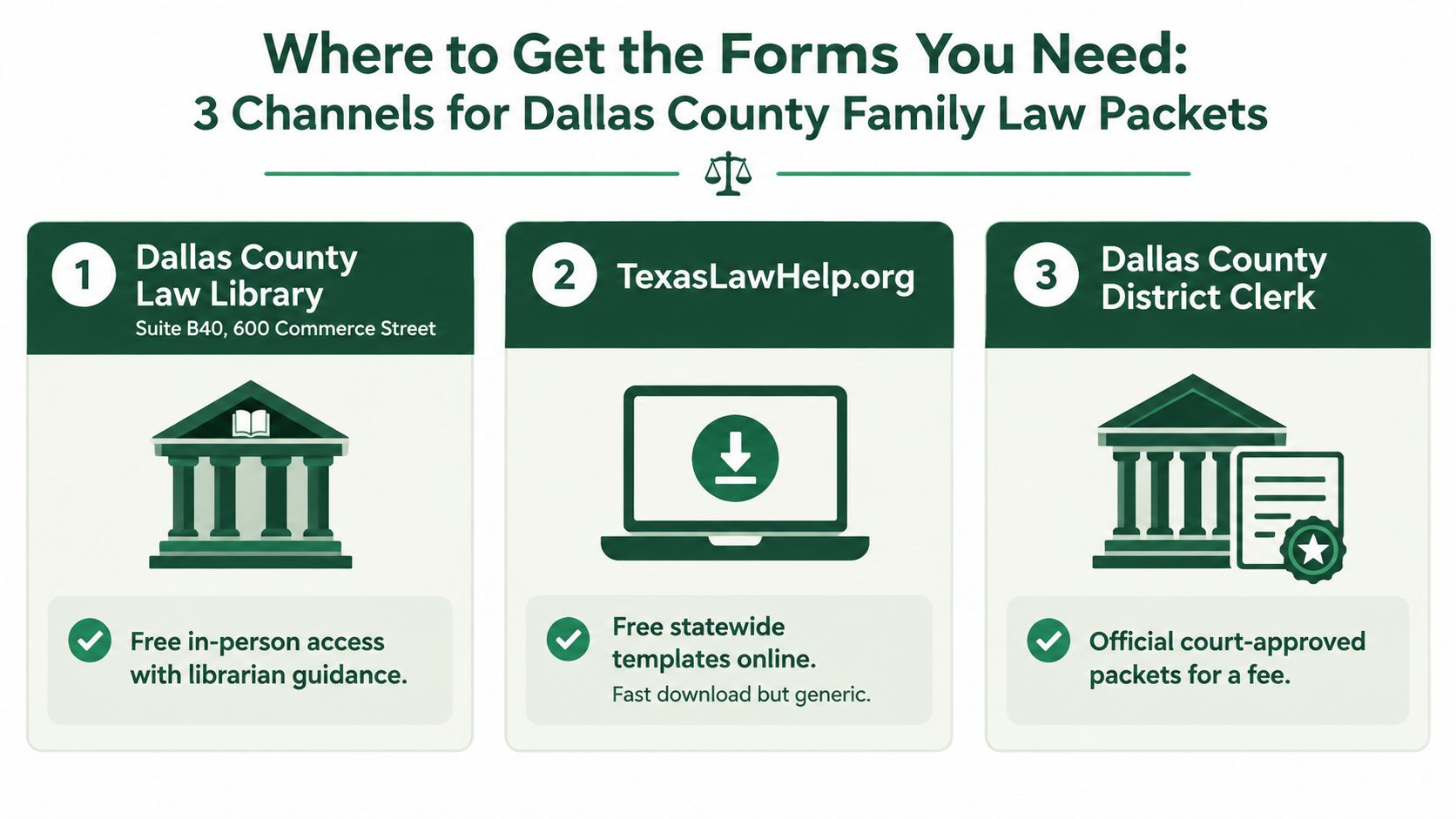
The Law Library is the hands-on option. At the library inside the Allen Courts Building, you can request a packet by subject, review its instructions, and use research materials during the posted in-person hours. Ask what must be filed with the District Clerk or another Dallas County office, because the packet itself is only your preparation set. Extra pages or copies carry the county's stated per-page charge. For location and courthouse context, see this guide to the George Allen Sr. Courts Building, where family cases are heard.
TexasLawHelp.org supplies free statewide forms and guided interviews for matters such as divorce, SAPCR, paternity, and protective orders. Use those materials as a starting point, then check them against current Dallas County standing orders and local attachments. A statewide form does not automatically include every county-specific requirement.
Guide and File may fit eligible uncontested divorces without children and adult name changes. It asks screening questions, prepares documents, and may support e-filing. It cannot assess complicated property tracing, a closely held company, disputed retirement interests, relocation, CPS involvement, or contested custody history.
For a simple eligible matter, online preparation may be convenient. A contested modification, enforcement case, or complex-asset matter calls for careful packet review, often with a qualified attorney.
Common Mistakes Dallas County Self Represented Filers Make
A complete-looking packet can still fail if the filer chooses the wrong case type or skips a local requirement. The most common problems arise from treating forms as interchangeable PDFs rather than documents tied to a particular case, court, filing office, and service method.
The errors that cause avoidable delays
- Missing local materials: A SAPCR filer may overlook a Dallas County standing-order attachment concerning children. Review every insert before signing and serving documents.
- Wrong divorce version: A no-children form set doesn't fit a case involving minor children. Property, pregnancy, or disagreement can also affect which process is appropriate.
- Incorrect clerk: Family filings generally go through the District Clerk's Family Courts process, not a general County Clerk records counter. Confirm the destination before you travel.
- Defective service paperwork: A waiver may lack a required signature or notarization, or a citation may not be properly issued or returned. A defective service step can prevent the court from moving forward.
- Unresolved fee issues: If you can't pay a filing fee, ask the clerk about the current process for a Statement of Inability to Afford Payment of Court Costs. Don't submit an incomplete filing and hope the issue is fixed later.
The same caution applies to exhibits and electronic submissions. Check the current e-filing requirements before uploading large exhibits, because technical rejection can become a procedural delay.

Filing and Service Steps in Dallas County Family Court
Once your forms are complete, separate preparation from filing. The Law Library gives you paperwork. The District Clerk creates the court file and returns file-stamped copies.
- File the original petition. Submit the appropriate pleading through the Dallas County District Clerk's Family Courts filing process, either electronically when available or at the designated counter.
- Save the file-stamped copies. The clerk's stamp confirms that the document entered the court's file. Keep copies for your records and for service.
- Complete service or obtain a valid waiver. If the other party won't sign a legally effective waiver, the clerk can issue citation for service. Service may involve an authorized sheriff, constable, or process server. If the person can't be located, service by posting or publication may require additional sworn information and court approval.
- Track the response and court requirements. Monitor eFileTexas and keep every filing notice. Read any order entered in the case, complete required forms, and avoid assuming that filing alone schedules a hearing.
- Request the appropriate hearing or finalization step. An uncontested case may require a prove-up or final hearing. A contested case may require temporary proceedings, discovery, mediation, or trial preparation. Confirm the setting with the appropriate court coordinator rather than relying on an informal date.
Service is more than delivering a copy of the petition. The method must comply with the applicable rules, and the return of service must reach the clerk correctly. A respondent who signs a waiver may eliminate the need for personal service, but the waiver must be executed in a legally effective manner.

If the respondent doesn't answer or appear, that doesn't automatically mean you win. The court still has to determine whether service, notice, evidence, and requested relief satisfy the law. This is especially important when children, property, protective orders, or support are involved.
Quick Reference for Dallas County Family Form Packets
You arrive at the Allen Courts Building with a packet request, a case type, and several possible filing paths. Use the matrix below to identify the likely office and the legal subject covered. Treat it as a starting map. The packet instructions, an existing cause number, and the current clerk directions control the final route.
| Packet / Case Type | Filing Office | Approx. Filing Fee | Texas Family Code Authority |
|---|---|---|---|
| Divorce | District Clerk, Family Courts process | County's current civil and family filing charges apply | Texas Family Code, marriage dissolution provisions |
| SAPCR | District Clerk, Family Courts process | County's current family filing charges apply | Texas Family Code, parent-child relationship provisions |
| Protective order | Filing location depends on the proceeding and current Dallas County intake instructions | Confirm current county charges and any fee exception | Texas Family Code, protective-order provisions |
| Paternity | District Clerk, family district court process | County's current family filing charges apply | Texas Family Code, parentage provisions |
| Adult name change | County Clerk or the current designated filing channel | Confirm the current county charge | Texas Family Code, name-change provisions |
| Modification | District Clerk, tied to the existing cause number | County's current post-judgment filing charges apply | Texas Family Code, modification provisions |
The Law Library is inside the Allen Courts Building, Suite B40. In-person hours and packet availability can affect whether you leave with a complete set of forms, so confirm those details before making the trip. Staff can provide the requested packet and copies, but the packet does not file your case or select the correct filing office for you.
Packet-copy charges and court costs are separate. A paper packet may have a per-page charge, while an electronic filing can involve portal or court fees. Check the county's published fee schedule for the current filing amount, and ask the District Clerk whether a fee waiver or exception applies to your circumstances. Keep the receipt and compare the packet contents with the filing checklist before submitting anything.
Practical Next Steps After You Pick Up Your Packet
Before you leave Suite B40, confirm the packet's case type, read the instructions, and identify every Dallas County insert. Check whether you're starting a new case or modifying an existing order. If the packet refers to a cause number, court, standing order, or required attachment, don't leave that item unresolved.
Next, complete the petition and supporting forms carefully. Use the District Clerk's current e-filing portal when your case qualifies, or take the original paperwork to the Family Courts filing counter. Keep file-stamped copies, track service, and preserve every e-filing notice.
A simple uncontested filing may be manageable with careful preparation. A disputed custody case, enforcement matter, protective-order request, service-by-publication problem, or financially complex divorce is different. Business interests, retirement accounts, separate-property tracing, relocation, CPS involvement, adoption, and appeals can create consequences that a fill-in-the-blank packet can't evaluate.
If you need help deciding whether self-representation is sensible, a Dallas family-law attorney can review the facts and explain available options. The Law Office of Bryan Fagan, PLLC offers Dallas County family-law consultations and representation for matters that range from basic filing questions to contested divorce, custody, support, and complex property disputes.
The Law Office of Bryan Fagan, PLLC can help you evaluate a Dallas County packet, identify filing and service issues, and plan the next stage of a divorce, custody, support, or modification case. Contact the Dallas office to discuss your circumstances before you file documents that could affect your property, parental rights, or financial obligations.
