 Skip to content
Dallas County pro se family law forms are available from the Dallas County District Clerk Family Forms page, the Dallas County Law Library in the George L. Allen, Sr. Courts Building, and TexasLawHelp, with in-person, mail, and e-file options connected to that building. The main courthouse location is 600 Commerce Street, Suite 103, Dallas, Texas 75202, and the District Clerk lists (214) 653-7307 for assistance with its forms gateway. Dallas County's Family Court Forms page is the safest starting point when you're representing yourself.
You may be standing outside the George L. Allen, Sr. Courts Building with a divorce, custody, support, or protective-order problem and no idea which form applies. The practical answer is to start with the official county page, use the Law Library for printed materials and local guidance, and use TexasLawHelp when you need help identifying the correct case type.
A form directory alone isn't enough. Dallas County materials distinguish between an uncontested divorce without children and other family-law filings, while county checklists identify additional documents that can determine whether the clerk accepts your papers. Start by naming the legal problem, not by downloading the first PDF that contains the word “family.”
Table of Contents
- Where to Start When You Need Dallas County Family Law Forms
- The Dallas County District Clerk Family Forms Page
- The Dallas County Law Library Inside the Allen Courts Building
- TexasLawHelp and the State Judiciary Self-Help Library
- Matching Forms to Your Family Law Case Type
- Filing Options for Dallas County Family Law Cases
- Typical Filing Fees and What to Expect at the Counter
- Supporting Documents Dallas County Checklists Commonly Require
- When Pro Se Filing Stops Being Practical in Dallas County
- Practical Next Steps After You Have the Right Forms
Where to Start When You Need Dallas County Family Law Forms
Use these three sources before relying on a commercial template, an old packet, or a form found through a general internet search:
Dallas County District Clerk Family Forms page: This is the county-maintained online source for official family-law forms and pro se materials. The page includes a Statement of Inability to Afford Payment of Court Costs, Request for Service, and protective-order-related documents. It also provides access to Guide and File for an Uncontested Divorce Without Children and Adult Name Changes. Visit the Dallas County District Clerk's family forms gateway before preparing your filing.
Dallas County Law Library: The library is in Suite B40 of the George L. Allen, Sr. Courts Building. Dallas County's 2023 newsletter states that the library printed the complete TexasLawHelp family-law form sets for divorce, SAPCR, modification, name change, and paternity, along with Dallas County additions such as Standing Orders and Citation by Posting or Publishing. The county Law Library newsletter gives its listed hours as Monday through Friday, 8:00 AM to 4:30 PM, and its phone number as 214-653-7481.
TexasLawHelp: This resource organizes materials by case type. Its divorce, custody, parentage, and modification guides help you determine whether you need a divorce petition, a SAPCR filing, an answer, or a petition to modify an existing order. TexasLawHelp's family-law answer guidance is especially useful if someone has already served you.
The right form depends on whether you're filing for divorce, custody, paternity, modification, enforcement, or a protective order. Identify that category first. Starting with an outdated packet can create avoidable filing problems.
The Dallas County District Clerk Family Forms Page
The District Clerk page is the primary downloadable source for Dallas County family-law paperwork. It's valuable because it gives self-represented litigants a county-specific starting point rather than forcing them to guess whether a statewide template matches local filing requirements.
The page separates materials by purpose. Look for the documents that correspond to your procedural position:
- Divorce matters: An original petition starts the case, while a waiver of service may be relevant when the respondent agrees to waive formal service. A final decree ends the case only after the required issues have been resolved and the court signs it.
- Parent-child cases: A petition to modify the parent-child relationship is used when an existing custody, possession, or support order may need to change. SAPCR materials address suits affecting the parent-child relationship, including parentage-related disputes.
- Protective orders: An application for a protective order and hearing-related notice materials involve different service, notice, and evidence concerns from an ordinary divorce.
- Affordability and service: A Statement of Inability to Afford Payment of Court Costs and a Request for Service may be necessary when you can't pay costs or need formal service arranged.
Use the county page to confirm the exact document title and whether Dallas County provides a related instruction sheet. A statewide form may describe the same general legal action, but local filing materials can include requirements that a generic packet doesn't address.
Before filing, check the current version displayed by the District Clerk. Complete documents carefully, use the format the form requests, and keep a complete copy of everything submitted. The District Clerk's page is the local gateway, but it isn't a substitute for legal advice when your case involves disputed custody, property, service, or safety issues.
The Dallas County Law Library Inside the Allen Courts Building
The Dallas County Law Library is the most practical in-person destination when you need printed family-law forms or help locating the right packet. It's inside the George L. Allen, Sr. Courts Building at Suite B40, with public access from the courthouse on Commerce Street.
Dallas County's 2023 newsletter lists the library's hours as Monday through Friday, 8:00 AM to 4:30 PM, and identifies 214-653-7481 as its telephone number. Court holidays and schedule changes can affect access, so call before making a special trip.
The library has printed TexasLawHelp family-law materials for divorce, SAPCR, modification, name change, and paternity, plus Dallas County-specific additions. That combination matters. A statewide packet may help you draft the core pleading, while the county material may identify a Standing Order, service document, or local checklist item that belongs with it.
What library staff can and cannot do
A librarian can help you locate a form, find a reference book, identify a checklist, and explain where filing materials are submitted. Library staff can't choose a litigation strategy, tell you what facts to plead, predict a judge's ruling, or represent you.
You can also use the library's public research and document services. Ask about printing and copying before submitting a large packet, because public document services may involve a per-page charge.
For courthouse layout and family-case logistics, this guide to the George L. Allen, Sr. Courts Building can help you orient yourself before arriving. Bring identification, your case information, and a written list of questions. You'll get more from a short library visit if you know whether you're dealing with a new case or an existing order.
TexasLawHelp and the State Judiciary Self-Help Library
TexasLawHelp is most useful when you know the family problem but don't yet know the correct pleading. Its materials are organized by case type, not as one universal family-law packet. That distinction prevents a common error, using a no-children divorce kit for a marriage involving children or using an original custody filing when the actual issue is modification.
TexasLawHelp provides separate materials for an uncontested divorce without children, an uncontested divorce with children, respondents in divorce cases, respondents in SAPCR cases, and modifications involving custody, visitation, child support, and medical or dental support. Its family-law filing guidance is a useful reference when you've received papers and need to determine your role.
Use the resources in this order:
- Start with the case-type questions: Decide whether the problem is divorce, parentage, custody, support, enforcement, or modification.
- Read the instructions before downloading: The facts that trigger extra forms often appear in the guide rather than in the PDF title.
- Cross-check Dallas County materials: After identifying the statewide packet, compare it with the District Clerk's local forms and checklist.
- Save your completed documents: Download and store the generated PDFs, instructions, and supporting documents in a folder you can access later.
TexasLawHelp can identify the correct family-law pathway, but Dallas County remains the filing location for a Dallas County case. Don't assume a statewide packet includes every local document. The county's materials specifically show why self-represented filers need a scenario-based checklist, particularly when children, service problems, or support orders are involved.
Matching Forms to Your Family Law Case Type
The form you need depends on what you want the court to do and whether an existing order already controls the family. A new divorce is different from a custody case between unmarried parents. A request to change support is different from an enforcement action alleging that someone violated an order.
| Case Type | Primary Forms | Typical Dallas Add-On |
|---|---|---|
| Divorce without children | Divorce petition, service or waiver materials, final decree | Local instructions and applicable standing-order materials |
| Divorce with children | Divorce petition, child-related pleadings, proposed final orders | Parenting and possession materials, support-related documents |
| SAPCR or parentage | SAPCR petition, parentage pleading, possession and support materials | Dallas County checklist items and service documents |
| Modification | Petition to Modify Parent-Child Relationship, supporting facts, proposed order | Prior order, affidavit or testimony materials, support documents |
| Enforcement or protective order | Motion for Enforcement or Application for Protective Order | Service, notice, evidence, and hearing-related documents |
Read the case label carefully
TexasLawHelp's organization by case type is a strong screening tool. If you have children, don't stop at a divorce packet. Your filing may require decisions about conservatorship, possession and access, child support, medical support, and geographic restrictions.
If a final order already exists, a modification or enforcement pathway may be appropriate instead of a new original case. Bring the prior decree or order to the Dallas County Law Library or the District Clerk intake area so you can identify the proceeding correctly.
Paternity disputes can also involve more than a simple name-change or custody form. Parentage may need to be established or challenged before the court can address the full range of parent-child orders.
Protective-order cases have their own urgency and procedure. The application, notice, service, and evidence must fit the allegations and the relief requested. Don't use an ordinary divorce filing to raise a safety issue.
The Dallas County pro se checklist shows why a form cluster is better than a single-document search. Some cases call for an affidavit of testimony, the Austin S.A.F.R. information form, a wage withholding order, or a statement of evidence when service occurred by posting. Those requirements depend on the facts and procedural posture.
Filing Options for Dallas County Family Law Cases
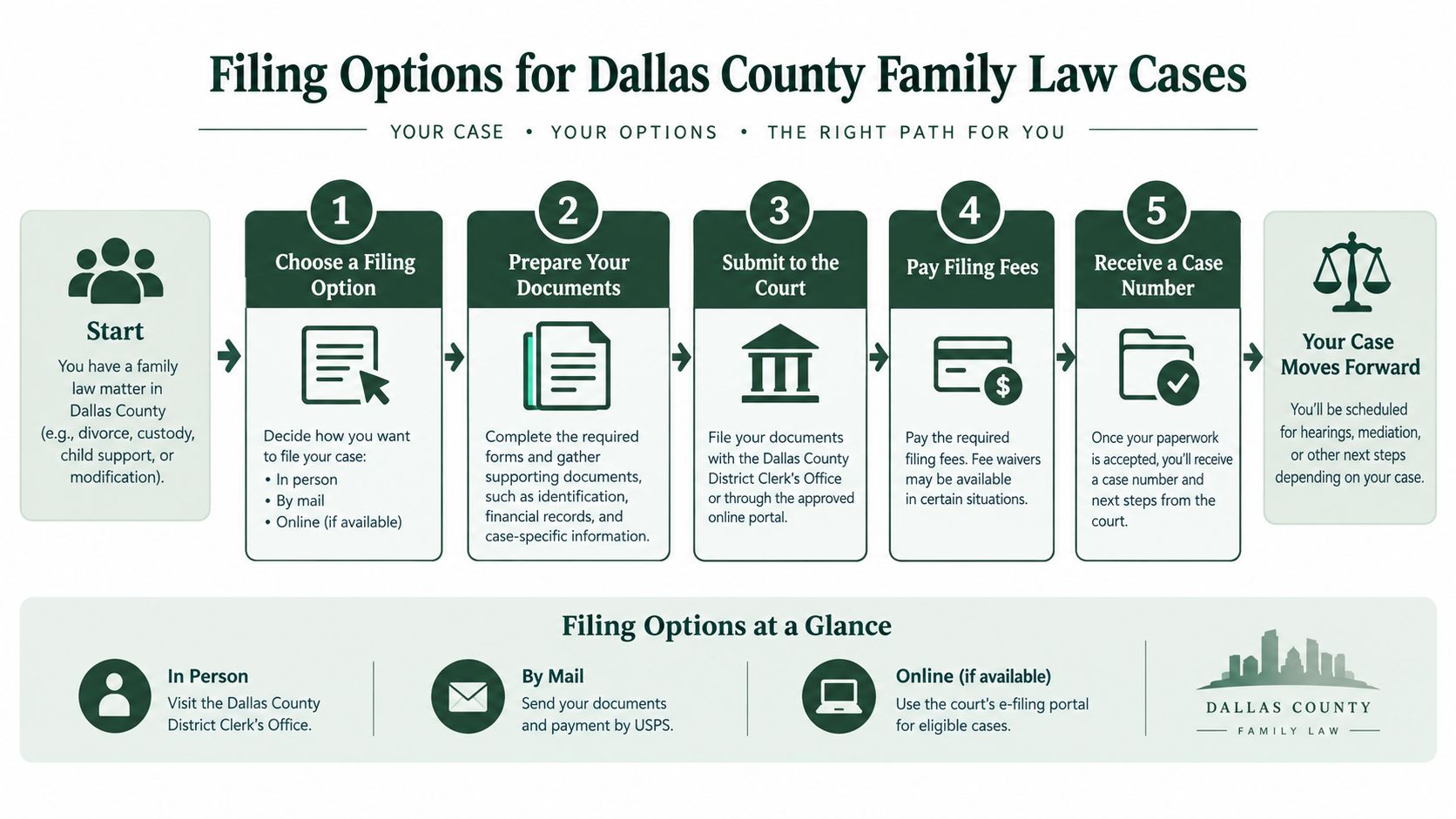
The George L. Allen, Sr. Courts Building at 600 Commerce Street is the central Dallas County location identified on the District Clerk's family forms page. You generally need to choose among in-person filing, mail, and electronic filing, but the correct option depends on urgency, document type, and whether the clerk accepts the submission through that channel.
In-person filing
In-person filing lets you bring your papers to the District Clerk's filing area and address basic submission questions at the counter. It's the practical choice when you need to confirm that a packet is complete or when a time-sensitive request requires prompt attention.
Take a complete copy for your records. Ask for file-stamped or conformed copies if the clerk provides them, and check that the case number and filing details appear correctly before leaving.
Filing by mail
Mail a family-law filing only after confirming the current mailing instructions and payment requirements with the District Clerk. Use a secure mailing method, include the required payment or fee-waiver paperwork, and provide a return envelope if you need copies sent back.
Mailing creates a delay between delivery, acceptance, and your receipt of file-stamped documents. It isn't the right choice when you need immediate confirmation.
E-filing
Texas e-filing can be available to self-represented litigants through an approved provider. You'll need readable PDFs, the correct case category, payment or a completed fee-waiver request, and a way to monitor filing notices.
Do not assume an electronic submission is filed merely because you clicked submit. Keep the envelope, acceptance notice, rejection notice, and every uploaded document together.
If the courthouse location is inconvenient, review Dallas County subcourthouse locations in Garland, Richardson, and Mesquite to determine whether a related service is available there. Don't assume every family-law filing can be initiated at every subcourthouse.
Typical Filing Fees and What to Expect at the Counter
Dallas County filing costs change, and the correct amount depends on the case type, requested services, and whether you need citation or service. The District Clerk's current fee schedule is the only reliable source for the amount due on the day you file. Review the Dallas County divorce filing fee schedule before preparing a payment.
| Filing Type | In-Person Cashier | By Mail | E-File, Service Fee Extra |
|---|---|---|---|
| New divorce case | Confirm current fee schedule | Payment method must follow clerk instructions | Provider and payment charges may apply |
| SAPCR case | Confirm current fee schedule | Include acceptable payment and return materials | Upload the correct case type |
| Modification | Confirm current fee schedule | Include prior-order information and payment | Check provider submission requirements |
| Answer or counterpetition | Confirm whether a fee applies | Follow current clerk directions | Select the correct filing code |
| Citation or service | Additional cost may apply | Request and pay according to clerk instructions | Service arrangements may be separate |
The cashier counter may accept several payment methods, but acceptance and processing charges can change. Don't send cash through the mail. If you're asking for a waiver, use the Statement of Inability to Afford Payment of Court Costs and complete it accurately.
At the counter, the clerk can process documents and identify basic filing problems. The clerk can't advise you whether a waiver is strategically wise, whether your pleading states the right legal claim, or whether your evidence proves it.
Supporting Documents Dallas County Checklists Commonly Require
The fillable pleading is only one part of many family-law filings. Dallas County checklist materials identify additional items that can determine whether a self-represented filing moves forward or comes back for correction.
Start with the documents tied to the case:
- New-case materials: A civil case information sheet or similar intake document may be required, depending on the filing and current local instructions.
- Existing orders: Bring the prior decree, custody order, support order, or enforcement order for any modification or enforcement proceeding.
- Parent-child documents: A proposed parenting plan, possession schedule, or support-related order may be needed when children are involved.
- Financial material: A support modification may require income and expense information, wage details, and documents supporting the requested change.
- Service material: A Request for Service, waiver, citation, or evidence concerning service by posting may be necessary depending on how the respondent can be notified.
- Protective-order evidence: An application may need a supporting affidavit and exhibits that explain the conduct, dates, threats, injuries, or other facts supporting requested protection.
The county checklist specifically identifies possible add-ons such as an affidavit of testimony, the Austin S.A.F.R. information form, a wage withholding order, and a statement of evidence when service was by posting. Those aren't universal attachments. They become relevant because of the case's facts or procedural history.
Practical rule: Match every attachment to the exact checklist for your case type. A complete-looking petition can still be incomplete if the required order, service document, or evidence statement is missing.
Don't prepare a proposed order casually. The wording can affect possession, support, enforcement, and property rights long after filing. If the proposed order would resolve a contested issue, attorney review is sensible before submission.
When Pro Se Filing Stops Being Practical in Dallas County
Self-representation can work for an agreed, limited filing. It becomes risky when the case depends on evidence, testimony, legal objections, discovery, or a contested interpretation of an existing order.
A contested custody dispute is not just a paperwork exercise. The court may need to evaluate conservatorship, possession, safety allegations, relocation, school issues, medical decisions, or a parent's requested geographic restriction. A person representing themselves must present admissible evidence and respond to the other side's arguments while following courtroom procedure.
The same problem appears in more financially complicated divorces. Business ownership, professional practices, real estate, investment accounts, retirement assets, stock compensation, separate-property tracing, reimbursement claims, and disputed or hidden assets require records and legal analysis. A form cannot divide an interest correctly when the value, characterization, or ownership is disputed.
Cases that deserve an attorney consultation
- Interstate custody disputes: Jurisdiction may depend on facts governed by the Uniform Child Custody Jurisdiction and Enforcement Act.
- Relocation cases: Moving a child can affect possession, geographic restrictions, transportation, school arrangements, and parental rights.
- Protective-order hearings: Safety allegations, emergency requests, service, testimony, and exhibits leave little room for procedural mistakes.
- Enforcement proceedings: Contempt or enforcement claims require careful comparison between the existing order and the alleged violation.
- Complex divorce: Business records, retirement interests, separate property, and high-income finances rarely fit safely into a bare form packet.
If the case will be decided through testimony rather than agreed paperwork, you're no longer solving a form problem. You're preparing for advocacy.
A Dallas family-law attorney consultation can help you identify the disputed issues, preserve evidence, and decide whether limited-scope or full representation makes sense.
Practical Next Steps After You Have the Right Forms
Before you walk into the George L. Allen, Sr. Courts Building or submit an electronic filing, use a written checklist. The objective is to prevent a correct form from being filed with the wrong case designation, missing attachment, or incomplete service request.
Confirm the case type. Decide whether the filing involves divorce, SAPCR, parentage, modification, enforcement, or a protective order. Confirm the exact form title on the District Clerk Family Forms page.
Collect the case history. Locate prior decrees, custody orders, support orders, enforcement orders, and relevant service information. For a divorce, gather documents such as the marriage license if the current instructions call for it.
Build the supporting packet. Include the Dallas County checklist items that apply, such as a proposed order, parenting or possession document, affidavit, wage withholding order, or evidence statement. Keep one complete electronic and paper copy.
Choose the filing channel. Use in-person filing when urgency or document review matters, mail when timing permits and the clerk's current instructions support it, or e-file through an approved provider when electronic submission fits the case.
Address payment. Check the current District Clerk fee schedule. If you can't afford court costs, review the Statement of Inability to Afford Payment of Court Costs and the related TexasLawHelp instructions instead of guessing at the waiver process.
Calendar legal obligations. A Texas divorce generally involves a statutory waiting period, subject to exceptions, and service requirements can affect how the case proceeds. Custody, support, protective-order, and enforcement matters have their own timing concerns.
If the other parent or spouse contests service, custody, support, relocation, property division, or the wording of a final order, stop treating the case as a document download. Get a Dallas family-law attorney to review the situation before you file something that limits your options.
The Law Office of Bryan Fagan, PLLC offers Dallas family-law consultations and assistance with divorce, custody, child support, modifications, enforcement, protective orders, and complex property issues. If you're unsure whether your Dallas County matter is simple enough for pro se filing, visit The Law Office of Bryan Fagan, PLLC to learn about available family-law resources and request a consultation.
