 Skip to content
You've spent months exchanging pleadings, gathering school and medical records, and trying to resolve a custody dispute. Now your Dallas County case is approaching pretrial, and you want the judge to set a final trial date. The surprise is that mediation may need to happen before the case can move onto the final-trial track.
The Dallas County local rules for mediation before final trial are driven by the specific policy of the court handling your case. Those policies can require mediation, set deadlines for contacting a mediator, require a status report, and warn that a missed deadline may affect the trial setting. The exact order in your case matters more than a general statement that “Texas courts encourage mediation.”
Table of Contents
- Why Mediation Comes Before Final Trial in Dallas County
- Which Dallas County Family Cases Require Mediation
- Key Timelines and Deadlines for Pretrial Mediation
- Exemptions, Waivers, and Mediator Selection Rules
- A Typical Mediation Day in a Dallas Family Case
- What Happens If You Skip or Miss Mediation
- Preparing for Mediation in Dallas County Family Court
- After Mediation and Next Steps for Dallas Families
Why Mediation Comes Before Final Trial in Dallas County
Dallas County family courts use mediation as a procedural checkpoint in contested cases. Under the 301st Judicial District Court policy, mediation must be completed before pretrial. The policy also states that trial settings are obtained at the pretrial hearing. In practical terms, mediation can stand between an unresolved family dispute and the final trial date you're seeking.
That structure applies to more than divorce disputes over property. It can affect custody, conservatorship, possession and access, child support, enforcement, modification, and other contested family matters. In a custody case, the same 301st policy requires a child-custody evaluation to be started and to have an anticipated completion date before the case moves forward. Mediation is therefore part of a larger readiness process, not an isolated settlement appointment.
Why the court uses this checkpoint
A trial requires witnesses, exhibits, courtroom time, and preparation by the court and both sides. Mediation gives the parties a structured opportunity to resolve some or all issues before the judge must decide them. It also lets parents and spouses create terms that may be more detailed and practical than a ruling made after limited trial time.
For a Dallas parent, settlement can include workable exchange locations, communication procedures, school responsibilities, holiday arrangements, and decision-making provisions. For a business owner or high-income spouse, mediation may allow more time to analyze closely held companies, real estate, retirement assets, equity compensation, separate-property claims, and reimbursement issues than a short hearing permits.
Practical rule: Treat the mediation deadline as part of your trial preparation, not as an optional settlement suggestion.
The local policies also attach consequences to noncompliance. The 301st policy references Dallas Family Court Local Rule 5.03 and warns that failure to appear at pretrial can lead to dismissal for want of prosecution or a default judgment. Other Dallas family court policies warn that missing mediation can result in removal of the trial date. The later sections explain how to identify the rule governing your case and how to avoid turning a scheduling requirement into a litigation emergency.
Which Dallas County Family Cases Require Mediation
The requirement generally matters when a Dallas County family case is contested and has reached the pretrial or final-trial stage. That can include a divorce involving disputed property division, a suit affecting the parent-child relationship involving custody or support, a modification of an existing order, an enforcement proceeding, and many paternity disputes.
The trigger usually comes from the assigned court's standing order, pretrial order, or local policy. Filing the original petition doesn't automatically mean you must attend mediation immediately. The obligation often becomes concrete when the judge issues an order directing the parties to prepare for pretrial or final trial.
Common case categories
A contested divorce may require mediation before the court treats the case as ready for final trial. A custody case may require it before the court addresses disputed conservatorship or possession issues at trial. Modification and enforcement cases can also involve mediation when the parties disagree about changing or enforcing an existing order.
Uncontested matters can follow a different path. For example, a divorce in which the spouses have resolved every issue may proceed through agreed documents or a prove-up process rather than the same contested-case mediation track. Default matters, emergency requests, and protective-order proceedings may also operate under different procedures. A protective order or emergency custody request should not be delayed while someone assumes that ordinary final-trial mediation rules answer every procedural question.
| Case Type | Mediation Required? | Typical Trigger Point |
|---|---|---|
| Contested divorce | Often, under the assigned court's policy | Pretrial or standing final-trial order |
| Custody or conservatorship dispute | Often | Pretrial preparation and final-trial setting |
| Child support dispute | Often when contested | Court order directing pretrial readiness |
| Modification case | May be required | Pretrial or final-trial order |
| Enforcement action | May be required | Court-specific order or contested setting |
| Paternity matter | Depends on the assigned court and disputed issues | Pretrial or case-management order |
| Uncontested agreed case | The same mediation requirement may not apply | Agreed submission or prove-up process |
| Protective or emergency proceeding | May follow a different track | Emergency or protective-order procedure |
The courthouse location alone doesn't determine the rule. Dallas County family matters may be heard through the Dallas County Family District Courts at facilities such as the George L. Allen, Sr. Courts Building or the Frank Crowley Courts Building, but the assigned court's order controls the immediate requirements. Read the caption, standing order, pretrial order, and any later scheduling notice together.
If your case involves domestic violence, a safety concern, CPS involvement, relocation, or an emergency request affecting a child, tell your attorney and the court promptly. Mediation may still be ordered in some circumstances, but safety and emergency relief can change how the court handles scheduling and participation.
Key Timelines and Deadlines for Pretrial Mediation
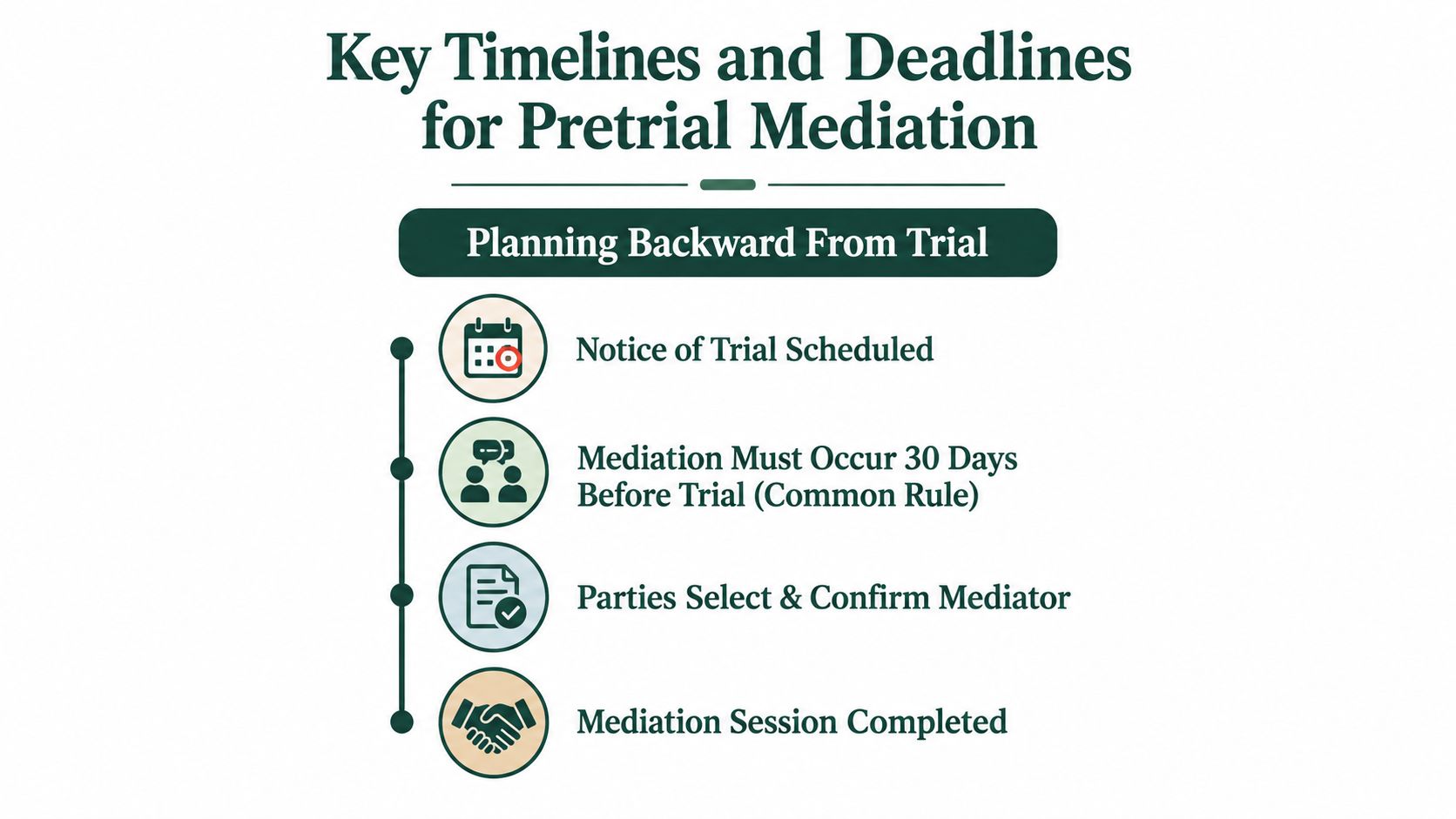
A final-trial date can look far away until the court's mediation deadlines are counted backward. Dallas County does not use one universal mediation calendar. The order assigned to your case controls, so compare the final-trial date, mediation deadline, mediator-selection requirement, filing instructions, and fee provisions in that order.
The 255th Judicial District Court's pretrial order requires mediation before final trial. It requires the mediator's status report confirming that mediation occurred to be filed at least 30 days before final trial. Each party must contact the mediator within five days after the order, and the parties must split mediator fees equally. The order also warns that failing to mediate, file the status report, or pay required fees can affect the trial setting. Review the 255th Judicial District Court pretrial order for its exact language.
Reading the calendar backward
Begin with the final-trial date in your order. If mediation must occur at least 30 days before trial, schedule the session early enough for the mediator to complete and file the status report by that deadline. A session booked too close to trial can create a compliance problem even when both sides intend to participate.
Other Dallas County policies use a 45-day benchmark. One policy also requires the parties to mediate again if the case has not been mediated within the last 12 months. Those provisions do not automatically govern every Dallas family case. They show why a general online summary cannot replace the order in your file.
A separate Dallas County policy gives the parties 20 days after the first answer is filed to select a mediator before the court appoints one. It requires mediation no later than 45 days before trial. The Dallas County court policy concerning mediator selection and timing concerns a county court at law, but its deadlines show how specific local scheduling language can be.
For a case-specific comparison, review the Dallas County 302nd District Court family docket procedures. Confirm the selection and completion deadlines, filing requirement, fee allocation, and procedure for reporting an impasse.
Exemptions, Waivers, and Mediator Selection Rules
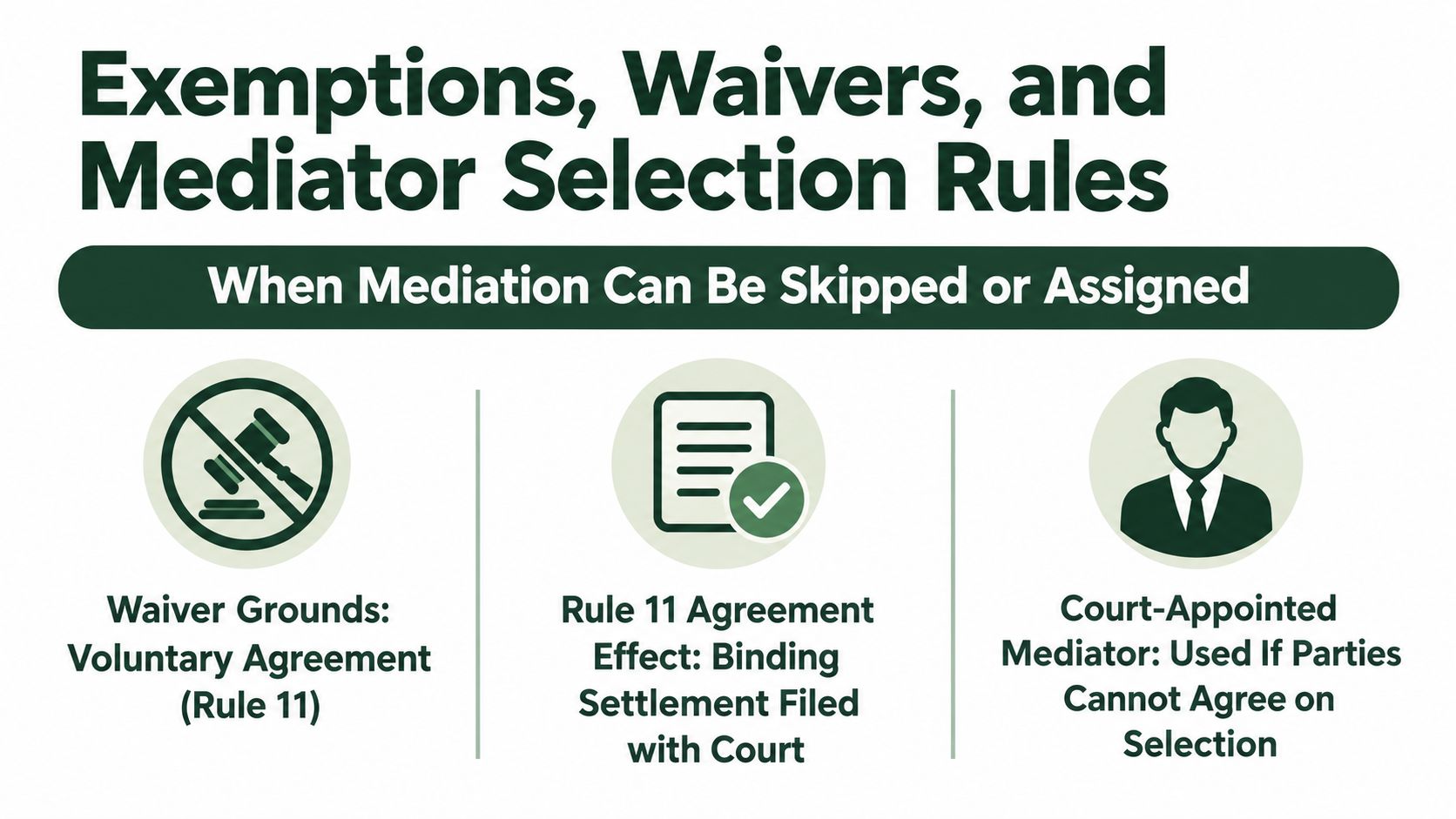
Mediation waivers in Dallas County family cases are limited and depend on the assigned judge's order. A court may consider a waiver request in a non-complex matter, especially when the parties have already reached a complete agreement, but you shouldn't assume that a private agreement eliminates a court-ordered mediation requirement.
Safety concerns can also matter. Domestic violence findings, emergency motions, and cases in which mediation would create a serious risk may require special handling. The correct step is to raise the issue with the court through the proper motion or request, not just fail to appear.
What a Rule 11 agreement can and cannot do
A Rule 11 agreement is a written agreement between the parties, signed by the parties or their attorneys, that addresses an issue in the case. In the mediation context, a court policy may recognize a filed Rule 11 agreement that preserves the finality of a settlement despite an attorney's absence or failure to sign the mediated settlement document. The agreement must be carefully drafted and filed in the manner required by the court.
A Rule 11 agreement isn't a casual email saying the parties are “close.” It should identify the resolved terms and make clear whether it addresses mediation, settlement, or both. If children, support, property, or enforcement rights are involved, unclear language can create a second dispute about what was agreed.
When the court selects the mediator
If the parties can't agree on a mediator within the applicable selection period, the court may appoint one. The 256th Judicial District Court policy states that mediation should occur at least 30 days before final trial, applies mediation to any trial longer than 2 hours, and provides that the court will appoint a mediator when the parties cannot agree. The policy also states that mediator costs are usually split equally. Details appear in the 256th Judicial District Court policy and procedures.
Don't wait for the court to solve a selection problem. Contact opposing counsel, identify acceptable mediators, confirm availability and qualifications, and preserve the communications showing a genuine effort to comply.
A Typical Mediation Day in a Dallas Family Case
A Dallas custody case may reach mediation with the parents still divided over conservatorship, school decisions, and possession. After receiving the judge's pretrial order, each parent must contact the mediator within five days. They choose a mediator, confirm the date, and agree to divide the mediator's fee equally, consistent with the 255th District Court pretrial order discussed earlier.
The session may occur at a North Dallas office instead of the courtroom. Each side usually has a separate room, while the mediator moves between them. The mediator may start by explaining the process together, then hold private discussions with each party. The mediator does not decide custody, award property, or enter support orders. The role is closer to a guide at a crossroads, helping both sides assess disputed positions and test possible agreements.
What the parties discuss
Parents may review a proposed possession schedule, transportation duties, holidays, school communication, and methods for resolving future disagreements. A divorce involving substantial assets may also include home equity, investment accounts, a closely held company, retirement assets, or tracing disputed separate property. The mediator organizes the conversation, but each party remains responsible for understanding the proposal and choosing whether to accept it.
Mediation communications are generally confidential under Texas law, subject to statutory limits. Ask your attorney how those limits apply to particular statements and documents exchanged during the session.
The day can include long pauses while the mediator works privately with each room. A parent may leave with a complete agreement, a partial agreement, or no agreement. Each result gives the case a different trial posture. Even a partial agreement can reduce the number of issues requiring evidence, witnesses, and preparation.
What gets reported to the court
The mediator's status report or certificate generally confirms whether mediation occurred and whether the case settled, partially settled, or did not settle. It should not disclose private bargaining positions. Before leaving, ask counsel who will file the required report and whether the court's deadline has been met.
If the parties settle, review the written terms before treating the case as finished. A verbal understanding in a hallway or parking lot does not replace properly documented settlement terms. The writing should match what the parties resolved and identify any remaining issues.
For courthouse information, including the location associated with many Dallas family matters, consult this guide to the George L. Allen, Sr. Courts Building.
What Happens If You Skip or Miss Mediation
Missing mediation can affect the case even when you believe the underlying dispute is strong. Dallas County family court policies warn that failing to attend mediation within the court-ordered timeframe can result in the trial date being removed from the docket. A missed appointment can therefore create a scheduling problem at the moment you're trying to finish the case.
The policy for the 255th Judicial District Court also warns that failure to mediate, file the status report, or pay required fees can lead to removal of the trial setting, sanctions, or pleadings being stricken. The response depends on the order, the reason for noncompliance, notice, prejudice to the other party, and the judge's ruling.
Conduct that creates risk
A party who attends mediation in good faith but cannot reach an agreement generally has a different procedural position from a party who refuses to participate. An impasse isn't the same as disobedience. By contrast, refusing to attend, ignoring mediator communications, failing to pay a required fee share, or withholding the status report can invite a motion for sanctions.
Dallas Family Court Local Rule 5.03 is also referenced in the 301st policy in connection with pretrial attendance. The policy warns that failure to appear at pretrial can lead to dismissal for want of prosecution or a default judgment. A default judgment is especially serious because an unresponsive party may lose the opportunity to present a defense on issues the court decides.
| Triggering Conduct | Likely Court Response |
|---|---|
| Failure to attend ordered mediation | Trial setting may be removed or reset |
| Failure to file the mediator's status report | Court may require corrective filing or impose sanctions |
| Failure to pay the required fee share | Sanctions or loss of the trial setting may follow |
| Failure to appear at pretrial | Dismissal for want of prosecution or default judgment may be possible |
| Good-faith attendance without settlement | Case generally continues toward the next required step |
| Repeated noncompliance | The court may consider stronger enforcement remedies |
Some remedies listed in planning materials, such as attorney's fees, striking pleadings, contempt, or other coercive measures, require a proper motion and court ruling. Don't assume a warning means a sanction has already been entered.
If mediation was missed, contact your attorney or the clerk's office promptly, review the docket, and determine whether a motion to reset, motion to retain the trial setting, or other filing is required. Waiting can make the court's scheduling problem harder to fix.
Preparing for Mediation in Dallas County Family Court
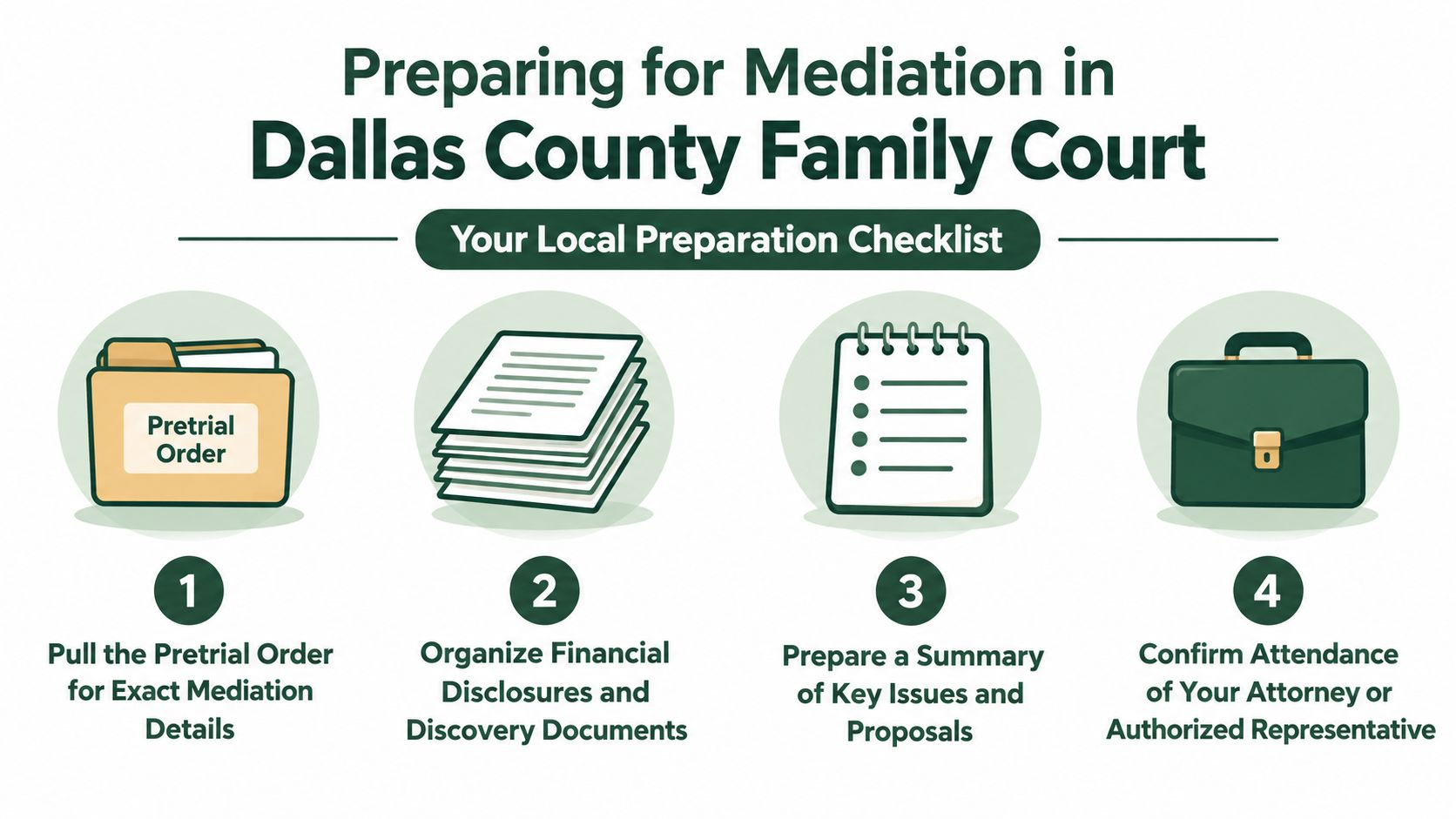
Preparation starts with the court order, not with a generic mediation checklist. Pull out the pretrial order and mark the exact deadline for selecting a mediator, completing mediation, filing the status report, and paying any required fee. If the order conflicts with an older rule or a prior email, ask counsel to determine which directive controls.
Assemble the decision-making file
For a property dispute, organize pay records, tax filings, bank statements, retirement summaries, deeds, business records, debt statements, and the sworn inventory or schedules required in your case. The right documents depend on the issues. A business owner may need company financial records and valuation materials, while an employee with equity compensation may need award documents and vesting information.
For a custody or support dispute, gather the current order, proposed possession schedule, school information, relevant medical records, child-support records, and communications that directly relate to the disputed issue. Keep the file organized by topic, with a short explanation of what each document proves.
A concise mediation statement can help the mediator understand the history, disputed points, and settlement proposals. Separate firm priorities from issues where you have room to compromise. Don't make concessions you haven't evaluated with counsel.
Confirm the people and logistics
Confirm who has authority to settle. A business representative, trustee, parent, or spouse who lacks decision-making authority can cause the session to stall. If an interpreter is needed, arrange that in advance rather than assuming the mediator or court will provide one.
Attorneys may be required to attend Family Court Services mediation or remain available by phone unless a Rule 11 agreement addresses the effect of counsel's absence. Review the assigned policy before the session.
Parking, security screening, and building access can affect arrival time at the George L. Allen, Sr. Courts Building or Frank Crowley Courts Building. If you're representing yourself, the Dallas County guide to pro se family-law forms may help you locate general filing resources, but forms don't replace advice about strategy or settlement consequences.
Use this short preparation sequence:
- Read the order: Record every local deadline and filing requirement.
- Confirm the mediator: Verify availability, qualifications, fee terms, and attendance rules.
- Build the evidence file: Organize financial, parenting, medical, school, and property records.
- Write realistic proposals: Prepare terms that can be implemented after the case ends.
After Mediation and Next Steps for Dallas Families
Mediation usually leaves a Dallas County family case in one of several procedural positions. The next filing depends on whether the parties resolved everything, reached only a partial agreement, or remained at impasse.
Full settlement
If the parties resolve all issues, the attorneys should reduce the agreement to a written document. In a divorce, that may include property and debt division, maintenance, retirement accounts, business interests, and the language needed for a final decree. In a custody case, it may address conservatorship, possession, support, medical support, decision-making, and geographic restrictions.
A mediated settlement agreement can carry significant legal consequences when it satisfies the applicable statutory requirements. Don't sign just because the day has become exhausting. Ask questions about tax effects, retirement implementation, property transfers, business ownership, future support, and how parents will handle disagreements.
After signing, counsel typically prepares and submits the agreed final orders to the assigned court. The case isn't necessarily finished until the judge signs the final order and the parties complete implementation tasks.
Partial settlement
A partial resolution should identify exactly what has been resolved and what remains disputed. The parties may use a Rule 11 agreement or partial settlement document, then continue negotiating the remaining property, support, custody, or enforcement issues.
Partial settlement can reduce trial time, but only if the written terms are precise. A statement such as “the parties agree on custody” may leave major questions unanswered, including decision-making authority, possession exchanges, holidays, travel, and communication procedures.
No settlement
An unsuccessful mediation doesn't automatically end the case. Confirm that the mediator's required status report has been filed, then follow the trial order for witness lists, exhibits, motions, proposed orders, and remaining pretrial tasks.
Monitor the Dallas County online docket through the appropriate clerk resources and check for new orders or settings. If the court removes or changes a trial date, find out what filing or hearing is required to restore the case to the trial track.
After final orders are signed, implementation may involve transferring property, preparing retirement-division documents, updating beneficiaries where appropriate, establishing support payments, exchanging children under the parenting schedule, or returning to court if the other party violates the order. Modifications, enforcement actions, relocation disputes, CPS matters, protective orders, and appeals each require their own procedural analysis.
For case-specific questions, consider speaking with a qualified Dallas family-law attorney, contacting the Dallas County Self-Help Center, or using the State Bar of Texas lawyer referral service. A local rule can be decisive, but only the order in your case and the facts surrounding your dispute determine how it applies.
If your Dallas County divorce, custody, support, modification, or enforcement case has a mediation deadline, The Law Office of Bryan Fagan, PLLC can help you review the court order, prepare for mediation, and plan for settlement or trial. Visit The Law Office of Bryan Fagan, PLLC to learn about Dallas family-law services and request a consultation about your next procedural step.
