 Skip to content
The Dallas County standing order is automatic the moment a divorce or SAPCR is filed, and it restricts conduct involving the children, finances, property, insurance, and communications before any temporary-orders hearing happens. You don't wait for a judge to sign a case-specific temporary order before these baseline rules apply.
That can feel surprising. You may file a petition on Monday believing the first meaningful court event will be a hearing, then learn that the filing itself has already changed what you and your spouse may do. The order is designed to preserve the existing situation while the Dallas County Family District Court decides whether more specific relief is needed.
Table of Contents
- What the Dallas County Standing Order Is and When It Applies
- How the Standing Order Differs From Temporary Orders and Emergency Injunctions
- Restrictions on Children, Travel, and Communications
- Financial Freeze, Property, Insurance, and Beneficiary Limits
- A Realistic Dallas Scenario Showing How the Order Plays Out
- Exceptions, Modifications, and How to Ask the Court for Relief
- Practical Next Steps and Dallas County Resources
What the Dallas County Standing Order Is and When It Applies
The trigger is filing, not service. When an Original Petition for Divorce or a Suit Affecting the Parent-Child Relationship, commonly called a SAPCR, is filed in Dallas County, the standing order applies automatically to the case. Dallas County identifies the standing order as a standard filing attachment in its family-court materials, and the current Dallas County standing-order materials explain the restrictions that accompany divorce and SAPCR filings.
No hearing is required for the order to take effect. Both spouses are expected to follow it, and its child-related provisions apply when the case involves children. The order is meant to stop either side from making unilateral changes that could make the later custody or property dispute harder to resolve.
What filing changes immediately
The standing order addresses conduct involving:
- Children and residence: A parent generally can't remove the children from Texas to change their residence, hide them from the other parent, withdraw them from school or day care, or change their place of abode without written agreement or a court order.
- Property and records: A party can't destroy, conceal, transfer, encumber, damage, or improperly dispose of property or records.
- Communications: The order restricts disparaging remarks about the other parent in the children's presence and discussions about the litigation with a child or within a child's hearing.
- Insurance and beneficiaries: The order limits unilateral changes to existing insurance arrangements and beneficiary designations.
The order remains the controlling baseline until it is dissolved, modified, or replaced by later court relief, including a final decree. A violation can become an enforcement issue, and contempt is a serious possibility when the required legal elements are established.
Practical rule: Read the signed order attached to your case, not a summary from a friend or an older form found online.
The George L. Allen, Sr. Courts Building in downtown Dallas is the filing location identified in the county's family-court resources. Because forms and orders can be revised, use the current version posted by the Dallas County District Clerk or obtain the operative copy from the clerk's office.
How the Standing Order Differs From Temporary Orders and Emergency Injunctions
The standing order is a baseline status-quo injunction. It applies automatically at filing and supplies general restraints while the parties wait for a more individualized court process. It doesn't establish the complete parenting schedule, calculate child support, decide who occupies the marital home, or resolve the final division of property.
Temporary orders serve a different function. They are case-specific orders addressing immediate arrangements during the lawsuit, often including conservatorship, possession and access, child support, temporary spousal support, payment of expenses, use of property, and protection of assets. The court ordinarily considers temporary relief through notice and a hearing, although the precise procedure depends on the requested relief and the circumstances. Texas Family Code provisions governing temporary orders include chapters 105 and 109, and Dallas County scheduling and filing practices should be checked before relying on a general description. The Dallas County family docket procedures can help readers understand why local procedure matters.
An emergency injunction is narrower and more urgent. A court may grant emergency relief without advance notice when the request satisfies the applicable requirements, including the standards associated with Texas Rule of Civil Procedure 680 and Texas Family Code section 105.001. The applicant must present a specific factual basis, commonly through a sworn application or affidavit, rather than just stating that the divorce is contentious.
| Order | Trigger | Notice Required | Typical Scope | Evidentiary Burden |
|---|---|---|---|---|
| Standing order | Filing of the divorce or SAPCR | No hearing is needed for it to take effect | Baseline restraints involving children, property, records, insurance, beneficiaries, and conduct | The order applies automatically. A later enforcement request still requires proof of the alleged violation |
| Temporary orders | A party requests case-specific interim relief | Usually notice and a hearing, subject to procedural exceptions | Parenting arrangements, support, possession, expenses, property use, and other temporary needs | Evidence supporting the requested interim arrangement |
| Emergency injunction | A sudden threat requires immediate court action | May be sought without advance notice when the legal standard is met | Immediate protection against a specified danger, transfer, concealment, or other harmful act | Specific sworn facts showing why immediate relief is necessary |
The same family court case can involve all three layers. The standing order supplies the floor, temporary orders build a workable day-to-day structure, and emergency relief addresses a threat that can't wait for ordinary scheduling.
Restrictions on Children, Travel, and Communications
Consider a simple Dallas example. A mother files for divorce on Monday, and the standing order applies when the clerk accepts the filing. By Tuesday, she may still handle ordinary parenting responsibilities, but she can't decide unilaterally to remove the children from Texas to change their residence, withdraw them from school, hide them from their father, or change their abode without written agreement or a court order.
That doesn't mean every trip, school pickup, or activity requires a judge. The line is usually between ordinary parenting decisions and a material change to the children's residence, access, schooling, or relationship with the other parent. An emergency involving the children's immediate safety may require prompt action, but an emergency isn't a blanket exception for convenience or conflict.
What the child-related rules are protecting
The order's purpose is to keep one parent from creating a new reality before the court can hear both sides. A parent who moves children, changes a school, or prevents contact may argue afterward that the change should continue because the children have already adjusted. The standing order tries to prevent that unilateral advantage.
The order also regulates how adults communicate around children. A parent shouldn't make disparaging remarks about the other parent in the children's presence, disturb the children's peace, or discuss the lawsuit with a child or where the child can hear it. The concern isn't limited to a direct lecture. Texts, social-media posts, messages passed through relatives, and conversations with school personnel can create problems when they expose children to adult litigation or recruit them into the dispute.
For a deeper explanation of the judicial roles involved, see what a Dallas County family-court associate judge may decide.
Travel, location, and school decisions
Travel questions require careful reading of the signed order. A short ordinary trip is different from taking the children away to establish a new home. Passport access, international travel, school enrollment, and the children's location can become especially sensitive when one parent fears concealment or relocation.
Keep written records of proposed travel, school communications, and agreements. If the other parent won't consent to a necessary change, ask the court for an order rather than treating silence as permission. A temporary-orders hearing can establish possession, communication, geographic limits, and decision-making rules that the standing order alone doesn't provide.
Children shouldn't become messengers, witnesses in casual conversation, or leverage in settlement negotiations.
Financial Freeze, Property, Insurance, and Beneficiary Limits
The financial side of the standing order matters most when the marital estate includes a business, investment property, retirement accounts, valuable personal property, or complicated records. Dallas County's published order restricts destroying, removing, concealing, encumbering, transferring, or damaging property. It also prohibits falsifying records, misrepresenting property, refusing proper disclosure, and selling or otherwise alienating property except as authorized.
Suppose a North Dallas business owner operates a closely held company while a divorce is pending. The owner may continue ordinary business operations, pay routine expenses, and receive ordinary compensation, but shouldn't drain a business account, transfer equipment to a relative, manipulate records, or move money into a new account to make it difficult to trace. The distinction is between preserving ordinary operations and changing the estate or the evidence before the court can evaluate it.
What the order generally restricts
The order can affect more than a checking account. It may apply to real estate, brokerage accounts, retirement interests, business records, safe-deposit contents, insurance policies, beneficiary designations, and property held outside Texas. Existing coverage and records deserve immediate attention because a cancelled policy or changed beneficiary may be difficult to repair after the fact.
The order isn't ordinarily a prohibition on earning a paycheck or using separate earnings for legitimate living expenses. It also doesn't mean every purchase is improper. The risk arises when a party uses community funds to make unusual expenditures, pays favors to relatives, runs up joint credit, strips an account, or conceals an asset.
| Restricted by the Standing Order | Generally Allowed |
|---|---|
| Hiding, transferring, damaging, or encumbering property | Ordinary household and business expenses |
| Destroying or falsifying financial records | Receiving ordinary compensation and paying ordinary obligations |
| Selling property without authorization | Maintaining routine business operations |
| Changing insurance or beneficiary designations unilaterally | Preserving existing insurance and financial records |
| Refusing proper disclosure or misrepresenting assets | Using property in the ordinary course, subject to the signed order |
| Making unusual transfers or creating avoidable debt | Seeking written agreement or court authorization for an exception |
A standing order doesn't itself award child support or spousal maintenance. If one spouse needs support, wants the other spouse to pay specific bills, or needs exclusive use of a home, that relief ordinarily requires agreement or a temporary order.
Why high-asset cases need early review
A business-owner divorce can involve valuation, tracing, reimbursement claims, separate-property assertions, real estate equity, retirement interests, and records held across multiple accounts. A seemingly harmless transfer can affect characterization and credibility, especially when the other side later compares bank statements, accounting records, payroll data, and tax documents.
Potential consequences include a request for temporary orders, sanctions, an injunction, or contempt. The result depends on the order's exact language, the evidence, the party's intent, and the procedural requirements for enforcement.
A Realistic Dallas Scenario Showing How the Order Plays Out
Use the fictional names Elena and Marcus. Elena files a Dallas County divorce petition on Monday at the George L. Allen, Sr. Courts Building. The standing order attaches when the clerk accepts the petition, even though Marcus hasn't yet attended a hearing.
That afternoon, Marcus closes a joint savings account, removes the children from marital insurance, and changes the beneficiary on a 401(k). Two days later, Elena reports the changes to her family-law attorney. Her attorney asks the Dallas County court for enforcement and emergency temporary relief, supported by account records, insurance documents, and the beneficiary-change confirmation.
How a court may analyze the conduct
The judge won't decide the entire divorce from these events alone. The immediate questions are whether Marcus violated the operative order, whether the requested emergency relief meets the applicable standard, how to restore coverage or preserve funds, and what evidence must be heard later.
A temporary restraining order or temporary injunction may address the immediate risk. Possible make-whole relief could include reinstating insurance, preserving disputed funds, and preventing further transfers while the court considers temporary orders. Whether any particular remedy is available depends on the pleadings, notice, sworn evidence, and the exact wording of the order.
The conduct may also return at final trial. A judge can consider disputed transfers, missing records, and beneficiary changes when evaluating property division, credibility, and requested relief, although no outcome is automatic.
Exceptions, Modifications, and How to Ask the Court for Relief
A standing order isn't meant to make ordinary life impossible. Its language typically recognizes practical exceptions for ordinary-course business expenses, pre-authorized payroll, agreed temporary support, and other activity permitted by the order. Emergencies may require immediate access to funds or immediate action to protect a person or child, but the safer course is to document the reason and seek court relief as quickly as the circumstances allow.
Consent also matters, but informal consent is risky. A text message may show an agreement about a particular expense, yet it may not authorize a broad transfer, beneficiary change, relocation, or sale of property. Written agreements should identify the specific action, the account or property involved, and any limits.
Choosing the right request
A request to modify or clarify the standing order asks the court to explain or adjust a restriction. A request for temporary orders asks the court to establish a broader interim arrangement, such as who pays a mortgage, who uses the home, how parents exercise possession, or whether a party may operate a business in a particular way.
A filing may include:
- A verified motion: The party states the requested relief and verifies the factual allegations.
- A supporting affidavit: Sworn facts explain why the court should act.
- A proposed order: The judge can see the precise language requested.
- Notice or citation materials: The required process depends on the type of relief and whether the request is contested.
- Supporting records: Bank statements, insurance notices, school records, travel information, or business documents may establish the need.
Emergency relief may be requested without advance notice only when the legal requirements for that procedure are met. Non-emergency matters generally proceed through a noticed hearing under the court's local scheduling process. Don't assume an emergency label eliminates the need for specific sworn facts.
Avoiding self-help changes
Before transferring funds, changing beneficiaries, cancelling coverage, signing a major business transaction, or relocating children, ask whether the action conflicts with the signed order. If it does, seek written agreement or court authorization first. Acting quickly is useful, but acting secretly can create a second legal problem while you try to solve the first.
Practical Next Steps and Dallas County Resources
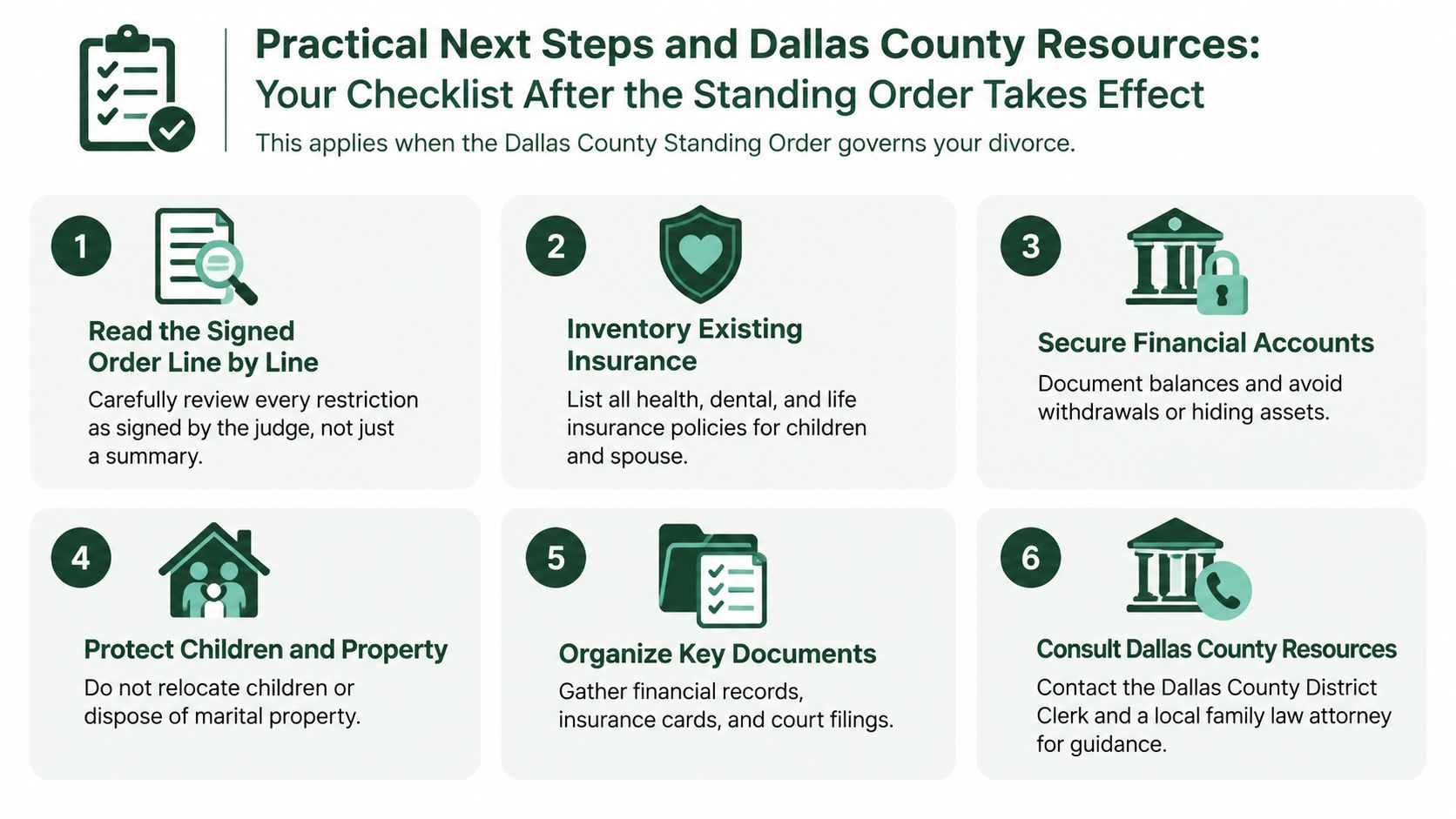
If a Dallas County standing order governs your divorce or SAPCR, begin with the document itself. Don't rely only on a petition, a verbal explanation, or an internet summary. The Dallas County District Clerk's family-court resources identify the George L. Allen, Sr. Courts Building as the filing location for civil, family, and juvenile matters, and the county provides access to the current standing order and related forms.
A working checklist
- Read the signed order line by line. Mark provisions involving children, travel, school, property, records, insurance, beneficiaries, debt, and communications.
- Inventory existing insurance. Record current health, dental, auto, home, and life coverage, along with beneficiary information where applicable.
- Gather financial records. Preserve statements, payroll information, tax records, business documents, retirement information, deeds, loan records, and insurance notices.
- Avoid nonordinary transfers. Don't move, hide, sell, encumber, or give away disputed property without agreement or court authorization.
- Document urgent needs. Keep records showing why a deviation is necessary, what harm may occur without it, and what narrower solution could protect everyone.
- Get Dallas-specific help. Use the Dallas County District Clerk's family forms and filing resources, consult the Dallas County Law Library's self-help materials, and review plain-language resources at TexasLawHelp.org.
People handling their own filings may also find Dallas County pro se family-law forms and where to get them useful. Forms can help you locate the right starting point, but they can't determine whether a proposed transfer, relocation, business action, or emergency request fits your signed order.
Here is the video resource included for readers who prefer a visual explanation:
Contact a Dallas family-law attorney promptly if children may be relocated or concealed, insurance has been cancelled, property may be dissipated, a business or retirement account is disputed, or someone may already have violated the order. An attorney can help distinguish standing-order restrictions from temporary relief, preserve evidence, and select a procedure that matches the urgency.
The Law Office of Bryan Fagan, PLLC offers Dallas family-law guidance for standing-order concerns, divorce, custody, temporary orders, property division, and enforcement matters. Visit The Law Office of Bryan Fagan, PLLC to learn about the firm's Dallas resources and request a consultation about the restrictions affecting your case.
